
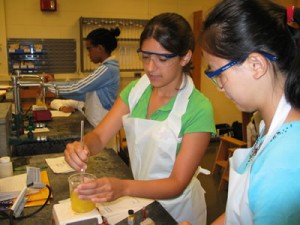

The science, technology, engineering, and math (STEM) industry should make every effort to work from the top down to encourage women and minorities to pursue careers in those fields, according to a study by the Bayer Corp., a health-care and nutrition company.
The Bayer Facts of Science Education XIV survey polled more than 1,200 female, black, Hispanic, and American Indian chemists and chemical engineers, who also are members of the American Chemical Society, about childhood, academic, and workplace experiences that play a role in attracting and retaining women and underrepresented minorities in STEM fields.
“Almost eight in 10 of our survey respondents say women and underrepresented minorities are missing because they were not encouraged to study STEM fields early on,” said Bayer Corp. President and Chief Executive Officer Greg Babe.
Mae C. Jemison, a chemical engineer and America’s first black female astronaut, noted that she was lucky when she was growing up to have access to scientists and science programs that allowed her to explore her interest in the field.
“When I was in grade school in Chicago, we thought an engineer was the person who drove the train,” she said, pointing out that it was her access to teachers who were passionate about science that let her know becoming an engineer was an option.
Regardless of gender, race, or ethnicity, interest in science begins in early childhood.
Nearly 60 percent of respondents said they first became interested in science by age 11. This parallels the findings of a 1998 Bayer Facts survey of American Ph.D. scientists, which included white men. In that survey, six in 10 also reported interest in science by age 11.
“All children have an innate interest in science and the world around them. But for many children, that interest hits roadblocks along an academic system that is still not blind to gender or color. These roadblocks have nothing to do with intellect, innate ability, or talent,” Jemison said.
“On the contrary, they are the kinds of larger, external socio-cultural and economic forces that students have no control over. As students, they cannot change the fact that they do not have access to [high-] quality science and math education in their schools. But adults can. And we must.”
Jemison pointed out that her childhood and early academic experience were exceptions and not the rule.
The survey results identified the three top causes or contributors that respondents thought lead to underrepresentation in STEM fields.
Those causes include a lack of high-quality science and math education programs in poorer school districts (cited by 75 percent of respondents); persistent stereotypes that STEM isn’t for girls or minorities (66 percent); and financial issues related to the cost of education (53 percent).
Discouragement also is something that those surveyed said they have to face and overcome if they want to be successful in STEM fields.
“Sixty percent say college is the leading place they are discouraged,” Jemison said. “I had professors who were not entirely pleased to see me in their classrooms.”
In the survey, U.S. colleges were cited as the leading place in the American education system where discouragement happens, with 44 percent saying college professors were the individuals most likely to discourage. The survey found that the K-12 education system fell short as well, with respondents giving it a “D” for the job it does to encourage minorities to study STEM subjects and a “D+” for girls.
“If we want to achieve true diversity in America’s STEM workforce, we must first understand the root causes of underrepresentation and the going challenges these groups face,” Babe said. “We want to knock down barriers. If we can do that, we’ll be able to develop the attitudes, behaviors, opportunities, and resources that lead to success.”
Across the board, respondents gave their company, organization, or institution a “C” for placing women and underrepresented minorities in senior positions to serve as role models and mentors for the younger employees—something Babe said is extremely important in encouraging young scientists and engineers.
“We’re trying to identify mentors early in their careers for females or underrepresented minorities to help guide them through their career path,” he said.
Other key findings include:
- Respondents said science teachers play a larger role than parents in stimulating and sustaining interest in science. During the elementary school years, 70 percent of the respondents said teachers have the most influence. During high school, 88 percent said teachers do.
- Nearly two-thirds (62 percent) of those polled said underrepresentation exists in their company’s or organization’s workforce.
- Leading workplace barriers for the female and minority chemists and chemical engineers include managerial bias (40 percent), company/organizational/institutional bias (38 percent), lack of professional development (36 percent), little or no access to networking opportunities (35 percent), and a lack of advancement opportunities (35 percent).
- Nearly three-quarters (70 percent) of the chemists/chemical engineers said it’s harder for women to succeed in their field than it is for men, while two-thirds (67 percent) think it is more difficult for minorities to succeed than it is for non-minorities.
Link:
- 3D equipment helps school lessons take on a whole new dimension - September 3, 2010
- IETF: AT&T’s net neutrality claim is ‘misleading’ - September 3, 2010
- To boost security, Facebook adds remote logout - September 3, 2010

Comments are closed.