
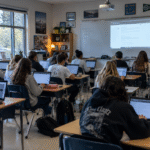
COVID-19 brought with it new safety guidelines and strategies. And classroom air quality has topped the list of school leaders’ concerns.
With students back in physical classrooms, classroom air quality must take priority regardless of a district’s mask policy.
Join this eSchool News webinar to learn about:
- health and safety risks associated with impure air and the need to “up our game” in classroom air purification
- regulatory guidelines on indoor air quality and a practical guide to evaluating your present air purification system(s)
- your peers’ experiences going through a recent upgrade to fix air quality concerns

- Children learn best on paper: We need better technology, not less of it - July 13, 2026
- In districts, reaching readiness, retention, and success - March 5, 2026
- AI use is on the rise, but is guidance keeping pace? - January 2, 2026
More from eSchool News

Vibe coding: 3 easy steps to classroom magic
No matter where you turn today, it feels as though people just can’t stop talking about artificial intelligence (AI). Suddenly it’s become a part of our workspace, our entertainment, the tools we use for shopping and paying bills, but perhaps most notably, it’s quickly found its way into our classrooms.

Helping students discover they belong in science
Growing up, science was my least favorite subject. That usually surprises people when they learn I’m a middle school science teacher. That’s the hard thing about science. The way we…

Year-round K-12 recruitment can win the talent pipeline and retention game
A recent report making national headlines reveals a stark reality: The “learning recession” that started well before the pandemic is still with us.
Standardize to sustain: Building a resilient K-12 technology strategy
A K-12 device purchase sets years of work in motion. Long after the procurement paperwork is signed, district teams are left to deploy, secure, repair, update, and eventually replace student and staff devices.

We urgently need to rethink media literacy education–here’s how I did
In my classroom, I see students make rapid judgments about information they encounter online, but struggle to explain why they trust it and if it is trustworthy.

E-Rate’s quiet impact on student success
When people think about technology in schools, they often think about devices in students’ hands. What they don’t always see is the infrastructure operating behind the scenes to make those tools available, or the funding that allows districts to build and maintain it.

We need a continuous K–12 literacy system
The latest National Assessment of Educational Progress (NAEP) Long-Term Trend results showed encouraging reading gains among 9-year-olds, while reading scores for 13-year-olds remained statistically unchanged.

“My boss probably used AI”: What school leaders need to know about AI, authenticity, and trust
AI is increasingly part of everyday leadership work, from drafting emails and reports to organizing ideas. Used thoughtfully, it can reduce administrative burden. But when AI enters more personal communication—feedback, recognition, recommendations, and appraisals—the question is no longer simple.

Learner agency comes first in AI-driven digital literacy
For many schools, the path to AI literacy remains unclear. The challenge is not simply AI’s rapid evolution, but its ability to generate answers almost instantly, forcing educators to reconsider how learning is guided and measured.

Denver is opening more specialized classrooms as the number of students with autism grows
The autism center at Denver’s West High School is twice as big as a typical classroom and more than half as empty. That’s intentional: These specialized centers are meant to have fewer students, more adults, and be a more versatile space.