

Register |  Lost Password?
Facebook twitter Linked in
September 30th, 2010
Post to Twitter
Email Email   

Virginia using iPads to teach social studies

State pilot project will support the move toward an all-digital curriculum

virginia-using-ipads-to-teach-social-studies


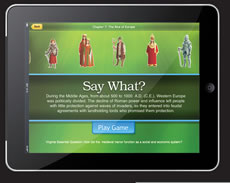
Pearson's new Social Studies app for Virginia schools.

Pearson's new social studies app for Virginia schools


In a huge step forward for K-12 education’s move toward an all-digital curriculum, the Virginia Department of Education (VDOE), in collaboration with education publishing giant Pearson, is implementing a pilot program that puts fourth, seventh, and ninth grade social studies curriculum on an iPad.

Supporters say this revolutionary education technology program will test whether students can better acquire knowledge of a subject if instruction caters to different learning styles.

The idea for Pearson to provide an entire social studies curriculum via the iPad was part of the VDOE’s “Beyond Textbooks” initiative, which is designed to “explore the potential of wireless technology and digital textbooks to enhance teaching and learning.” The initiative is supported by a grant from the governor’s Productivity Investment Fund, along with products and services donated by multiple private-sector partners, including textbook publishers and software developers.

The VDOE says it analyzed the commonwealth’s history/social science standards of learning (SOL) assessment data to identify elementary, middle, and high school history content with corresponding achievement levels that suggest a need for additional instructional resources and tools. School divisions were chosen to take part in the program based on their ability to provide the necessary infrastructure and support, as well as their existing relationships with participating textbook publishers.

Besides measuring simple student engagement, Beyond Textbooks also includes a research component to measure the impact of the initiative on classroom instruction. Researchers from Radford University will interview teachers, administrators, and students in the participating schools about how the use of digital textbooks affects teaching and learning.

“The experiences of students and teachers will be evaluated, and the knowledge gained will help policy makers, educators, and our private-sector partners better understand the potential instructional uses of interactive digital media and wireless technology,” said Superintendent of Public Instruction Patricia Wright as she announced the Beyond Textbooks initiative during a news conference at Rich Acres Elementary School in Virginia’s Henry County. “We will learn what works in the classroom and build on that as our schools move beyond traditional textbooks.”

4 Responses to Virginia using iPads to teach social studies

  1. mgozaydin

    October 5, 2010 at 12:32 am

    Great.
    It seems they were bought at $ 520 a piece. Not bad.
    Let us make them lower to be used by millions of students.
    Also thanks to
    Pearson
    Five Ponds Press
    Victory productions
    Adobe
    MashOn
    McGraw
    providing their digital content at no cost. World need you.
    Thanks billion.
    mgozaydin@hotmail.com from Turkey

  2. mgozaydin

    October 5, 2010 at 12:32 am

    Great.
    It seems they were bought at $ 520 a piece. Not bad.
    Let us make them lower to be used by millions of students.
    Also thanks to
    Pearson
    Five Ponds Press
    Victory productions
    Adobe
    MashOn
    McGraw
    providing their digital content at no cost. World need you.
    Thanks billion.
    mgozaydin@hotmail.com from Turkey

  3. cyberluz

    October 5, 2010 at 1:08 am

    This is a welcome step to begin to document the advantages to all stakeholders, especially the advantages for students, in an all digital curriculum.

    A concern I have, however, is that I see companies like Pearson having at least a controlling interest if not outright ownership of textbooks/digital media as well as the standardized testing in a public education system. I question whether there is sufficient guidance and control by educators and state education departments over what constitutes “success” for students using this media and testing combined.

    Our “testing” system and ability to measure effectively student learning over more than surface content information is as out of date as will be the textbook approach compared to all digital resources.

    Will they measure in this pilot a broader range of “increased student success?” How do we address these concerns of educational resource monopolies? How do we protect ourselves from private sector profit over real measurement of educational progress and growth?

    A Middle School Educator and Technology Integrator

  4. cyberluz

    October 5, 2010 at 1:08 am

    This is a welcome step to begin to document the advantages to all stakeholders, especially the advantages for students, in an all digital curriculum.

    A concern I have, however, is that I see companies like Pearson having at least a controlling interest if not outright ownership of textbooks/digital media as well as the standardized testing in a public education system. I question whether there is sufficient guidance and control by educators and state education departments over what constitutes “success” for students using this media and testing combined.

    Our “testing” system and ability to measure effectively student learning over more than surface content information is as out of date as will be the textbook approach compared to all digital resources.

    Will they measure in this pilot a broader range of “increased student success?” How do we address these concerns of educational resource monopolies? How do we protect ourselves from private sector profit over real measurement of educational progress and growth?

    A Middle School Educator and Technology Integrator

  5. littlemargie7

    October 7, 2010 at 5:49 pm

    I reviewed the article “Virginia using iPads to teach social studies: State pilot project will support the move toward an all-digital curriculum”, by Meris Stansbury, e-SchoolNews.com; http://www.eschoolnews.com
    This is a pilot program moving toward education in a digital curriculum with the Virginia Department of Education collaborating with Pearson Publishing and a governor’s Productivity Investment Fund grant. They are working with researchers from Radford University to document the use of interactive digital media and wireless technology. They have purchased iPads to be used by the students along with the interactive software created by Pearson Publishing.
    This is a truly awesome undertaking and they have links to Pearson’s Social Studies Apps. I followed the links and logged in as a student at Western Michigan University to see if I could see a prototype of the actual product. I was able to preview the chapter on the Constitution. The screen will zoom in on the pages and allow me to make the print what ever size I require to read it. Each section has a review quiz area that would allow the student using the iPad to enter answers and refer them back to sections they would need to review if they entered the incorrect answer. They also have some history learning games that are demonstrated in a recorded video that the student would be allowed to play to help them understand the individual role of each of the characters.
    These are way more imaginative ways of using technology to help students learn history, work at their own pace and receive individual remedial instruction to understand they key concepts. I had only imagined an e-book type program to cut the cost of textbooks. This is way beyond that. I do not know if the iPad would actually read the material to the student, or not. If it did that would be another benefit for the audio learner and the low vision students. I do know when reviewing the vocabulary section it did pronounce the words and read the definition if it was clicked on. As it has always been a habit of mine to guess at the pronunciation this would be a big benefit to me—also I did not detect a specific dialect in the voice, which might be a benefit to children learning the language.
    After review of the program at several different grade levels and reviews with both the teachers and students using them, the schools will determine with the help of the researchers how well project went. This will allow them to evaluate the overall learning results against the students that were using the traditional textbook against the students using the digital learning method. They are hoping this could potentially save the state money by moving to an all-digital curriculum. They will also be able to consider additional factors like maintenance, replacement cost, possible savings on remediation for students, and how well the teachers buy into the program.
    The benefits for the students to meet their individual learning needs are there at so many levels. The various learning styles are available for all students: visual learners, the audio learners, hands on learners, learner that require note cards for retention and review; it’s all there to help them succeed. “There’s never just one solution for learning” said Cohen… Never a truer statement for education, and this could truly be the wave of the future for us all.
    Margaret Springer

  6. littlemargie7

    October 7, 2010 at 5:49 pm

    I reviewed the article “Virginia using iPads to teach social studies: State pilot project will support the move toward an all-digital curriculum”, by Meris Stansbury, e-SchoolNews.com; http://www.eschoolnews.com
    This is a pilot program moving toward education in a digital curriculum with the Virginia Department of Education collaborating with Pearson Publishing and a governor’s Productivity Investment Fund grant. They are working with researchers from Radford University to document the use of interactive digital media and wireless technology. They have purchased iPads to be used by the students along with the interactive software created by Pearson Publishing.
    This is a truly awesome undertaking and they have links to Pearson’s Social Studies Apps. I followed the links and logged in as a student at Western Michigan University to see if I could see a prototype of the actual product. I was able to preview the chapter on the Constitution. The screen will zoom in on the pages and allow me to make the print what ever size I require to read it. Each section has a review quiz area that would allow the student using the iPad to enter answers and refer them back to sections they would need to review if they entered the incorrect answer. They also have some history learning games that are demonstrated in a recorded video that the student would be allowed to play to help them understand the individual role of each of the characters.
    These are way more imaginative ways of using technology to help students learn history, work at their own pace and receive individual remedial instruction to understand they key concepts. I had only imagined an e-book type program to cut the cost of textbooks. This is way beyond that. I do not know if the iPad would actually read the material to the student, or not. If it did that would be another benefit for the audio learner and the low vision students. I do know when reviewing the vocabulary section it did pronounce the words and read the definition if it was clicked on. As it has always been a habit of mine to guess at the pronunciation this would be a big benefit to me—also I did not detect a specific dialect in the voice, which might be a benefit to children learning the language.
    After review of the program at several different grade levels and reviews with both the teachers and students using them, the schools will determine with the help of the researchers how well project went. This will allow them to evaluate the overall learning results against the students that were using the traditional textbook against the students using the digital learning method. They are hoping this could potentially save the state money by moving to an all-digital curriculum. They will also be able to consider additional factors like maintenance, replacement cost, possible savings on remediation for students, and how well the teachers buy into the program.
    The benefits for the students to meet their individual learning needs are there at so many levels. The various learning styles are available for all students: visual learners, the audio learners, hands on learners, learner that require note cards for retention and review; it’s all there to help them succeed. “There’s never just one solution for learning” said Cohen… Never a truer statement for education, and this could truly be the wave of the future for us all.
    Margaret Springer

  7. jimbosilk

    October 9, 2010 at 5:39 pm

    What struck me first was the fact that the Department of Education (a small cadre of 230 units) is using the iPads at a variety of levels. There are students using them in fourth grade, middle school, and high school. Even advanced placement biology students have an opportunity with the devices. In each of these cases the iPads are being used in different ways to show the versatility. Content can be as simple as a text book but it is adapted to allow interaction to programs that are specifically designed for curriculum. Some students will create unique media or have a chance to seek out material on their own. Over 100 apps are accessible and I would guess there will continue to be more added.

    This is current and there is no data at this time to compare learning outcomes, efficacy of each subject or the engagement of individual students. Cost will be the other interesting technology question of this pilot program. First year flight students here are issued documents, operating manuals, procedures, and information on links directly connected to their studies. Could we give them homework, quiz them on study materials, show them simulation with such a tool? Hhhmmm… I need a good research project for my Capstone.

  8. jimbosilk

    October 9, 2010 at 5:39 pm

    What struck me first was the fact that the Department of Education (a small cadre of 230 units) is using the iPads at a variety of levels. There are students using them in fourth grade, middle school, and high school. Even advanced placement biology students have an opportunity with the devices. In each of these cases the iPads are being used in different ways to show the versatility. Content can be as simple as a text book but it is adapted to allow interaction to programs that are specifically designed for curriculum. Some students will create unique media or have a chance to seek out material on their own. Over 100 apps are accessible and I would guess there will continue to be more added.

    This is current and there is no data at this time to compare learning outcomes, efficacy of each subject or the engagement of individual students. Cost will be the other interesting technology question of this pilot program. First year flight students here are issued documents, operating manuals, procedures, and information on links directly connected to their studies. Could we give them homework, quiz them on study materials, show them simulation with such a tool? Hhhmmm… I need a good research project for my Capstone.

You must be logged in to post a comment Login

My eSchool News provides you the latest news by the categories you select.
Customize your news now. You must be logged in to view your customized news.
Watch this short video to learn more about My eSchool News.
Username:
Password:    
Register |  Lost Password?