
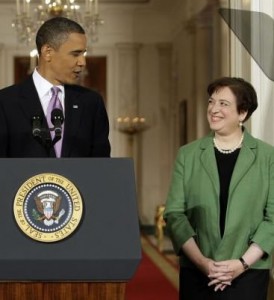
Elena Kagan, President Barack Obama’s pick to fill Justice John Paul Stevens’s seat on the Supreme Court, could become a voice for education rights, thanks to her background as an esteemed professor who comes from a family of educators.
Kagan was born in New York City in 1960. Her father was a lawyer and former chairman of a community board on Manhattan’s Upper West Side, while her mother taught for many years at Hunter College Elementary School. Her two brothers are also teachers.
“My mother was a proud public school teacher, as are my two brothers—the kind of teachers whom students remember for the rest of their lives,” said Kagan during her May 10 nomination. “My parents’ lives and their memory remind me every day of the impact public service can have, and I pray every day that I live up to the example they set.”
Said Obama during her nomination: “…they instilled in Elena not just the value of a good education, but the importance of using it to serve others.”
Click below to watch the nomination on eSN.TV
[field name=iframe]
After receiving a Bachelor of Arts degree from Princeton University, she attended Worcester College, Oxford, until 1983. After Oxford, Kagan attended Harvard Law School and graduated in 1986.
From 1986 to 1987, Kagan clerked for Judge Abner Mikva of the U.S. Court of Appeals for the Washington, D.C., Circuit Court. The next year, she clerked for U.S. Supreme Court Justice Thurgood Marshall. She worked as an associate in the Washington, D.C., law firm of Williams & Connolly from 1989 to 1991.
Kagan began her academic career at the University of Chicago Law School, where she became an assistant professor in 1991 and a tenured professor of law in 1995. It was there that she met Obama, who was teaching as an adjunct professor.
“My professional life has been marked by great good fortune. I clerked for a judge, Abner Mikva, who represents the best in public service, and for a justice, Thurgood Marshall, who did more to promote justice over the course of his legal career than did any lawyer in his lifetime,” she said.
From 1995 to 1999, Kagan served in the White House, first as associate counsel to the president in 1995 to 1996 and then as a domestic policy aide. She worked on the White House response to the settlement of tobacco lawsuits reached by state attorney generals.
Kagan came to Harvard as a visiting professor and became a law professor in 2001. While on the faculty, she taught administrative law, constitutional law, civil procedure, and seminars on issues involving the separation of powers. She was appointed dean of the law school in 2003—the first woman to be given this position. As dean, she revamped the grading system, the curriculum, and made major capital improvements—from fresh coats of paint in classrooms to a new gymnasium, reported The Wall Street Journal.
Kagan also hired new employees at the law school, including both conservative and liberal scholars.
“…Elena is respected and admired not just for her intellect and record of achievement, but also for her temperament, her openness to a broad array of viewpoints, her habit, to borrow a phrase from Justice Stevens, of understanding before disagreeing, her fair-mindedness and skill as a consensus-builder,” said Obama during the nomination. “And she encouraged students from all backgrounds to respectfully exchange ideas and seek common ground. Because she believes, as I do, that exposure to a broad array of perspectives is the foundation not just for a sound legal education, but of a successful life in the law.”
Not much is known about Kagan’s judicial philosophy, but as dean of Harvard Law she was instrumental in beefing up the school’s Berkman Center for Internet & Society by recruiting Lawrence Lessig and others who take a strong position on “fair use” in copyright disputes, according to reports.
According to John Palfrey, faculty co-director of the Berkman Center, during Kagan’s six years as dean, she supported, and was deeply involved in, the center’s mission and goals.
“She helped recruit faculty and students, was influential in its development, and helped to raise tens of millions of dollars for the center. She was deeply invested in helping promote our research, which focuses on the study of intellectual property and cyber law. She was well-versed on these issues,” Palfrey said.
That could help as the High Court grapples with an increasing number of thorny issues in the digital age, such as a case heard earlier this spring that could determine whether public employees have a right to privacy in communications sent and received via a work-issued cell phone.
As Harvard Law School dean, Kagan, with the support of other school deans, said the military’s “don’t ask, don’t tell” rule on gay members of the military violated the schools’ antidiscrimination policies. However, the Supreme Court rejected the argument unanimously, upholding a federal law denying federal funds to schools that blocked the military recruiters.
Last year Kagan returned to Washington as solicitor general (again, the first woman to be appointed to this position), the lawyer who represents the government before the Supreme Court. Kagan defended bipartisan campaign finance reform against special interests seeking to spend unlimited money to influence elections, and while the Supreme Court struck this down, “Elena still chose it as her very first case to argue before the court,” said Obama. “…I think that says a great deal not just about Elena’s tenacity, but about her commitment to serving the American people.”
The Supreme Court did, however, grant Kagan a success by allowing congressional efforts to maintain a cross that has stood for years in California’s Mojave National Preserve.
Too inexperienced?
Though Kagan has never served as a judge, ruled on a case, or written an opinion, supporters say she is more than qualified and is one of the “foremost legal scholars in the country,” said White House senior adviser David Axelrod to FOX News.
“If there was any concern about her not having been a judge, to some extent that will be undercut by her having been solicitor general, which is often talked about as the ‘10th justice,’” said Robert Bennett, law professor at Northwestern University. “She’s not only an advocate before the Supreme Court, but she’s also a confidante of the Supreme Court.”
Also, Kagan wouldn’t be the first non-judge appointed to the Supreme Court—both the late Chief Justice William Rehnquist and Justice Lewis Powell Jr. were confirmed to the court in 1972 without a judicial background.
“The fact that she has so much practical experience, on a court where it is missing, should be considered an asset,” said Sen. Chuck Schumer, D-N.Y., Judiciary Committee member. “She has a long record as a consensus builder and is the kind of person who can bridge the 5-4 splits that have become so routine on this court.”
While many senators agree with Schumer, some senators are more hesitant about the nomination.
“Her previous confirmation, and my support for her in that position [as solicitor general], do not by themselves establish either her qualifications for the Supreme Court or my obligation to support her,” said Sen. Orrin Hatch, R-Utah, Judiciary Committee member. “I have an open mind and look forward to actively participating in the confirmation process.”
“She has been nominated for a lifetime appointment on the nation’s highest court, and we will carefully review her brief litigation experience, as well as her judgment and her career in academia, both as a professor and as an administrator,” said Senate Minority Leader Mitch McConnell, R-Ky.
If confirmed for the seat, Kagan will be the fourth woman ever confirmed to the Supreme Court and the third woman among the current justices.
“…Through most of my professional life, I’ve had the simple joy of teaching, of trying to communicate to students why I so loved the law: Not just because it’s challenging and endlessly interesting, although it certainly is that, but because law matters, because it keeps us safe, because it protects our most fundamental rights and freedoms, and because it is the foundation of our democracy,” Kagan said.
Links:
- ‘Buyer’s remorse’ dogging Common Core rollout - October 30, 2014
- Calif. law targets social media monitoring of students - October 2, 2014
- Elementary world language instruction - September 25, 2014

Comments are closed.