
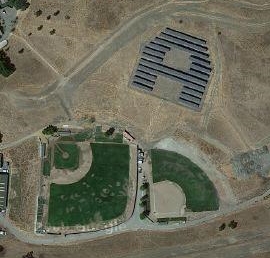
Web surfers requesting a Google Earth view of the Athenian School in Danville, Calif., are greeted with an image of what school officials call the “solar A”—a mass of 1,300 solar panels on a hillside near the school, and a testament to the nation’s renewed interest in sustainable energy resources and solar power to cut school energy bills.
Solar energy proponents say an increased focus on “green” lifestyles and practices has helped place the technology once again near the forefront of school energy practices. While solar power is not a new idea, it gained momentum during the energy crisis of the 1970s, which led to tax incentives for solar power. Once fuel prices stabilized, however, tax incentives disappeared. But now, with an uncertain economy, rising fuel prices, and deep cuts to education, solar power once again holds attractive benefits for school districts.
The Athenian School’s system—1,300 panels sit above the school’s baseball field—supplies 50 percent of the school’s power needs, said Bob Oxenburgh, Athenian’s director of facilities.
The California Solar Initiative covered one-third of the installation cost, Oxenburgh said, and the school partnered with a solar installation company to construct the system. California-based Tioga Energy owns the installation, which sits on the Athenian School’s property, and Tioga Energy recoups its investment by selling power directly to the school in what is known as a power purchase agreement (PPA).
The Athenian School signed an agreement to initiate the solar energy program with Tioga Energy and REC Solar in August 2008, and on Dec. 10, 2008, the system generated its first power.
State incentives and tax credits help immensely in a solar power installation, Oxenburgh said, because the actual systems are very expensive. Oxenburgh said surrounding schools and districts with plans for solar installation have toured the school for more information about the installation process.
And while the Athenian School has no plans to build additional buildings for quite some time, Oxenburgh said solar power will be a part of any future construction.
“We would not construct anything without most of [the power] being supplied by renewable energy; that’s the only thing that makes sense,” he said. “We want to get off the grid as much as we can.”
Five New Jersey school districts in the state’s Morris County—Boonton, Mountain Lakes, Parsippany-Troy Hills, West Morris Regional, and Morris Hills Regional—have entered into a program with Tioga Energy and SunDurance Energy, a New Jersey solar development team.
Fourteen schools will have solar panels installed on their roofs, and Morris County official William Chegwidden said the participating districts will pay 35 percent less for power from the solar systems in the first year of the program than they would pay for utility-provided power.
Boonton School Superintendent Christine Johnson predicted a $16,000 savings and a 36-percent reduction in energy consumption in the first year of the program. Johnson said savings could reach $25,000 per year as the program progresses.
Tioga Energy and SunDurance Energy will oversee the design, installation, operation, and maintenance of the solar equipment, which will reside on the schools’ roofs. Morris County will purchase its solar-produced electricity at a fixed price through a 15-year PPA with Tioga Energy.

- Children learn best on paper: We need better technology, not less of it - July 13, 2026
- In districts, reaching readiness, retention, and success - March 5, 2026
- AI use is on the rise, but is guidance keeping pace? - January 2, 2026
Comments are closed.