
Key points:
- Paper and curriculum for the human work of learning, technology for the logistics of running a room
- The future researcher in every fifth grader: The case for curiosity-first teaching
- When a teacher ditched screens, class got harder–that may be why it worked
- For more news on teaching trends, visit eSN’s Innovative Teaching hub
It is an odd thing to hear from someone who builds education technology for a living, but the most important tool in an elementary classroom is still a pencil. The learning science says so. So does the pile of paper that good teaching produces–the pile that buries the teacher who produced it. The real question is whether technology can lift that weight without putting one more kid in front of one more screen.
I taught math in a New York City public high school in 2009, before I ever read a single study about how children learn. I was thrown into the classroom like many of my peers, joining the ranks on an alternative teaching certificate. My pedagogy was limited, but I was equipped with some basic instructional routines. At the end of every class, my kids would look down at their exit tickets, pick up their pencils, and get to work while I moved about the room, studying what they wrote.
Years later I found out there was a name for what I was watching, and an enormous amount of research behind it. Here is the synthesis, and the part that has me, after all these years in this work, more optimistic than I have ever been.
Technology should make teachers’ work lives easier and their impact more powerful, not have kids spend more time on screens.
Let’s start with reading, because it is the most surprising. When pre-literate five-year-olds learn their letters by writing them by hand, and not by typing, the reading circuits in their brains light up later just from looking at the letters.¹ The act of forming a letter, badly, with a fat pencil and poor control, is what teaches the brain what a letter is. That messiness is the lesson.
The advantage carries. In one training study, five-year-olds who learned new letters by hand decoded them far more accurately than children who typed them. On the hardest task, writing the letters from dictation, the hand group roughly doubled the typers.² Hand to letter to sound to word. That is the chain reading is built on, and the hand is the first link.
Writing builds memory the same way. Typing is fast, which is exactly the problem. It is fast enough to transcribe a thought without ever having one. Writing is slow enough to make the brain choose what matters. The slowness is where the learning lives.³ Even plain comprehension holds up a little better on paper than on a screen. The effect is modest, but it is steady, and it points the same direction as everything else.⁴
None of this is an argument against technology. Don’t forget that paper and pencil are technology too. This is an argument about which tools are most appropriate for maximizing classroom potential and productivity. To see why that matters right now, you have to look at the other thing that has changed.
For all of my teaching years, curriculum was part scavenger hunt, part guesswork. I authored lessons after hours against the state standards, pulling from whatever I could find, including prior state exams. Then, whenever I got tired or hit writer’s block, I would go online to fill the gaps. The materials were a patchwork, and the quality was whatever I could pull together late at night. Nearly everyone I knew in the ranks was doing the same, or strictly following an outdated textbook.
That has largely changed, and it keeps changing–fast. Over the last decade, education got serious about high-quality instructional materials (HQIM). Coherent, research-based curriculum, vetted and sequenced so that what a child learns in October sets up what she learns in March. Districts now choose these programs on purpose.⁵ It is one of the most important and least celebrated shifts in American schooling. For the first time, we have real agreement on what “good” looks like.
Here is the catch: The best of this curriculum was authored to be executed on paper. Books, consumables, trade books, and the rest. Perhaps it was not made that way on purpose, with the cognitive science in mind. But that is where the thinking connects and the aha moment lands, at least until adolescence.
So schools now hold two things at once that they never held together before. We know how children learn. We have the materials worth learning from. The only thing missing is the connection between them. A great curriculum that teachers cannot get all the way through, because they are buried under the logistics of 30 kids and a stack of grading, is a promise half kept.
That gap is exactly the kind of problem modern technology should solve. Not by replacing the page, but by helping teachers act on it quickly.
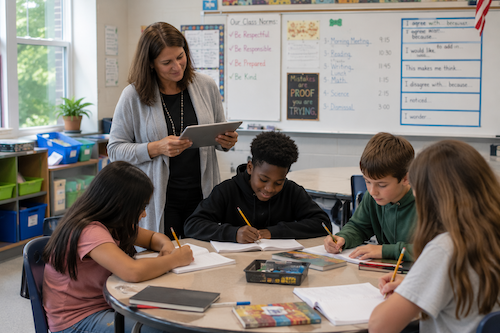
Picture the classroom. A six-year-old works through a formative assessment from a strong curriculum, by hand, the way the science says they should. The teacher moves through the room and, with a mobile device, lifts that student’s paper work onto the projector at the front of the room in seconds, name hidden, so the whole class can reason through it together. Later, the teacher scans the stack and it comes back scored in minutes, with misconceptions flagged and strategies to reteach them. The child never touched a device. The curriculum stayed “on paper.” The technology did the connecting and the carrying, the work no pencil should ever have to do, in 2026 or beyond.
Here is why that matters so much, and it has almost nothing to do with the technology itself. When a teacher can see, every week, which kids are on track and which are quietly slipping, and exactly what each one is missing, they can do the part of teaching that actually moves a child. They can give each kid what that kid needs. Pull the four students who tripped on the same step and reteach it on Tuesday. Stretch the ones who are ready for more. Catch a gap in October instead of finding it on a state test in May. That is how a teacher gets a whole class to grade level and beyond: with better information, sooner.
That is the whole idea, and it is finally within reach. Paper and curriculum for the human work of learning. Technology for the logistics of running a room. Each doing the one thing it is best at. For most of the short history of edtech, we had this backwards. We put the machine where the child’s mind belonged and left the teacher drowning in the paperwork. We are climbing out of that now, and it is a powerful thing to watch.
I think about my room in 2009 compared to the rooms I walk into in 2026. There is still a lot of paper, but today we can make sure all the work students produce is honored and recognized.
We finally know what great materials are made of. We are remembering how children actually learn. And for the first time, the technology can hold the two together instead of crowding them out. The pencils have not changed. Neither have the kids clutching them. What is different is that the work no longer has to disappear unread.
Every warm-up, every activity, every exit ticket, every page, can be seen and acted on before the next bell. Acting on it early can keep a kid from falling behind the class before the gap ever gets serious. That is the classroom now within reach. Not someday, but this year, with today’s teaching ranks, curriculum, and technology.
Notes
[1]: The brain-imaging result is from James and Engelhardt (2012). Pre-literate children who practiced printing letters, rather than typing or tracing them, later showed activation in the brain’s reading network, including the fusiform gyrus, when simply looking at letters. The sample was small and the journal a specialized one, but the finding is consistent with the author’s broader body of work on handwriting and the literate brain (see James, 2017, in Works Cited).
[2]: From Ibaibarriaga, Acha, and Perea (2025), a study of 50 kindergartners learning unfamiliar letters and pseudowords. Children in the handwriting conditions identified trained words more accurately than those in the typing conditions (61.6% versus 47.8%), with the largest gap appearing on writing to dictation. This was a controlled training study using an invented alphabet, not a measure of long-term reading achievement. A corrigendum was published in 2026.
[3]: On writing as generative encoding, see Mueller and Oppenheimer (2014), who found that students taking notes by hand outperformed laptop note-takers on conceptual questions, apparently because longhand forces summarizing rather than verbatim transcription. A 2019 replication by Morehead, Dunlosky, and Rawson found smaller and less consistent effects, so this point is made modestly.
[4]: From Delgado, Vargas, Ackerman, and Salmerón (2018), a meta-analysis of 54 studies and more than 171,000 readers, which found a small but reliable advantage for paper over screens (Hedges’ g = -0.21). The effect was concentrated in informational texts and under time pressure, and was negligible for narrative texts.
[5]: On the weight of curriculum quality, see Chingos and Whitehurst (2012), who argued that the evidence shows instructional materials have effects on student learning large enough to rival the effects of differences in teacher effectiveness.
Works Cited
Chingos, M. M., & Whitehurst, G. J. (2012, April 10). Choosing blindly: Instructional materials, teacher effectiveness, and the Common Core. Brookings Institution, Brown Center on Education Policy. https://www.brookings.edu/articles/choosing-blindly-instructional-materials-teacher-effectiveness-and-the-common-core/
Delgado, P., Vargas, C., Ackerman, R., & Salmerón, L. (2018). Don’t throw away your printed books: A meta-analysis on the effects of reading media on reading comprehension. Educational Research Review, 25, 23–38. https://doi.org/10.1016/j.edurev.2018.09.003
Ibaibarriaga, G., Acha, J., & Perea, M. (2025). The impact of handwriting and typing practice in children’s letter and word learning: Implications for literacy development. Journal of Experimental Child Psychology, 253, 106195. https://doi.org/10.1016/j.jecp.2025.106195
James, K. H., & Engelhardt, L. (2012). The effects of handwriting experience on functional brain development in pre-literate children. Trends in Neuroscience and Education, 1(1), 32–42. https://doi.org/10.1016/j.tine.2012.08.001
Morehead, K., Dunlosky, J., & Rawson, K. A. (2019). How much mightier is the pen than the keyboard for note-taking? A replication and extension of Mueller and Oppenheimer (2014). Educational Psychology Review, 31(3), 753–780. https://doi.org/10.1007/s10648-019-09468-2
Mueller, P. A., & Oppenheimer, D. M. (2014). The pen is mightier than the keyboard: Advantages of longhand over laptop note taking. Psychological Science, 25(6), 1159–1168. https://doi.org/10.1177/0956797614524581
Further reading (consulted, not cited in text)
Furenes, M. I., Kucirkova, N., & Bus, A. G. (2021). A comparison of children’s reading on paper versus screen: A meta-analysis. Review of Educational Research, 91(4), 483–517. https://doi.org/10.3102/0034654321998074
James, K. H. (2017). The importance of handwriting experience on the development of the literate brain. Current Directions in Psychological Science, 26(6), 502–508. https://doi.org/10.1177/0963721417709821
Longcamp, M., Zerbato-Poudou, M.-T., & Velay, J.-L. (2005). The influence of writing practice on letter recognition in preschool children: A comparison between handwriting and typing. Acta Psychologica, 119(1), 67–79. https://doi.org/10.1016/j.actpsy.2004.10.019

- Children learn best on paper: We need better technology, not less of it - July 13, 2026
- In districts, reaching readiness, retention, and success - March 5, 2026
- AI use is on the rise, but is guidance keeping pace? - January 2, 2026