

In a move to help rural schools keep pace with more developed districts, the U.S. Department of Education (ED) said it will create an Online Learning Registry that will provide access to historical, artistic, and scientific primary-source materials.
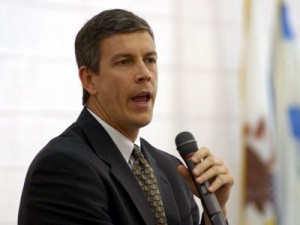
Education Secretary Arne Duncan made the announcement July 21 at the National Rural Education Technology Summit held at the National Museum of the American Indian (NMAI).
“Knowledge knows no boundaries, and we cannot allow distance to stand between students, education, and opportunity,” Duncan said. “We have the hardware, the latest software, and huge investments are being made in the build-out of the National Broadband Plan to connect us as never before.”
The registry is one of the recommendations the Federal Communications Commission (FCC) made in its National Broadband Plan to give more students and teachers access to high-quality digital content that the federal government owns.
“No technological innovation in our lifetime has greater potential to transform education than high-speed internet,” said FCC Chairman Julius Genachowski.
“The National Broadband Plan recommended that the federal government increase the pool of high-quality digital resources that educators can easily find, access, and combine with other content to help their students learn. I am very pleased to see this recommendation being adopted.”
Many of the resources that will appear in the Online Learning Registry have associated educational materials that have been created by education professionals, and some of those educational resources are available online. However, currently it is difficult to find these many resources, because they are available across numerous agencies.
During his remarks to the more than 150 rural education stakeholders and technology experts, Duncan described digital artifacts from the first moon landing as an example of why the registry is needed. He said the artifacts, which include things such as weather records and recordings of conversations, are currently spread across three agencies.
“Right now, frankly, they’re not organized in a way that makes them easy to access. This registry will make it easy for teachers and students to find the variety of resources available,” he said.
And the collections, especially those at the Smithsonian Institution, belong to all Americans—including those who live in rural areas, said Smithsonian Secretary G. Wayne Clough.
“We have ambitious plans to use new technologies to reach new audiences. … We have much to offer students and teachers in art, science, history, education, and culture. We want to give learners of all ages access to America’s treasures and our creative experts who bring them to life,” he said.
A healthy American economy depends on a prosperous rural America, said Kathleen Merrigan, deputy secretary for the U.S. Department of Agriculture (USDA).
“Broadband investment boosts innovative capacity, drives business competition, and expands both educational resources and health-care services in small communities throughout the country,” she said, “USDA, working with other agencies, recognizes that access to high-speed internet is fundamental for rural communities that seek to overcome the challenges of time and distance and provide sustained economic development and job creation.”
More than half the nation’s school districts are located in rural areas, and one-fifth of all public school children are enrolled in rural schools. There are successful models for providing access to college-level coursework, new content, and high-quality teaching online and through blended learning with faculty using the latest technology innovations, according to an ED press release.
Some of those models were highlighted during a panel discussion moderated by Gene Wilhoit, executive director of the Council of Chief State School Officers.
“Our goal as chief state school officers is to move from these beautiful exceptions to mass scalability,” he said.
All schools in South Dakota have been wired for the internet since the 1990s, as well as every school in New Hampshire, but New Hampshire Commissioner of Education Virginia Barry said the state’s schools still have issues with connectivity. And South Dakota Superintendent Tom Oster noted that the state network’s connection speed has slowed over the years without some of the necessary maintenance.
Through its National Education Initiative (NEI), NMAI has started to offer historically accurate and authentic educational materials about American Indians. NEI’s mission is to share American Indian knowledge through educational excellence and many of the reservations where American Indians live are in very rural areas.
“We know there’s need for this content,” said Tim Johnson, associate director for museum programs at NMAI. “Teachers and curriculum supervisors need in-depth educational materials that integrate native perspectives.”
NEI offers a number of online resources, including videos, lesson plans, and other tools, as well as professional development to train teachers about integrating Native American perspectives into lessons.
Links:
Federal Communications Commission
Council of Chief State School Offices
National Museum of the American Indian – Education
Note to readers:
Don’t forget to visit the Re-imagining Education resource center. Inspiring and engaging today’s 21st-century learners, who have grown up surrounded with digital media and are used to having instant access to information, requires flexible resources that change with students’ needs. When teachers can leverage multiple technologies in a resource-rich classroom—supported by top-notch professional development—students forget they’re in school and instead become excited about real-world applications of the lessons they are learning. Go to:
Re-imagining Education
- 3D equipment helps school lessons take on a whole new dimension - September 3, 2010
- IETF: AT&T’s net neutrality claim is ‘misleading’ - September 3, 2010
- To boost security, Facebook adds remote logout - September 3, 2010
Comments are closed.