
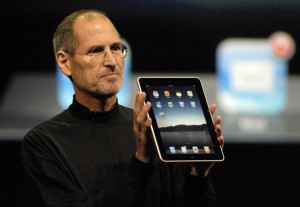
“Apple is Steve Jobs, Steve Jobs is Apple, and Steve Jobs is innovation,” Chowdhry said. “You can teach people how to be operationally efficient, you can hire consultants to tell you how to do that, but God creates innovation. … Apple without Steve Jobs is nothing.”
Earlier this month, Apple became the most valuable company in America, briefly surpassing Exxon Mobil. At the market close on Aug. 24, its market value was $349 billion, just behind Exxon Mobil’s $358 billion.
Jobs’ hits seemed to grow bigger as the years went on: After the colorful iMac computer and the now-ubiquitous iPod, the iPhone redefined the category of smart phones and the iPad all but created the market for tablet computers.
His own aura seemed part of the attraction. On stage at trade shows and company events in his uniform of jeans, sneakers, and black mock-turtlenecks, he’d entrance audiences with new devices, colors, and software features—building up to a grand finale he’d predictably preface by saying, “One more thing.”
Jobs, 56, shepherded Apple from a two-man startup to Silicon Valley darling when the Apple II, the first computer for regular people to really catch on, sent IBM Corp. and others scrambling to get their own PCs to market.
After Apple suffered a slump in the mid-1980s, he was forced out of the company. He was CEO at Next, another computer company, and Pixar, the computer-animation company that produced “Toy Story” on his watch, during the 12 years before he returned.
In 1985, the year Jobs left, Apple launched its groundbreaking Apple Classrooms of Tomorrow (ACOT) project as a way to study how technology influences teaching and learning. The ACOT program lasted through 1995, when it was replaced by the Apple Classrooms of Tomorrow-Today (ACOT2) program.
From this initiative, Apple identified six key principles for successful schools in the digital age: (1) understanding of 21st-century skills and outcomes; (2) relevant and applied curriculum; (3) informative assessment; (4) a culture of innovation and creativity; (5) social and emotional connections with students; and (6) ubiquitous access to technology.
Though Apple established itself as a leader in educational technology during this period, thanks largely to the Macintosh platform that Jobs created and the ease of use of its graphical interface, the company was foundering before Jobs returned—having lost $900 million in 1996 as Microsoft Windows-based PCs came to dominate the computer market. Apple’s fortunes began to turn around with its first new product under his direction, the iMac, which launched in 1998 and sold about 2 million units in its first 12 months.
- New research challenges fears about AI in the classroom - February 5, 2026
- How the FY25 funding freeze impacts students across America - July 24, 2025
- ‘Buyer’s remorse’ dogging Common Core rollout - October 30, 2014