Email a copy of 'I’m a first-year teacher. How do I become successful in the classroom?' to a friend
 Loading ...

Email a copy of 'I’m a first-year teacher. How do I become successful in the classroom?' to a friend
Loading ...
When I started teaching in the early 90s, I was an eager and very green third grade teacher ready to change the world, one class at a time. My colleagues and I worked hard to build a learning community that met the needs of our students, no matter their circumstances or the resources at our disposal (or lack thereof).
Since then, I have served in various roles in public education and the private sector and have witnessed innovations in curriculum, instructional design, classroom design, and more. But amid all this change, one area has remained relatively static in public education. When it comes to training and developing teachers, we have been letting opportunity to leverage technology pass us by. Instead of a place to break new ground and match the demands of the modern classroom, professional development programs remain a pain point for teachers.
More than half of teachers have expressed wanting to leave the profession, with many citing a lack of quality development and support as a contributing factor. Teacher PD feels obligatory, generic, time-consuming, and for many, out of reach.
So, what can we do? I propose three ways to address the professional development needs of teachers today:
Increase Teacher Choice
As a former principal, I know that data and district mandates can determine the focus and timing of professional development. The increased focus on social-emotional learning as we emerge from the pandemic is a great example school and district PD requirements. Administrators are right to equip their teams with SEL trainings and resources, but teachers also face myriad challenges unique to their classrooms that aren’t being met in the moment.
According to a 2014 study by the Bill & Melinda Gates Foundation, 38 percent of teachers cited “learning that is not customized enough” to the content they teach and the skills they need as a barrier in their professional learning. However, teachers who choose all or most of their professional learning opportunities are more than twice as satisfied with professional development as those with fewer options.
Related:
AI’s pivotal role in authentic PD
Is your PD missing this key element?
Teachers need the ability to create a personalized teacher PD experience that not only serves their school or district goals but also helps them best support every student in their classroom.
Offer Resource-Efficient Solutions
According to reports, many teachers say that outside of a handful of in-service professional development days provided by their districts, they have to pay for their own professional development. Some even have to take personal or sick days to get the PD they want or need. Consider, too, that they spend more than 65 hours annually on these activities.
As technology has infiltrated our lives and our classrooms, we have not adequately leveraged it to support the growth and development of our teachers. We need teacher PD that doesn’t pull them away from their students and families, and that doesn’t force them to dig deep into their own pockets. By delivering content online and on-demand we can reduce time teachers are spending out of the classroom and give them the flexibility to meet their PD goals in ways that serve them, and their students.
Improve Relevance and Timeliness
Today, teachers juggle an ever-growing list of demands on their time and energy: curating lessons, preparing for standardized tests, and serving as counselors, coaches, and confidantes, all while navigating staff shortages, COVID protocols, and cultural discord the likes of which my generation never confronted in the classroom. Despite this, 50 percent of all teachers feel current PD does not improve outcomes There’s a sense of urgency and timeliness to get teachers what they need to serve the kids they have.
Rather than having to wait for the next teacher workday to address what they’re facing in the classroom this week, teachers should have real-time access to diverse topics in the form of on-demand, personalized teacher PD content with a focus on preparation and planning, data-driven practices, instructional environment, and building relationships
A lot has indeed changed in education over the past three decades. We must innovate the ways in which we support and develop our teachers. Communities across the country are already grappling with teacher shortages. If these challenges are left unaddressed, it could lead to further exodus from the profession at a time when the nation needs quality teachers more than ever. We cannot shy away from this for another 30 years.

A successful coaching program can have an extraordinarily positive impact on teachers, students, and schools. A recent national survey of educators showed that most districts agree — 75 percent see the connection between coaching, teacher growth, and student achievement.
Here are 6 key elements of successful coaching programs that can serve as a roadmap for building and sustaining a successful instructional coaching program.
1. Create a strong vision for the coaching program
The most effective coaching programs are the ones in which the leaders are intentional about building and designing them with teacher support and student outcomes in mind. As a district, ensure that there are conversations about the ultimate goals of the program. What will look and feel different in a school that has a coaching program? What are the resources needed to invest in the program? What is the timeline for implementation? How will you measure coaching work to make sure the program is meeting your objectives?
2. Get the right people in the right roles
People are the key factor in any successful coaching program. Selecting the right people as coaches is very important in creating credibility, particularly with other teachers. When selecting coaches for your program, district leaders need to determine the process for selection as well as who will be involved in that process. What role will the district play? The school? How will you ensure the program is inclusive of diverse backgrounds and perspectives?
Related:
Using online modules to strengthen teacher leadership programs
How teachers like me can use AI to improve their teaching
3. Foster a positive, reflective learning environment that keeps equity at the forefront
At its core, coaching is about equity — it improves teaching practice for all students which in turn improves student outcomes. When building a coaching program, equity should be at the forefront in terms of the initiatives that are chosen, the coaching application process, and outreach to potential candidates, just to name a few.
4. Be clear about the processes and structures for implementation
In order for a coach and therefore a coaching program to be successful, the expectations for the coach have to be clear: Who are they coaching? What is the coaching schedule? What is the process to debrief the visits? Establishing these processes up front will help boost efficiency and effectiveness.
5. Communicate frequently with all stakeholders
To ensure all stakeholders are clear on expectations and implementation timelines, frequent communication is key. This could take the form of weekly emails, an online coaching and communication platform, or regular newsletters. You can use these frequent communications to highlight best practices and spotlight coaches doing great work in your schools.
6. Measure the right things and adjust as needed
To ensure a coaching program is producing the intended results, districts need to constantly collect and evaluate data. In the TeachBoost 2022 Coaching Impact Report, which was compiled from a survey of education leaders from districts around the country, only 21 percent of respondents say they always use data to drive coaching decisions, and 57 percent say they often use data but would like to have more. Once you collect timely and relevant data on your coaching program, you’re able to make changes so that it is positioned to achieve the intended results—this may mean more time for observations or feedback, more focus on specific district priorities, better/clearer communication, or better alignment of how coaches are prioritizing their time.
Research has shown that when coaching is done right, it works to help support teachers and students, and build stronger districts. District leaders can maximize the potential of a coaching program by following a few key steps to improve educator effectiveness and job satisfaction so that they can help their students achieve their full potential.

The importance of professional development in education cannot be overstated. In fact, according to research, when teachers receive well-designed professional development, an average of 49 hours spread over six to 12 months, they can increase student achievement by as much as 21 percentile points.
Yet, professional development is often overlooked and considered an afterthought—especially with pressing concerns around students’ mental health and well-being, gaps in reading and math skills, and so much more. The COVID-19 pandemic shook up professional development, encouraging schools and districts to rethink what this process looks like and how to best set their educators up for success and, in turn, their students.
At Waxahachie ISD in Texas, we’ve implemented professional development through the use of video, and lean on self-reflection and personalization that is naturally part of the video process to transform how our educators learn, collaborate and grow.
Here’s why.
Enhanced self-reflection
Self-reflection is challenging, but crucial in any career and especially in education. A report from RAND notes that collaborative professional development activities provide opportunities for teachers to engage in informal mentoring with more experienced and more effective colleagues, experiment with new instructional approaches, and co-construct understandings of policies and practices—which, in turn, can shape teaching practice.
When a teacher watches themselves teach through video, they often notice things they missed in real-time. For example, perhaps a teacher is using their hands to explain a concept, but find when re-watching their lesson that the hand movements were distracting and took away from the lesson as a whole. Video enables teachers to capture real moments in their classrooms and pick up on little things that can otherwise go unnoticed. There’s a reason sports teams dedicate so much time to watching film on their opponents and themselves. Video allows teachers, much like sports teams, to reflect on their practice and note areas of improvement. They gain a new perspective, and their craft is further enhanced.
Related:
AI’s pivotal role in authentic PD
Do your teachers think PD is a dirty word?
Video also provides insight into how students learn and react. Perhaps there’s a student in the back of the classroom who raised their hand, but the teacher didn’t see it. Those little moments are visible with video and enhance a teacher’s awareness of their classroom and what, or who, to pay close attention to during their next lesson.
When a teacher uses video to review their instruction in a classroom and is made aware of habits that can be improved—such as using their hands too much, talking too fast or keeping their back turned to the class—they can correct themselves and improve their practice. That self-awareness helps teachers become stronger educators and greatly impacts the student experience for years to come.
Personalized feedback from colleagues
It’s difficult for district-level leaders to give teachers the dedicated time needed to provide actionable feedback on their instruction. Video allows teachers to share their strategies and gather valuable feedback from their colleagues.
With teachers pulled in so many different directions, dedicated time for self-reflection can fall short. However, when using video, educators can record themselves and continue teaching. Then, when teachers meet with their colleagues, it’s an engaging process, rather than a passive conversation.
Personalized feedback not only supports new teachers, but veteran educators as well, by providing an opportunity to discuss new and worn-in techniques, an avenue for authentic dialogue, and a chance for educators to truly collaborate and learn from one another. The time spent discussing and reviewing classroom video with others creates a nurturing environment where teachers build trust, share experiences and foster relationships with their colleagues,
Those interactions are key to student success and translate to tangible, real-world benefits.
Actionable next steps
Connecting, collaborating, and sharing teaching strategies strengthens instructional approaches and creates more effective teachers—which leads to more confident, successful students.
Through video, educators can see themselves in a new light, sparking self-reflection and conversations with their colleagues. Those important discussions lead to actionable next steps that can be applied the very next day in the classroom. From taking a moment to pause for questions, to learning a new instructional approach from a colleague, video helps teachers improve their craft and set students up for greater success.

We all know the problem. There is a frightening shortage of special education teachers and it’s getting worse. Even prior to the pandemic, 98 percent of school districts and 49 states reported that they had a shortage and a recent RAND report found that six months into the pandemic over one-third of school leaders were experiencing special education teacher vacancies.
Compounding the problem, the number of students receiving special education services is predicted to increase sharply as students who are overdue for evaluations seek help and others who have fallen behind during COVID will need additional assessments and revised services. Increases in diagnoses, particular in children diagnosed with autism, are also having an impact. Today 1 in every 44 children in the US have autism and students with autism now account for 11 percent of all students in special education, more than double the rate of a decade ago.
The Special Education Legislative Summit Council of Administrators of Special Education has called for “all hands on deck” in addressing the shortage. Speakers at the Summit highlighted three crucial areas that need to be addressed: competitive pay, stronger recruitment, and more effective professional development. But what does effective PD look like for special educators? Is it different from what other teachers need? What works? What kind? How much? And, most importantly, what types of PD will support these educators and keep them from leaving the profession?
We now know a great deal about what types of PD can not only support our special education teachers but help them thrive. In this new era of inclusive education — a positive development — we still need to focus on helping special educators by affirming the passion and caring that led them to enter the field in the first place. The big takeaway is that we need PD that helps these teachers affirm their professional identity, develop deeper understandings of the norms, language and routines of their profession, and helps them succeed in what matters most to them — making a difference in the lives of their students. Specifically, they need learning opportunities that are classroom-embedded, specialized, ongoing, and flexible.
Classroom-Embedded PD
Special educators report that they have had good training experiences outside of the classroom, but they also say that when the time comes to implement this new knowledge into their classrooms there is a big disconnect. The theories taught are important, but practical strategies for executing them into daily classroom experiences are missing.
Related:
Special education students need a whole child approach
A fresh perspective on VR in special education
Classroom-embedded PD helps teachers immediately apply and practice what they are learning directly to their classroom experiences. As they try out new skills they can receive immediate feedback, reflect on their teaching, and continuously adjust and improve their practices in real time. Expert facilitators need to have a deep understanding of each school and classroom’s unique challenges and culture and use data-based strategies to target specific needs, model evidence-based practices, and provide opportunities for hands-on work to build teachers’ skills, knowledge, and confidence.
Specialized Learning Opportunities
Special educators report on PD experiences that are overly generic and are aimed at the larger school or district environment and fail to provide them with what they need to be effective in reaching their specific goals within their own unique classrooms. Professional learning needs to be connected to the curriculum with specialized and relevant content that will serve to develop and deepen teachers’ ability to effectively implement the curriculum.
PD that focuses on strategies connected to specific curriculum content directly transfers into more effective teaching practices. Learning can drill down to focus on immediate and specific needs such as implementing data management systems and reviewing the fidelity of an implementation. Trainers can also step in and help teachers create individualized assessments, progress monitoring and progression planning as well as develop recommendations for tailoring IEP goals to align with student capacity and grade-level standards.
Ongoing Support
The majority of special education teachers report that their PD experiences were brief and typically take place during conferences. These one-off sessions present few opportunities for reflection, fail to deepen skills or pedagogical knowledge, and infringe upon the teachers’ time for planning.
Darling-Hammond and her colleagues report that the duration and intensity of professional learning has a clear and positive association with student achievement. They found that PD programs that included an average of 49 hours per year resulted in a 21 percent increase in student achievement. They emphasize that the number of hours spent and the duration of time — typically spreading out PD over the course of a school year — are crucial to seeing significant improvement in teachers’ abilities and student success.
Flexible Options Using Technology
Intentional use of technology can provide flexibility, facilitate access, and save schools and teachers time and money. Teachers andschool administrators report that they want the flexibility of virtual PD, but they also find that in-person options result in greater engagement and learning. We know that in-person training lends itself to being classroom-embedded and tied to specific curricula — all factors outlined above that result in effective outcomes. At the same time, in person is expensive, sometimes difficult to implement, and lacks the flexibility of online options.
But perhaps we can have our cake and eat it too? Webinars and videos that supplement classroom-embedded PD can serve to deepen learning. In addition, some promising new technologies can provide options that can approximate classroom-embedded PD. One example is eCoaching and BIE (Bug-in-Ear) technologies that have been shown to effectively provide performance feedback to teachers and specialists without a coach being physically present. Rural schools, in particular, could greatly benefit from this type of learning experience due to the challenges of getting trainers out to remote areas.
It is important to reduce pay disparities and create more robust recruitment strategies for special educators, but the bottom line is that if these teachers find that they don’t have the support they need to be effective in the classroom, they will continue to leave. Let’s focus on what matters most and provide them with learning opportunities that we know can help them succeed in making a difference in their students’ lives.
It is easy, as an educator, to get stuck in a rut. In fact, it’s nearly impossible to avoid at some point or another during the school year.
Throughout my 17 years of teaching, I’ve found myself asking questions like, “Is my instruction still engaging and fun?” and “Am I really helping my students become independent thinkers?”
I’ve even found myself feeling hesitant at times to use new technology. It can be time-consuming and, in some cases, intimidating.
That said, when I had an opportunity to try out a new professional learning platform – one that uses artificial intelligence (AI) technology to help teachers improve their instructional practices – I wanted to push myself and try it out. At the least, it would help me step outside of my comfort zone and take a closer look at my teaching.
Engaging in action-oriented professional development with AI coaching
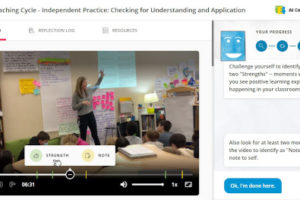
My district, Keller Independent School District (ISD), was one of the first districts in the nation to pilot AI Coach by Edthena. Using the platform, teachers are guided by a virtual coach as they reflect on videos of their classroom teaching and work through coaching cycles focused on specific areas of instructional practices. This includes developing goals and strategies for improvement based on teachers’ own self-reflection.
I’ll admit, I was nervous at first – this process meant I’d have to rewatch myself teaching and then really reflect on that teaching.
However, I soon realized being able to complete this coaching process independently would give me the time and flexibility to gather some real insights about my own practice before I shared them (or my videos) with my coach or colleagues as part of our ongoing professional learning.
The AI Coach process also aligned well with my district’s focus on action-oriented professional development. It’s far from traditional sit-and-get professional development, that’s for sure.
Becoming a more reflective teacher with AI coaching
As I started the AI-powered coaching process, I recorded a 12-minute mini lesson with my 7th graders, making sure my camera captured all of my actions, students, and conversations during the lesson. Since I was the only person who would see the video, I wasn’t worried about a special lesson.
Related:
AI’s pivotal role in authentic PD
Is your PD missing this key element?
I then uploaded the video to the AI Coach platform and started the self-reflection process. The virtual coach asked me questions and helped me home in on specific aspects of my practice that I wanted to improve upon, such as managing student behavior and my questioning techniques.
I realized in my mini lesson, which involved a group discussion, that some of my students were getting lost in the shuffle. Seeing this on video reminded me how important it is to stay aware of all of my students’ behaviors and to ask more prompting questions to increase participation and engagement.
Continuous teacher improvement using AI
It is a game-changer getting to see yourself in action, whether it is noticing how often you say certain things, or when you miss prime opportunities for questioning, or when you simply knock a lesson out of the park. Being able to watch myself, and honestly reflect on what I saw, has had such an impact on my teaching.
Of course, it’s possible to record yourself on your phone, but the reflection part is hard to do on your own. Working with the virtual coach, driven by AI to personalize the experience to my learning needs, really made the difference. It provided the extra layer of support I think all teachers can benefit from.
The self-reflections and insights I have garnered through the AI coaching process have already helped me in my lesson planning and delivery. Lessons I have (or feel like I have) taught a million times are now looking different and having a stronger impact on my students. I am more deliberate in what – and how – I teach now.
The virtual coaching process with the AI-powered coach has also helped me feel more prepared for conferences with my coaches and administrators. I know what I want to discuss with them in terms of my areas of strength and my areas in need of growth.
My advice for fellow teachers looking to strengthen their practice (and maybe get out of a rut)? Lean on new technology and coaching methods that support your development. Watch yourself and reflect on your practice. And, most importantly, be inspired by moments and opportunities where you can grow as an educator. For me, AI coaching has given me the opportunity to do all of the above as I continually work to be the best educator possible, for both myself and my students.

Teacher leader programs offer opportunities for teachers to assume leader roles and leverage their expertise in teaching without leaving the classroom. Despite some of the potential and promise of teacher leader programs, new programs often struggle with problems that stem from mismanagement that limits their effectiveness.
As teacher leader programs become more prolific across the country, there is a growing need for district- and school-level staff to design policies and practices to select, develop, support, manage, compensate, and retain teacher leaders. While there is a plethora of literature on teacher leadership that addresses these components, the information is not accessible to educators in a manner that allows them to easily and efficiently digest all of the different approaches and lessons learned to adapt to their context.
To make the literature on teacher leadership more accessible and engaging, we chose to develop interactive online modules—Managing Teacher Leadership—that cover nine components critical to managing teacher leadership programs. The modules focus on increasing awareness and understanding of how to design, implement, and evaluate a teacher leader programin a school building or district.
The nine modules correspond to components of talent management and present big ideas that distill essential information from the literature and offer readers relevant approaches to the specific work described in each module, varying from general guidance and exercises to relevant tools and resources. The online modules are designed to engage educators and make the approaches and lessons learned more accessible, to help school districts design and implement teacher leader programs on their own and at their own pace.
Related:
How to build relationships with instructional coaches
Is your PD missing this key element?
In West Virginia, the 2019 Board of Education Fall Listening Tour identified a need for opportunities for teachers to be able to assume leadership roles without leaving the classroom. Following the Fall Listening Tour, the West Virginia Legislature passed House Bill 4804 in 2020, directing the West Virginia Department of Education (WVDE) to help county school boards design and implement a Teacher Leadership (TL) Framework to support teacher induction and opportunities for professional growth.
The goals of the TL Framework are to 1) disseminate effective teaching strategies through collaboration, 2) develop stronger and more positive school and district cultures, and 3) increase student achievement via shared leadership structures. The WVDE requires all TL frameworks adopted by county boards to create specific roles and responsibilities; provide regular, targeted professional learning opportunities; provide time and opportunities for teachers to collaborate; monitor and evaluate the effectiveness of the TL program, and include teacher leaders in the school-improvement planning process.
Well-designed teacher leadership initiatives can improve conditions for learning and the quality of instruction, accelerate progress toward district and state goals, and establish sustainable and effective leadership systems (Center on Great Teachers and Leaders, 2019). But given multiple pressing priorities, it can be challenging to develop well-designed teacher leadership initiatives.
Many newly designed programs struggle with common barriers that can inhibit teacher leadership, including a lack of vision and goals, poorly defined TL roles and expectations, ad hoc selection criteria or “anointing and appointing” by the principal, unsupportive school climates, undifferentiated teacher leader evaluation processes, poorly articulated teacher leader and principal leadership roles, a lack of financial incentives, and ineffective TL program evaluation processes, and tools.
In collaboration with WVDE, the Region 5 Comprehensive Center (R5CC) developed interactive online modules to support district-level staff, building-level leaders, and teachers who are interested in designing and managing formal teacher leadership programs to support school improvement. After introducing the concept of teacher leadership and its benefits, the resource presents nine sequenced modules that describe components critically important to managing a teacher leadership program.
Each of the nine modules is organized into four sections: 1) The Big Idea, which distills essential information explored in each module 2) Practices, which offers readers relevant approaches to the specific work described in the module, varying from general guidance and exercises to relevant tools and resources; 3) Focus and Fit Tips, which reminds readers to ensure the work remains focused on teacher leadership competencies and all the practices fit together in a mutually supportive and reinforcing way; and 4) Your Turn, which provides actionable next steps to deeply engage in the work outlined in each module using the Engagement Guide.
During the 2022-23 school year, WVDE and R5CC staff will collaborate to disseminate and highlight sections of theonline modules to county stakeholders to increase awareness and use of the resource. The intention is to provide support in each component throughout the year by developing peer-to-peer opportunities to explore topics of common interest and, if requested, providing additional support to counties to help design and implement their teacher leader frameworks.
Overall, Carla Warren, Ed.D., NBCT, the Director of Educator Development and Support Services in the Office of Teaching and Learning at the WVDE commented, “I am extremely pleased with the support the department is receiving around teacher preparation and teacher leadership at this time.”
While designing and implementing teacher leader programs can be challenging, there are common lessons and approaches from the literature, including the use of online educational resources, that can support these initiatives. For more information and support, contact the Region 5 Comprehensive Center.
A report published by the U.S. Government Accountability Office (GAO) confirms that the pandemic greatly impacted students’ academic progress across all grade levels and instructional models.
Oklahoma City Public Schools (OKCPS) has leveraged pandemic relief funds to invest in additional resources for our district community. In addition to enhancing our summer school program, we are helping teachers support their students—and close learning gaps—by providing access to online, high-impact tutoring services.
While we originally implemented online tutoring for our virtual school only, we were so impressed by the results that we decided to scale the service across our district. Now, every student has unlimited access to high-quality tutors—regardless of their grade level or academic standing.
Here’s how high-impact tutoring benefits students, families, and educators.
Identifying the need
Throughout the pandemic, OKCPS has focused on maintaining communication with students, families, and teachers to ensure they have the tools they need to be successful.
In March 2020, one of our first priorities was to roll out a one-to-one device program and implement a new learning management system (LMS). While these initiatives can take two years or more to fully scale, our district’s program was up and running by August—just in time for the 2020–2021 school year.
Instructionally, we pulled in a variety of tools to help our teachers—including TutorMe, an online tutoring platform. While this has been a valuable resource for all students, it has been especially valuable for families who may not have had the money for tutors and related services. It’s not just about closing learning gaps—it’s about equitable opportunities for academic advancement.
Supplementing instruction with online tutoring
In a poll conducted by the National Education Association (NEA), 55 percent of educators indicated they are ready to leave the profession. The NEA has termed this situation as “an unprecedented [school] staffing crisis across every job category.” The well-being of teachers directly affects the quality of their teaching, and online tutoring can reduce some of their workload. And, for educators who are teaching across several grade levels within one classroom, tutoring alleviates much of the work that must be done to differentiate instruction for individual students.
Having a tutoring structure in place has been especially helpful for our newer teachers. They appreciate that they can direct students to tutors for additional support—especially in specific subject areas—and that the tutors are equipped to meet the needs of English learners.
This structure has also helped our district streamline teachers’ standard review process. With support from our tutoring partner, OKCPS launched a Writing Lab—saving teachers time (and red ink). Through the Writing Lab, students drop off their papers and essays for asynchronous review, and academic writing tutors provides feedback within a few hours.
Measuring success and closing the gap
One of our current priorities at OKCPS is setting usage targets that will measure the success of providing online tutoring in our schools. For example, we are tracking the percentage of students who are using our online tutoring platform during the school year, and when students are interacting with tutors. We are also tracking how many students are using the platform at each school.
In addition, we are tracking interim benchmarks, beginning-, middle- and end-of-the-year growth measurements and state assessment comparisons across school years to ensure we are on track to reach our goals and milestones. This also ensures we are able to justify continued investment in online tutoring beyond pandemic-related funding.
At OKCPS, we recognize our responsibility to eliminate past, present and predictable barriers to student success by ensuring that all students have access to the resources—people, time and money—they need to engage in high-quality learning. Through online tutoring, we are equipping teachers (and students) with the resources they need to be successful.

For assessments to be used effectively in schools, it’s important for districts and schools to consider what assessments are intended for and how the data gained from the assessments will be applied to support student learning. Building and maintaining a balanced assessment system is essential for schools, but the process can be complicated.
Asking these eight questions can help school district leaders who want to make sure they’re using and administering formative, interim, and summative assessments at the right times and in effective ways. Considering these key questions can help districts build assessment systems that better support student learning and improved outcomes.
1. What is the purpose of this assessment?
An assessment’s purpose includes the intentions of the designers who created it, as well as the district’s intentions in selecting it. To understand what a given assessment is meant to do, take a careful look at the materials that accompany it and any pertinent communications from the district. When in doubt, ask questions. The right questions can help those around you achieve the clarity they need to fully understand what an assessment is designed to accomplish.
2. What does that purpose mean for how I should use this assessment?
In contrast to an assessment’s purpose, its use refers to the real-world utilization of an assessment by teachers, support staff and specialists, and building or district administrators. With all these different stakeholders doing all sorts of different things to help students learn, no single assessment is going to meet everyone’s needs. To understand how an assessment might be useful to you, pay close attention to how those around you talk about it and use it.
3. Is there a disconnect between an assessment’s purpose and use?
When the way an assessment is used runs contrary to how it was intended to be used, that’s a major red flag. For example, if a formative assessment is being used for grading, this disconnect between purpose and use can interfere with students’ motivation to learn, it can reproduce existing inequities, and it can be confusing for students and families. Inappropriate uses for assessments lead us to make bad or poorly supported decisions that ultimately inhibit learning. Once you’ve identified an assessment’s purposes and uses, compare them side by side, carefully looking for any uses that might ask an assessment to do something inappropriate.
4. What resources do I need to use this assessment for its intended purpose?
Sometimes we can’t use an assessment for its intended purpose because other elements of a teaching and learning strategy get in the way. For example, a teacher focused on a strict scope and sequence for instruction for every student may have difficulty using an interim assessment like MAP Growth to differentiate instruction based on students’ individual learning needs. Look for a match between an assessment’s intended purpose and your teaching and learning strategies, and advocate for change where other policies, procedures, and common practices prevent you from using high-quality assessments to their full potential.
5. What can this assessment provide to our school that other assessments cannot?
Different assessments are better at different things. Formative assessment processes are ideal for proposing evidence of student learning in the moment and supporting students in becoming self-directed learners. Interim assessments like MAP Growth help teachers identify student needs across a content area, help teachers and administrators gauge progress toward learning goals, and help predict performance on state-mandated assessments. Purposeful summative assessments allow students to demonstrate what they’ve learned while providing administrators with important information about student learning overall.
When choosing new assessments, start by examining the gaps in your current assessment strategy. Having a clear understanding of those gaps will help you identify the types of assessments you may need in the future.
6. How will my students understand and use this assessment?
Students react to the assessment process in many different ways. Many students relish the challenge of demonstrating what they know, and they welcome opportunities to improve on their past performance. For other students, however, assessments can trigger fear, self-doubt, frustration, or even panic. These students may not understand how the assessments will be used, and they might even worry about how the assessment will reflect on them as individuals. How you talk to students about their assessment results and use them in instruction plays a big role in whether their experience is positive or negative.
7. How can I talk to students’ families about the purpose and uses of this assessment?
Families are among the most important stakeholders in the assessment process. Because a student’s caretakers can’t sit in your classrooms every day, assessments serve as a valuable source of information on how their child is doing and what they can do to support their learning. Make sure that families have what they need to prepare their students for assessments, understand the data they see from assessments, and build skills alongside their student over time.
8. How will this assessment support student learning?
The objective of every assessment should be to support student learning. The more you know your assessment tools, triangulate data between assessments, and provide students with the support they need to do their best, the more helpful assessments will be in meeting your most critical needs as an educator.
When you find yourself lacking clarity on how best to use the formative, interim, and summative assessments in front of you, try asking these eight questions before you get too far into the assessment process. They can help you not only better understand an assessment’s real purposes and uses, but also ensure that your students get the most value and meaning from it.

After a tumultuous few years teaching during a pandemic, some educators are embarking on a unique approach to social and emotional learning (SEL) training this summer: They’re pursuing a virtual wellness, SEL, and yoga training course.
Graduates of Breathe For Change’s 200-hour program will be certified to teach inclusive yoga classes to both adults and young people and lead SEL and wellness experiences in their schools, districts, and organizations.
“Our whole approach is a community-wide wellness approach–the home-school connection matters deeply,” said Dr. Ilana Nankin, Breathe For Change’s founder and CEO.
The certification program is designed specifically for educators who can use their SEL and yoga education for teacher well-being and student SEL.
Educators were stressed, overwhelmed, and overworked before the pandemic escalated things, said Nankin, a former PreK teacher, who focused on this topic in her dissertation. When Nankin used her research and teaching experiences to create Breathe For Change in 2015, educators who participated in the program saw transformations in their students, from an SEL perspective, but also from an academic perspective.
It reveals “how powerful SEL and wellness practices can be for students’ lives, in school and in an educational context,” she said. “Then, as educators, how do we utilize wellness, SEL, yoga, and mindfulness as vehicles for healing and social change across our whole community?”
Educator graduates have taken their training and started mindfulness programs in their schools, established yoga clubs for kids, are leading family wellness nights, hold SEL and well-being PD for their colleagues, and are transforming school culture and climate.
Breathe For Change’s SEL training component is split into various components, including breath awareness, mindful movement, community connection, and creative expression. Educators integrate these practices into their instruction while also weaving them together to facilitate wellness workshops and professional development.
The program also adds an “F” to turn SEL into SEL*F. That “F” stands for facilitation, and the training equips educators to lead wellness and SEL practices and programs in their schools and districts.
“It’s so critically important to embody, live, and breathe the practices and SEL competencies we hope to teach our kids,” Nankin said. “Training starts with a focus on transformation of self–educators first and foremost should take care of their own well-being and prioritize their own self-care so they can do the essential work of giving themselves to their communities.”
This summer’s educator participants draw attention to two growing issues: teacher burnout and the increased need for SEL and mental health support among students.
A nationally representative survey of teachers by RAND Education and Labor in late January and early February 2021 found that educators were feeling depressed and burned out from their jobs at higher rates than the general population. In the survey, one in four teachers–particularly Black teachers–reported that they were considering leaving their jobs at the end of the school year. Only one in six said the same before the pandemic.
A January 2022 study published in JAMA Pediatrics confirmed what many educators, administrators, and support staff already knew: School closures, disrupted learning, and a pandemic year have coalesced to create an alarming mental health crisis among teenagers.
The study found that up to 60 percent of students are experiencing “strong distress,” including anxiety and depression. The results echoed a recent American Psychological Association (APA) report, which found that more than 80 percent of teenagers experienced “more intense stress” during the pandemic.

Teaching at any level can often be a solitary occupation. Even with a classroom full of students, teachers often work in isolation from peers. Teachers rarely receive instruction on how to work with co-teachers or teacher assistants in their pre-service teacher education programs. Therefore, it is often difficult or awkward for teachers to ask for help or effectively collaborate with others. Instructors often don’t know how to accept help from the instructional coaches, even when they would like to.
Educational practice is shifting from isolating practice to collaborative efforts, and creating healthy and productive team dynamics is often a challenge. Instructional coaches can positively impact these relationships, but the trust must be in place for it to occur. Even in systems where working with a coach is expected, building those initial relationships can be challenging.
Instructional coaches, instructional designers, and even assigned co-teachers often struggle to establish working relationships with individual classroom teachers. Librarians regularly complain that they spend more time clearing jams from printers instead of assisting students with reference questions. However, clearing that paper jam can help the student see the librarian as a resource. In the same way, the instructional designer might start to build a relationship by helping an instructor properly format hanging indents for a research paper. One instructional coach started building a positive relationship by making copies for classroom teacher. Just like the proverbial salesman who had to get a foot in the door, sometimes the first step is a small one.
Just as teachers rarely learn about collaborating with others in their classroom, instructional coaches and others of their stripe are often trained to focus on analyzing student learning data or the technical skills. However, that is only one facet of the coaching role. Gathering and analyzing data is an important aspect of instructional improvement, but it is rarely successful as the first facet.
Instructional coaches need to begin by building relationships with those instructors they are assigned to support. Building a supporting and trusting relationship with those coaches is essential. Coaches have to be able to keep confidences with those they work with. Building trust is essential for coaches and co-teachers to be able to collaborate fully and honestly. It is easy for instructional coaches to be frustrated when asked to complete mundane tasks, but those mundane tasks might be the conduit to building an initial relationship with an instructor.
One recent instructional coach exclaimed to a class full of graduate students, “Please tell everyone to take that first step, even if it is to make copies. It just might be the important first step.” It might be those copies that were the first step to an instructor telling the coach, “Ok, I will try that, because it is you.”
Beyond the need to build relationships, instructional coaches need to ensure they help the instructors focus on the impact they are having on students. Instructors almost universally want their students to be successful. Once the coach has built a trusting relationship, then they can begin to suggest technical changes based upon the data and best practice. Here again, balance is important. Asking instructors to make wholesale changes will not be nearly as effective as working on a couple of specific high value items. After experiencing cooperative success, the coach can then push forward a few more suggestions. Pushing too much at once can turn an instructor off. Even with the most struggling instructors, instructional coaches should always look for bright spots where they can help instructors build confidence–particularly in those cases where the instructors have been directed to work with the coach due to performance concerns.
Effective coaching is a three-faceted process. Coaches need to build relationships with the instructors they support, then work to collaboratively analyze the relative data in light of the goal of impacting student achievement or otherwise supporting student success. All three facets of the coaching process need to be given adequate attention to build strong successful partnerships to improve the teaching and learning process.
One instructional coach articulated her process in this way: I started my process in an optional fashion, meaning my teachers choose “to work with me.” This has been a challenge that made me come up with ideas to get the foot in the door, made me feel sometimes ineffective as an instructional designer, but now after seven years, it has really made me appreciate the value of that journey.
As mentioned, instructional coaching is a multi-faceted process. There are many layers in it. The emotional wellbeing of your team is essential to build a foundation for further work. The small steps are key ingredients to start any coaching program and finding a framework to plan for structure and next level of practice. A coach starts with small tasks, but we need to be prepared to move our practice toward alignment with building goals, refine the work, and this is what a coaching framework provides.

Many people envision artificial intelligence’s (AI) role in education with a sci-fi twist, but in reality, AI is already embedded in promising new tools that address student learning, real-time feedback, and continuous professional development (PD).
AI-powered learning tools can offer students immediate feedback and a customized learning experience. And when used in PD, time-strapped educators can better reflect on their instructional practices and target areas for improvement.
Edthena, a provider of video-powered PD tools, is harnessing AI in its new AI Coach platform. The solution helps schools and districts give teachers access to supportive coaching to improve teaching effectiveness. AI Coach uses artificial intelligence to guide teachers through coaching cycles aligned to common growth areas.
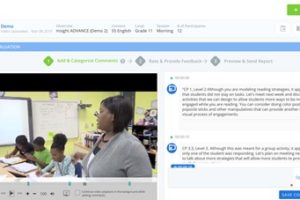
Using AI Coach platform, teachers connect with Edie, their virtual coach. Edie asks teachers about their professional goals, and then teachers analyze and reflect on videos of their classroom instruction by adding time-stamped comments.
Edie takes a guide-on-the-side approach to help teachers summarize the evidence found during video analysis and develop action plans to increase impact with their students. As part of their conversation with Edie, teachers develop a short-term goal, identify a strategy for change, and commit to a timeline for implementation. This evidence-based process enables teachers to receive many of the benefits of instructional coaching even if an in-person coach is not available.
“In the conversational AI space…you’re fundamentally able to have a conversation with the computer on the other end. That’s really exciting,” said Adam Geller, founder and CEO of Edthena. “What it means is that we’re able to take the ideas of some general-purpose technologies people are becoming familiar with and translate those techniques to professional learning for teachers. High-quality coaching is essential to helping teachers succeed in the classroom. However, ensuring that a coach is available for every teacher on a regular basis to support ongoing reflection was a near-impossible task until now. The AI Coach platform is a support tool for teachers that complements the efforts of school leaders and instructional coaches.”
The AI Coach platform helps school leaders and instructional coaches support teachers’ continuous learning and growth.
“Ideally, we’d have enough coaches and time to go visit every teacher in-person, but that’s just not possible, and it means that some teachers are getting ongoing support of a coach while others aren’t,” said Valerie Minor, coordinator of professional development and leadership at Keller Independent School District in Keller, Texas. “I see great value in being able to offer all teachers access to AI Coach which can guide them through cycles of self-reflection and empower them to continue their professional learning.”
Trained by experienced instructional coaches, the AI Coach platform personalizes the coaching cycle for each teacher’s self-identified focus areas. For example, if a teacher indicates they are interested in observing for “checks for understanding,” the AI Coach platform provides related observation tips for the video analysis. Then, when it’s time for the teacher to develop a strategy for making progress against their goal, the platform offers curated content to help the teacher learn more about “checks for understanding.”
“AI Coach by Edthena is not meant to replace existing coaches,” said Geller. “Instead, the platform is meant to help every school and district provide more coaching and feedback than they can deliver today due to not having coaches or not having enough coaches.”
And in the future, AI’s capabilities will bring more professional development opportunities to educators.
“We’ll continue to build out the ability of the AI to suggest things in a more nuanced way,” Geller said. “When it’s time to suggest more resources, maybe those resources will become more nuanced over time. Maybe the way the back-and-forth interaction works can become even more open-ended.”
Using AI in professional development is in its infancy, but its potential is great.
“I think we’re really at the beginning of the next generation of teacher professional learning tools. What it means for teachers is more personalized experiences that feel more streamlined, more integrated, and in some ways, invisible–more magic, because the best technology is the one that feels like magic,” Geller said. “I think where we’re headed is that teacher professional development tools will have the same delight and the same ease of use as when you pick up your phone and ask the phone’s digital assistant for the weather.”
AI Coach by Edthena is in continued development and testing with teachers this spring. Schools and districts will be able to share the AI Coach platform with all of their teachers starting in fall 2022.
“I think that idea that what AI will do is take technology for PD to this place that it feels invisible, magical–I think that’s the type of experience we’re trying to provide. Technology shouldn’t make people feel disconnected from each other; it should make them feel connected,” Geller said. “It shouldn’t feel like something extra; it should feel like something that’s streamlined. As we’ve built this tool, we’ve built something that helps prepare people to be better collaborators with their colleagues, their stakeholders, and their community while also making it easy to use.”
To learn more about the AI Coach platform and to join the waitlist for access, visit www.YourAICoach.com.
As Covid-19’s Omicron variant is pushing some school districts back into distance learning, teachers may be frustrated at the return of video meetings. However, imagine if video wasn’t as ubiquitous as it is today.
I contend that video technology helped to save education during the pandemic, and therefore should not be abandoned. As years of research from Harvard University has shown, the benefits of capturing and sharing videos to support preservice teachers, new teachers, and instructional coaching are far too great.
While a districtwide system dedicated to recording, annotating, and sharing video may sound like it would require a big budget, teachers can get started using just their cell phones. The evidence is all around us. From TikTok to Instagram to Snapchat, students are perfecting complex dances, learning, and showcasing their skills with musical instruments, teaching each other about climate change, and more.
That trend isn’t limited to young people. Educators are using video apps and tools to share lesson ideas, best practices, and classroom instruction. They record themselves, self-reflect, observe, and learn from each other. It’s all about growth.
Here are three suggestions for how educators can leverage video for years to come.
Teacher preparation
The pandemic forced teachers to broadcast videos to students who were at home. While this may have worked as a temporary solution, preservice teachers were not as fortunate.
Remote learning meant classrooms were shut down, with preservice teachers not only unable to be in schools, but also unable to observe more experienced teachers. As many teachers will attest, observing experienced teachers is critical to their development. This situation presented professors in teacher preparation programs with yet another challenge.
LaGrange College in Georgia was well-equipped to overcome this obstacle. Its teacher-preparation program had already been using video-based feedback for seven years. Dr. Rebekah Ralph, instructor of educational technology and EdTPA coordinator, pivoted to using video to support teacher candidates who had little to no interactions in the field.
During pandemic-induced shutdowns, Ralph provided feedback to preservice teachers from her back porch. As she recalls, she and her team “were able to support preservice teachers by continuing our observation and coaching models through the use of video when the school systems were not allowing visitors in the building. Our preservice teachers also were able to see a variety of teaching strategies used by their peers in diverse school settings as they shared, commented, and reflected on their teaching and the teaching of others.”
Mentoring and teacher induction
Research tells us that new teachers most often leave the profession in the first few years because they don’t feel supported. While mentor and induction programs have traditionally been effective, in the current environment, instructional coaches with districtwide responsibilities have been unable to visit classrooms frequently enough. The stress of teaching during a pandemic has amplified the problem.
Teachers who have entered the profession in the past 18 months only know chaos and uncertainty. As a result, and with an increasing shortage of teachers in the pipeline, education leaders like Kenya Elder, Executive Director of Teaching and Learning for Georgia’s Douglas County School System, have sought new ways to support new hires. This year, Douglas County onboarded 76 teachers “who were not only new to our district but also new to the teaching profession. This specific group of teachers joined us as we were enrolling and welcoming 26,000 students back to in-person learning.”
The problem, as Elder saw it, was, “How do we effectively and consistently connect our Induction Coaches to these teachers?” Their solution was to set up a structure that focuses on video observations “that are safe and non-evaluative.” So far, she says, this approach “is resulting in trusting relationships between teachers and coaches.”
Instructional coaching and observation
MSD Decatur Township in Indiana has been using video to support instructional coaching for about five years as part of the Empowering Educators to Excel (E3) TSL grant project.
Assistant Superintendent Dr. Stephanie Hofer and the district’s instructional leadership team started by asking teachers to record 10 minutes of their practice in order to encourage self-reflection. Eventually, this led to teachers sharing videos with peers and mentors for feedback. As teachers and instructional coaches became more comfortable with video, Dr. Hofer said, “We started using it more because it was actually giving us more value than anything else we were doing.”
When the pandemic arrived and physical classrooms shut down, the district had to make a choice about how to best support teachers. They decided to double-down and increase the use of video coaching—but they were met with a new challenge. According to Dr. Hofer, “We weren’t sure how we were going to evaluate our teachers or get evaluations completed. We decided to give teachers the option of recording themselves and uploading their lessons—and we’re still giving them that choice.”
The district’s several years of implementing video coaching had built a culture that enabled it to push through a difficult period. Dr. Hofer said that the pandemic “…was the catalyst for our district to go all-in on video coaching and begin using asynchronous video for teacher evaluations with the full support of our teachers union.”
Despite how uncomfortable video can be at times, the benefits are clear. It’s a tool that can help teacher candidates, new teachers, and veteran teachers improve practice, while also increasing the reach of mentors and instructional coaches. There’s never been a more important time to support teachers, and video can play a vital role.

The importance of professional development in education cannot be overstated. In fact, according to research, when teachers receive well-designed professional development, an average of 49 hours spread over six to 12 months, they can increase student achievement by as much as 21 percentile points.
Yet, professional development is often overlooked and considered an afterthought—especially with pressing concerns around students’ mental health and well-being, gaps in reading and math skills, and so much more. The COVID-19 pandemic shook up professional development, encouraging schools and districts to rethink what this process looks like and how to best set their educators up for success and, in turn, their students.
At Waxahachie ISD in Texas, we’ve implemented professional development through the use of video, and lean on self-reflection and personalization that is naturally part of the video process to transform how our educators learn, collaborate and grow.
Here’s why.
Enhanced self-reflection
Self-reflection is challenging, but crucial in any career and especially in education. A report from RAND notes that collaborative professional development activities provide opportunities for teachers to engage in informal mentoring with more experienced and more effective colleagues, experiment with new instructional approaches, and co-construct understandings of policies and practices—which, in turn, can shape teaching practice.
When a teacher watches themselves teach through video, they often notice things they missed in real-time. For example, perhaps a teacher is using their hands to explain a concept, but find when re-watching their lesson that the hand movements were distracting and took away from the lesson as a whole. Video enables teachers to capture real moments in their classrooms and pick up on little things that can otherwise go unnoticed. There’s a reason sports teams dedicate so much time to watching film on their opponents and themselves. Video allows teachers, much like sports teams, to reflect on their practice and note areas of improvement. They gain a new perspective, and their craft is further enhanced.
Video also provides insight into how students learn and react. Perhaps there’s a student in the back of the classroom who raised their hand, but the teacher didn’t see it. Those little moments are visible with video and enhance a teacher’s awareness of their classroom and what, or who, to pay close attention to during their next lesson.
When a teacher uses video to review their instruction in a classroom and is made aware of habits that can be improved—such as using their hands too much, talking too fast or keeping their back turned to the class—they can correct themselves and improve their practice. That self-awareness helps teachers become stronger educators and greatly impacts the student experience for years to come.
Personalized feedback from colleagues
It’s difficult for district-level leaders to give teachers the dedicated time needed to provide actionable feedback on their instruction. Video allows teachers to share their strategies and gather valuable feedback from their colleagues.
With teachers pulled in so many different directions, dedicated time for self-reflection can fall short. However, when using video, educators can record themselves and continue teaching. Then, when teachers meet with their colleagues, it’s an engaging process, rather than a passive conversation.
Personalized feedback not only supports new teachers, but veteran educators as well, by providing an opportunity to discuss new and worn-in techniques, an avenue for authentic dialogue, and a chance for educators to truly collaborate and learn from one another. The time spent discussing and reviewing classroom video with others creates a nurturing environment where teachers build trust, share experiences and foster relationships with their colleagues,
Those interactions are key to student success and translate to tangible, real-world benefits.
Actionable next steps
Connecting, collaborating, and sharing teaching strategies strengthens instructional approaches and creates more effective teachers—which leads to more confident, successful students.
Through video, educators can see themselves in a new light, sparking self-reflection and conversations with their colleagues. Those important discussions lead to actionable next steps that can be applied the very next day in the classroom. From taking a moment to pause for questions, to learning a new instructional approach from a colleague, video helps teachers improve their craft and set students up for greater success.
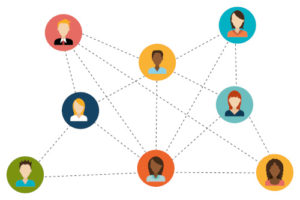
I am currently in an online doctoral program at Winona State University. One of our recent discussion queries required answering the following prompt: “Share three pieces of your own PLN that you think would be helpful to the others.”
I wasn’t quite sure if I should share platforms, tips, or connections, so I will be sharing three things I wish I would have considered sooner than later.
1. Drop the IRL
I have listened and visited with Angela Maiers–an educator, consultant, and speaker–a number of times. One thing that she frequently shares in her keynotes is around dropping the “IRL” (in real life) mentality when talking with your online PLN. For those who connect with you virtually, a digital relationship is IRL. You may never physically meet these individuals due to logistics, geography, or time and that is ok. Such relationships do not necessarily become instantly more meaningful when you meet in the same moment of time or space.
Darci Harland uses the term “digital colleagues” (DC) within research to support similar mentalities of the value of these online relationships attributed to working and collaborating during the COVID-19 pandemic.
2. Blend professional and personal
I strongly suggest having a relaxed presence within social media–one that honors our professional work while acknowledging that we are people with real lives. In the past, I kept siloed profiles to make sure that my personal and professional lives didn’t mix, that my professional communications were spotless, and that my digital footprint was as clean as possible. As I grew confident in the profession, understood social media more, and cultivated a group of online connections, I stopped and shifted my efforts over to my main accounts.
Blending professional and personal accounts allows one to share their authentic self and not perpetuate “the best life ever” mentality—the one that sometimes seeps into Instagram and Pinterest posts, that can slowly distort our perceptions of reality, and that can erode our self-perceptions of our own lives. This shift has also allowed me to make connections over personal interests, professional colleagues, fun events, and lifestyle choices that make the people we connect with real people.
3. Ask questions
This can be the most daunting. I didn’t want to look dumb. I didn’t want to look uneducated. I didn’t want to look like I didn’t know how things work. For quite some time I wouldn’t ask questions–and phew, that was the wrong approach.
When I started asking questions (even about things I already knew), I noticed that I started sparking discussion, sparking divergent thinking, and sparking new connections. I realized that, while I might have “looked dumb” to others, I didn’t care because I wanted to know more, and if I had questions, others did, too. This is something that is often shared with students in classrooms, yet I think it was challenging for me because I was publicly asking for help (which is challenging even in small groups) and that I knew the post would live on forever. Disclaimer: I am still working in this one!

If you feel like this year has been more stressful, more overwhelming, and more difficult to find the joy of teaching than ever before, you’re not alone. With pandemic protocols, political unrest, and increasing workloads and responsibilities ravishing the classroom, the heart of teaching can at times feel lost.
It doesn’t have to be this way, though. Let’s face it–many of these things are not under our control. If we hope to reignite our passion for education, we’re going to need to put them aside and focus on what we can change.
Ultimately, there is only one thing that any of us can really control: ourselves. The choices we make can often determine how we meet new challenges in our day-to-day life. While I don’t want to minimize the challenges we’re facing in the classroom, I do believe we can create positive outcomes when we focus on our personal growth, connections, and contributions.
Here are just a few strategies you can employ to help reignite your passion for teaching:
1. Give yourself grace: Showing self-compassion is the act of being kind to yourself and realizing that suffering, imperfections, and failures are part of being human. Consider creating a grace journal where you record incidents that leave you feeling frustrated or inadequate. Then write a few sentences to yourself from the perspective of a caring and compassionate friend. You can also create a list of everything that makes you feel energized and use it as a resource when feeling low.
2. Reframe the negative: It’s all too easy for your mind to get swamped by negative thoughts. Start by steering clear of toxic complainers who will drain your energy. Second, start replacing your “coulds” and “shoulds.” Reflection is an important part of growing, but there’s no point in wallowing in past mistakes. Additionally, avoid toxic positivity. Toxic positivity imposes that positivity is the only solution to problems. However, it is important to recognize that negative emotions are normal. Talk with nonjudgmental people and avoid always trying to always have a positive response.
3. Set YOUR goals: It is so easy to lose sight of your personal and professional goals as demands of the day-to-day take priority. Remember that your profession is also about you and what makes you tick as a teacher. Seek out PD opportunities that matter to you and find like-minded educators on social media who will provide a supportive environment. For more intentional goal-setting, consider using the SMART Goal protocol to create specific, measurable, attainable, relevant, and timely goals.
4. Celebrate your success: It is imperative to reflect and celebrate your many accomplishments. These include those huge milestones (i.e. receiving an advanced degree) or smaller scale, but nonetheless incredible, achievements (i.e. effectively redirecting a negative behavior). Consider keeping a record of your successes by writing them on pieces of paper and keeping them in a jar. And remember to share your awesome! Teachers want to hear from teachers. Consider presenting at conferences and workshops. If you are on social media, share what you are doing. We all love to hear from each other–we truly are better together!
Remember, we may not be able to control everything, but we still have a say in the things that matter. If you found these strategies helpful, be sure to check out the expanded list in our latest free webinar. Using these resources, we hope to see teachers rediscover their commitment to education and find the support needed to thrive. Together, we have the passion, creativity, and grit to overcome any challenge!

(Editor’s note: This article is the third in a three-part series about how school systems can build on the progress and leverage the investments they’ve made in technology during the pandemic to achieve true digital transformation. Part 1 looks at how K-12 leaders can develop an effective blueprint for redesigning education in a way that’s more equitable, meaningful, and learner-centered, and Part 2 explores how leaders can obtain stakeholder buy-in and support for their vision.)
Building on the changes that school systems have made during the pandemic to achieve true digital transformation requires an adaptive approach to K-12 leadership, as well as a focus on successful change management. These are adjustments that have to take place at the administrative level. But real transformation won’t occur unless it reaches the classroom as well, with teachers embracing change and trying out new approaches to instruction.
For this to happen, teachers not only have to buy in to what their school systems are looking to accomplish; they also need effective professional learning.
From decades of research, we know what effective teacher development looks like. For instance, in 2017 the Learning Policy Institute published a review of nearly three dozen studies on teacher professional development that identified common success factors. Among other characteristics, effective PD incorporates active, hands-on learning; provides opportunities for teachers to collaborate; and is ongoing rather than just a series of unconnected workshops.
We have been partnering with school systems for many years to deliver highly engaging and effective professional learning. Drawing from research-based best practices and our own extensive experience in working with educators, here are seven key strategies for leading professional learning that turns a school system’s vision into action.
Establish a learning culture.
In many school systems, teachers don’t look forward to professional learning because they see it as a waste of their time. What does it say about how school systems are approaching PD when the people who have such a natural love for learning that they want to instill this passion in the next generation aren’t being inspired to learn how to improve their own craft?
For professional learning to engage and inspire, K-12 leaders must first establish a culture of continuous learning in their district. Leaders also need to set the right tone at the outset of any professional learning opportunity by tapping into educators’ natural curiosity, building connections, and creating a community of learners.
When Microsoft released Minecraft Education Edition, we were asked by Microsoft Canada to roll it out in Ontario. We invited IT leaders, educators, and students to learn the basics of the game together and “thought shower” how it could be integrated into the curriculum. It was an opportunity for everyone to become active and collaborative learners, with agency over their own learning and development—and everyone, including early adopters and those who were shy about their technical skills, embraced the opportunity.
Make it directly relevant to what they’re teaching.
For professional learning to seem relevant, teachers need to understand how the skills and techniques they’re learning can be applied within their specific grade level or content area. They need to see a direct connection between what they’re learning and their own teaching environment.
Consider providing grade-level or content-specific instruction, or else deliver general instruction to the entire group and then have teachers break out into grade-level or content-specific teams to learn how to apply the lessons to their own instruction together. This can help teachers learn new skills within the context of their own classrooms.
Model the seamless integration of technology into professional practice.
Modeling effective instruction gives teachers a clear vision of what successful integration might look like. Teachers should have opportunities to observe new strategies and pedagogies in action before trying these methods for themselves.
Celebrate learning moments.
As we learn more about the importance of social and emotional learning, we realize the significance of pausing, recognizing the small moments of success we encounter each day, and feeling gratitude for those. When K-12 leaders share these moments and acknowledge teachers’ successes in front of their peers, it helps build connections and inspire further learning. During a global pandemic in particular, leaders need to be intentional about finding joy, happiness, and reasons to celebrate.
Expand teachers’ learning opportunities and networks.
Just as we argue that student learning shouldn’t end when the school bell rings, teacher development shouldn’t end when a professional learning session is over. K-12 leaders must look for ways to provide continuous learning opportunities for faculty, inviting them to push their practice forward and learn from colleagues.
In his book Lifelong Kindergarten, MIT professor Mitch Resnick describes how there should be a “low floor, wide wall, high ceiling” approach to learning. The “low floor” means that students should be able to engage in learning opportunities from a low entry point; the “wide walls” are intended to accommodate students of all interests and abilities with a variety of methods and approaches; and the “high ceiling” encourages students to engage in increasingly complex opportunities without putting a cap on their learning. This same philosophy should apply to teacher development as well.
Provide ready-to-use resources.
Teachers have always had a lot of responsibilities. That’s especially true during the pandemic, when teachers have faced even more challenges than usual—from tending to students’ emotional needs to stemming academic learning loss. Anything that K-12 leaders can do to make their jobs easier is a welcome development. With respect to professional development, this means giving them concrete lesson ideas and other resources they can take away from a training session and apply in their classroom right away.
Reflect and learn forward.
High-quality professional learning should give teachers the time and space to think about what they’ve learned, try it out with their students, and receive feedback they can use to further their development.
John Dewey said, “We do not learn from experience. We learn from reflecting on experience.” Reflection ensures that professional learning isn’t a single, standalone experience, but part of a learning continuum. For this reflection to occur, K-12 leaders should make it an intentional practice and build time for reflection into teachers’ busy schedules.
Digital transformation isn’t something that happens overnight. It’s an ongoing human process, and creating a culture of learning and continuous improvement is a key element in moving this process forward. We are all in “beta,” and educators and administrators alike must embrace a mindset of creativity, open-mindedness, and lifelong learning.
There’s a reason many large organizations have Chief Learning Officers, and it’s because they recognize that employee learning must continue long past their formal education. By fostering an environment in which teachers feel safe to take risks, encouraging and rewarding innovation, empowering teachers to take ownership of their learning journey, and nurturing their well-being, K-12 leaders can drive true digital transformation in their schools.

Over the last two years, educators have been forced into all kinds of unplanned experiments as we’ve searched for ways to keep students safe while continuing to advance their education amid a global pandemic.
At the Metropolitan School District of Decatur Township, we’ve found that one of the pandemic-related changes we’ll be keeping around is the use of video for teacher evaluations. I think it’s a change we’ll see a lot of other districts making in the next year or two as well.
Based on our experience, here’s how I can see it playing out across the country.
1. Teachers will overcome anxieties about video evaluations.
We hadn’t planned on using video to evaluate our teachers. A grant we secured nearly 5 years ago through the Teacher and School Leader (TSL) Incentive Program provided us access to the ADVANCEfeedback® platform, which we first used for instructional coaching.
At the outset, we weren’t really sure how to best use the platform and, to be honest, we were nervous about it. I think many of us are a little uncomfortable with the idea of being recorded on video. When you pile on making that recording at your place of work—and then asking people to watch and reflect on that recording by earmarking a timestamp and sharing their thoughts about what they’ve captured—you’re really asking people to put themselves out there.
So, we started slowly, by asking our teachers to submit 10-minute clips of themselves teaching, along with a bit of reflection about the clip. Some of our teachers, and even entire schools, really dove in and started recording and sharing a lot of videos. As we dug in across our district, we started using it more and more because we saw our teachers reflecting more and providing more self-reflecting feedback on their own to better their craft.
Over the course of remote learning, many of us became much more comfortable being on video simply because we were forced to. Teachers may still be a little anxious about the idea of being evaluated through a video, but at most districts around the country they’ve had a year to get used to the idea of their lessons being recorded, and this should be less of a barrier for districts moving forward.
2. Unions will see the value of tech tools that support teachers.
Our teachers’ union has been very supportive of our use of video for instructional coaching from the beginning. Asking teachers to create and submit only short clips at the beginning undoubtedly helped, but when the pandemic struck, we had to have a conversation with them about the practice. Our teachers already had trust in the process, they have always had control over which videos to share and who is able to see them.
Just like other schools across the country, we were worried about how we would carry on our work. When it came to teacher evaluations, ADVANCEfeedback was an obvious short- and long-term solution for us. We met with the union and told them we had this platform that had been delivering great value for us and that would allow us to maintain some sense of normalcy at a time when it felt like everything was so chaotic.
It did help that our teachers were so happy with the process, which simply required them to record their practice. They now get targeted, individualized feedback on the exact concerns they have about their practice—without the intrusive and distracting nature of having an observer in the room with them. Teachers are always going to be either your greatest supporters or your biggest detractors in any district-wide initiative, and because they were solidly on board, so was the union.
3. Video will expand the scope of PD and PLCs.
Over the years that teachers have been sharing their videos, we’ve been able to create a library of best practices created by our teacher leaders. These are always accessible to our teachers, created by colleagues they trust and respect, and rooted in our district’s culture and context. Just as our teachers can use our feedback platform to create a video on a topic they’re struggling with, upload it, and receive support, our instructional leaders can create exemplar videos on the gradual release model to share when they notice other teachers struggling in a particular area.
The ability to provide video feedback has also expanded who can offer coaching or attend professional learning communities. As an assistant superintendent with nine buildings in our district, my ability to sit in on meetings was logistically challenging before. Now I can join a meeting in one building and be at another in a school on the other side of the district immediately after.
We consistently hear feedback from administrators and lead teachers that using video feedback has enabled our district to make improvements beyond what we originally thought possible. I’m eager to see its use spread in the near future and to learn how other districts are using it to improve teaching and learning for their students.

It’s one thing to attend a professional learning or instructional coaching session—but taking what you’ve learned and putting it into action is another. Most often, it’s the experiences built upon collaboration, reflection, and active change that make the biggest difference.
My time as a classroom educator helped me realize a passion for helping fellow teachers learn and grow. It inspired a mission to transform professional learning into something that’s focused on teacher collaboration, learning and follow-through.
With this in mind, I compiled the following tips for getting the most out of professional learning and coaching sessions.
#1 Embrace the experience
When I first transitioned from teacher to coach, I remember feeling frustrated with the lack of impact that my professional development and coaching was providing. That’s because it was your typical “sit and get” experience where attendees learned something in the moment, but likely forgot about it as soon as the session was over. In coaching, I observed a teacher and “provided feedback” on what I saw–while teachers were often receptive to new ideas to try, any change was often short-lived.
This lack of impact is what led me to push for the use of video to enhance our professional learning and coaching sessions. I would have attendees pick one thing they learned to try out in the classroom, have them record it, and then use that video to self-reflect. I built in time for us to collaborate, so we could swap ideas and discuss what was and wasn’t working in the classroom. With those I coached, I recorded when I would visit and allow them time to see what I saw and let them lead the conversation based on their own reflections and questions.
By actively embracing the professional learning experience, rather than being a passive participant, educators find more meaning in what they learn, improving the experience for them–and for myself
#2 Be comfortable with vulnerability
About 12 years ago, I decided to start recording my classes so that students could go back and review previous lessons. I recorded several videos–about eight–over a two-week period.
When I went back to watch the recordings, I deleted all eight videos in the first five seconds. I didn’t like the sound of my voice, or what I was doing with my hands. My hair didn’t look great that day–my classroom was a mess.
Going back and watching yourself, or sharing a recording of yourself with someone else, is a challenging thing to do.
But, again, I was doing this for the students–not for myself. So, I recorded new videos and made myself watch each of them. This was an “aha” moment. I realized that almost all the things that went well during class were things I had not built into that day’s lesson but were done on the fly.
There were also things I realized I needed to work on, that I’m still working on to this day. Like many of my fellow teachers, I can be a fast talker, and, especially when I’m tired, I have a thick Southern drawl, and when that comes in, it can be hard to understand what I’m saying. More aware than ever, I took what I learned and revised my teaching.
Video became an invaluable reflective tool for me. In every role, I’ve leaned on video to drive sustainable change.
I’m a huge advocate for professional learning opportunities that use video to drive reflection and change. Even if video isn’t built into a PD opportunity, educators can still use it to self-monitor the implementation of a strategy they learned, look at student learning, and identify what is (or isn’t) working in the classroom.
#3 Reflect and follow through
In education, it is not hard to find new ideas and instructional strategies. It can be hard to change our practice, however. That’s where reflection comes in.
Reflection is central to how our mindsets work and how we shift our behavior. Allowing time for doing “the dirty work”—applying what we’ve learned and then reflecting on our progress—is a key ingredient to successful PD.
Learning never stops.
Whatever field you’re in, you’ve got to keep learning. If you don’t have a good grasp on where you are or where you’re supposed to be, that can be near impossible.
Using professional development as an opportunity to learn and evolve does not only enable educators to grow, but also to positively impact the lives of their students, school, and district community.

This time of year sees email in boxes filled with information about how to prepare for the next year, reminders that grades are due, and papers await grading. We are deluged with predictions about the future, what to worry about, and sometimes even what to be excited about. Those with calendar year goals are often rushing to complete projects or solidify a final sale. Family and other holiday obligations can often add an extra level of stress as well. One thing often missing is how to make sure you are balanced and ensure you are taking time for self-care.
According to a recent NBC article about the increasing educator shortage, between retirements among an already-aging population and the stress and burnout of the pandemic, the number of potential educators in the pipeline is not nearly enough to match needs.
An October 2021 NPR report showed that 80,000 aspiring nurses were turned away from nursing schools due to a lack of adequate nursing instructors. It is clear that educator burnout can directly lead to shortages in other critical areas such as health care.
What are some simple things that can be done to help ameliorate educator burnout? AASA, the national superintendent association, has just released a new program called Live Well, Lead Well to encourage and support self-care. We all learned about Maslow’s Hierarchy of Needs and the need to ensure basic needs before we can expect our students and colleagues to reach the upper levels of the hierarchy. Alicia has said, “You can’t pour from an empty cup, and you need to take care of yourself in order to be of any use to others.”
For yourself, ensure you are getting the rest and support you need. If you don’t have a support system, look to your institutional resources, religious leaders, or family to help search out resources. If you don’t have a dog or pet, maybe one should be in your future. Eighty-four percent of PTSD patients saw stress levels reduced simply by petting a dog, according to a Johns Hopkins study.
A dog is a serious commitment, so here are a few other options:
If you feel you need help, remember you are not alone and reach out. Contact your medical doctor, your religious advisor, or the Employee Assistance Program at your school. The National Institute for Mental Health includes links to a number of federal mental health resources. Most states and some large cities and many universities have similar mental health resource pages. Take care of yourself. It will help you and those with whom you work.
Pick any high-priority instructional initiative in your district. Can you think of at least one teacher who is excelling in that priority area?
Maybe it’s an early-elementary teacher facilitating small group math learning. Or, maybe it’s a high-school science teacher appropriately deploying sheltered-instruction techniques into a lesson rich with academic language.
Now ask yourself… how can every other teacher get a chance to see that teacher’s classroom?
Unless you have unlimited substitutes for release time, I’d suggest using technology to solve this problem.
Try setting up a district-wide video library.
Video libraries are a valuable resource for teachers and instructional leaders to see concrete examples of excellent practice, as defined by your district. And libraries of teaching videos support high-quality and personalized professional learning in a number of ways, too.
Teaching video libraries tap districts’ existing expertise
Video libraries highlight the exemplary teaching practices already happening within your district. District video libraries of teaching aren’t just a collection of generic, canned videos – they are created by your educators, for your educators.
The videos within the library can highlight any effective teaching strategy. This could be a lead teacher demonstrating a new math strategy or a new teacher using strong academic language during a reading lesson–you name it.
Regardless of the given topic, the videos provide other teachers with an authentic way to see effective strategies happening within the district and discover colleagues who can be a resource.
For example, when Hartford Public Schools was first building out its video library, instructional coaches helped to identify more than 60 classrooms in the district where high-quality teaching practices were taking place day-in and day-out. The teachers from these “lab classrooms” then recorded and shared videos of their instruction within the library for other teachers to see the best practices in action.
In addition to being used as a learning resource, video libraries also provide a great way for districts to celebrate the teachers who submit videos. Having their skills on display for others in the district to see is a great accolade and acknowledgment of teachers’ successes in the classroom.
District video libraries help develop teachers’ professional vision
A shared vision of high-quality teaching is important for every district as it provides the framework for ongoing professional development and coaching. Video examples reinforce this vision and help teachers understand what high-quality teaching looks like from a very practical standpoint.
Having a vetted collection of videos also helps ensure teachers are always referencing teaching practices that the district deems as “good teaching” – there’s no second guessing on the part of the teacher.
The videos can additionally serve as concrete examples during coaching sessions and professional learning communities. This enables coaches to show teachers examples of effective strategy in practice instead of just trying to explain it. For example, you can capture videos of teachers successfully implementing new curriculum, for others to emulate.
As a group, educators can review and discuss what they are seeing in the videos, and offer additional tips for how those same strategies can be implemented with fidelity in the classroom. This encourages ongoing discussion regarding professional learning, supports a common language of effective teaching, and helps align educators in reaching their goals.
Teaching video libraries provide teachers with on-demand support
People love watching how-to videos on YouTube because they get the information they need when they need it. Video libraries provide a similar—and powerful—experience when it comes to professional learning.
Instead of scouring the internet for resources, teachers can simply search the district video library of teaching for videos that meet their needs. This can include grade-, subject-, strategy-, or standards-specific videos focused on areas they are looking to improve.
Online video libraries can also be accessed from anywhere. This enables professional learning to happen wherever and whenever it is convenient for teachers, who often don’t have time to observe other classrooms or the ability to visit other schools within the district.
Teaching video libraries are a sustainable investment
A video library of teaching examples is easy to start and gets easier to sustain over time. There is no need to have thousands of videos to launch your library. Even a small collection of videos can be helpful.
For example, maybe start by collecting videos of one particular grade-level or strategic priority area. Do you run a Teacher of the Year recognition program? Those teachers could be great candidates to contribute videos, too.
And, you can keep building your library over time as more moments of excellence are uncovered in classrooms across your district.
Once videos are added to your teaching video library, teachers can access those videos for years to come. Good teaching is good teaching, regardless of when it took place.
With the ongoing need for effective and accessible professional learning opportunities, video libraries can support many educators both easily and quickly.
A 2021 study by the Council of the Great City Schools emphasizes the need for teachers to have ongoing access to high-quality professional development (PD). The study maintains that high-quality PD “must be actionable and contextualized within the framework of daily classroom life – whether those classrooms are physical, virtual, or hybrid.”
This study, along with recent events, demonstrates that, as with most other forms of education, professional development needs to be flexible and convenient yet still robust.
Face-to-face PD is still the optimal experience, of course, but sometimes that’s just not an option. And, while webinars offer a decent alternative, I would like to posit that online PD is an even better option for these times.
Online PD puts the power of learning in teachers’ hands, much the way we empower children to own their learning through student-centered education. Online opportunities that employ platforms such as Teachable offer learners the convenience of choosing when to complete the course, freeing them from the physical constraints they might have with traditional PD. Moreover, online learning can be engaging, even interactive, a noticeable difference from the static nature of webinars.
Pillars of a strong online PD course
As with all learning opportunities, the strength of an online course depends on the time and effort put forth by its creators. Solid online PD:
• Makes the most of the e-learning platform, providing learners with relevant, open-ended activities and challenges and the option to access the course anytime, anywhere.
• Incorporates helpful, downloadable, and interactive resources such as planning tools that can be filled out on the spot, videos, quizzes, and links to supporting articles.
• Makes the learning simple by presenting concepts in small, digestible pieces that learners can easily build on as they complete the course.
• Is relevant and timely. As we know, educators’ time is valuable. They need – and deserve – courses that make good use of their time. Courses on how to use a specific product, for example, or how to implement a given solution into an already busy classroom provide tangible learning that teachers can actually use.
• Employs the engineering design process whenever possible. Stick with me here. I know not every course lends itself to the engineering design process, but you’d be surprised how often this iterative method works to really drive home various concepts.
• Provides a certificate of completion at the end. To be truly relevant and worthy of educators’ time, e-learning PD should include a way to receive those all-important continuing education credits.
If you’re looking for a strong online PD course, make sure it checks off all, if not the majority of, those boxes.
Teacher credibility
Of course, when it comes to professional development, the proof is in the pudding. In this case, the “pudding” is educators. Two educators evaluate an online learning course titled “Creating STEM PBL.” Both teachers appreciated the way the content was presented. “The content was very clear and easy, even for someone who had no understanding of any STEM concepts,” replied Chris Gibson, STREAM lab teacher for Grades K-6 at S. F. Austin STEM Academy in Jones Creek, Texas. Amanda Wood, a STEM teacher and coordinator in Atlanta, TX, agreed. “I think it’s a great training. I loved how it was broken down into very small pieces.”
The included resources were also a big hit with both teachers. “I love the planning tools,” said Wood, who added that “the videos were to the point and the activities were useful.” Gibson noted that “the use of video, supporting articles and web links, and downloadable work-along documents” were really helpful. “I really appreciate the PDFs that you can fill in,” she noted. “I thought that was great to include rather than including just a download.”
But perhaps the most important question: Was this a good use of their time? According to both Gibson and Wood, the answer is a resounding “Yes!” “I felt like my time was put to good use,” Wood said. “I think teachers will appreciate that.” Likewise, Gibson stated, “The course gives a good basic introduction to STEM and PBL as if the learner doesn’t have much experience in either.”
If you’re looking for a convenient, robust alternative to traditional professional development, I encourage you to look into online PD. When done well, it hits all the necessary PD requirements while also providing that added bonus of flexibility and learner ownership.
I am currently in an online doctoral program at Winona State University. One of our recent discussion queries required answering the following prompt: “Share three pieces of your own PLN that you think would be helpful to the others.”
I wasn’t quite sure if I should share platforms, tips, or connections, so I will be sharing three things I wish I would have considered sooner than later.
1. Drop the IRL
I have listened and visited with Angela Maiers–an educator, consultant, and speaker–a number of times. One thing that she frequently shares in her keynotes is around dropping the “IRL” (in real life) mentality when talking with your online PLN. For those who connect with you virtually, a digital relationship is IRL. You may never physically meet these individuals due to logistics, geography, or time and that is ok. Such relationships do not necessarily become instantly more meaningful when you meet in the same moment of time or space.
Darci Harland uses the term “digital colleagues” (DC) within research to support similar mentalities of the value of these online relationships attributed to working and collaborating during the COVID-19 pandemic.
2. Blend professional and personal
I strongly suggest having a relaxed presence within social media–one that honors our professional work while acknowledging that we are people with real lives. In the past, I kept siloed profiles to make sure that my personal and professional lives didn’t mix, that my professional communications were spotless, and that my digital footprint was as clean as possible. As I grew confident in the profession, understood social media more, and cultivated a group of online connections, I stopped and shifted my efforts over to my main accounts.
Blending professional and personal accounts allows one to share their authentic self and not perpetuate “the best life ever” mentality—the one that sometimes seeps into Instagram and Pinterest posts, that can slowly distort our perceptions of reality, and that can erode our self-perceptions of our own lives. This shift has also allowed me to make connections over personal interests, professional colleagues, fun events, and lifestyle choices that make the people we connect with real people.
3. Ask questions
This can be the most daunting. I didn’t want to look dumb. I didn’t want to look uneducated. I didn’t want to look like I didn’t know how things work. For quite some time I wouldn’t ask questions–and phew, that was the wrong approach.
When I started asking questions (even about things I already knew), I noticed that I started sparking discussion, sparking divergent thinking, and sparking new connections. I realized that, while I might have “looked dumb” to others, I didn’t care because I wanted to know more, and if I had questions, others did, too. This is something that is often shared with students in classrooms, yet I think it was challenging for me because I was publicly asking for help (which is challenging even in small groups) and that I knew the post would live on forever. Disclaimer: I am still working in this one!

This past year, teachers were introduced to a lot of new technology to help facilitate distance learning. And, because of this, professional development (PD) time often morphed into technical training–how to use Zoom, how to best utilize a new learning app or software program, how to troubleshoot student device issues.
With so much on teachers’ plates, this so-called PD became draining. Teachers simply couldn’t spend any more valued time learning yet another new program. And they weren’t getting the important support they needed to make tactical pedagogical shifts for their evolving learning spaces.
Heading into a new school year, we have a chance to hit the reset button to restore true PD time into teachers’ schedules.
Yes, technical training is important. But, technical training shouldn’t be used as a synonym for professional learning. It does not provide the same benefits to teaching and learning as does research-based PD.
For school and district leaders, it is important not to conflate the concepts of technical training and PD. Carve out time this year for the types of professional learning that will lead to better student outcomes.
Align professional development to teachers’ needs… by asking them
PD is all about making teachers feel supported and giving them the tools needed to continuously improve their instructional practice. And, this coming school year, teachers will undoubtedly need extra support. How can they connect with students entering back into the classroom? What instructional strategies can they use to accelerate learning? How can they build strong and collaborative relationships with their colleagues after months of working online?
We can all make guesses, but do you really know what’s on top of your teachers’ priority list? There’s an obvious but easy way to find out… ask them!
It will be especially important for building leaders and coaches to have open dialog with teachers about what they are feeling and where they need extra help, and then really home in on these areas of need during the PD time.
Providing targeted, data-driven feedback to teachers is at the heart of the PD process and is one of the best ways to support instructional improvement in the areas teachers need it most. To deliver this feedback and build collective teacher efficacy, systems need to be in place to talk about actual events from classrooms and develop a shared definition of successful classrooms.
After more than a year of hybrid and online teaching, it’s safe to say teachers are more than familiar with teaching on video, so now they should start recording that teaching and start talking about it! This is a statement that applies to both in-classroom and online teaching.
The use of video reflection ensures that reflections are grounded in fact versus memory, a benefit for teachers and those providing feedback. A video does not have an opinion—it’s a mirror for the teacher on what truly happened.
Whether it is an entire lesson or a short three-minute snippet, video recordings enable teachers to self-reflect on their own practice. And, they enable instructional coaches and colleagues to comment on specific moments in time or evidence related to the teacher’s learning goals. This video-powered process allows for really granular feedback on practices that may have been missed during a traditional in-person observation.
Design PD to give teachers a choice in their own learning
In addition to providing teachers with needed feedback and support, PD should give teachers a voice in their own learning. This empowers teachers as they work to reach their individual goals.
Choice boards are one way to help facilitate teacher-directed learning. With choice boards, teachers are essentially provided with a menu of professional learning experiences they can choose from and work on throughout the school year. Do they want to work on strategies for increasing student engagement? Or work on lesson delivery and pacing? Choice boards give them the option.
Keller Independent School District has implemented choice boards with great success. At the district, the boards specifically help guide participating teachers on how they’d like to implement video coaching into their learning plans during each phase of the year. This could include sharing video of different aspects of their lesson design or video of them delivering an actual lesson, for example.
With choice boards, teachers are able to select what – and how – they will learn. Plus, it allows for more targeted and personalized coaching cycles.
As always, setting proper expectations and being intentional about what PD is (and what it is not) is important. So while teachers will most certainly need technical training and support this school year, they, more importantly, will need PD time that focuses on instructional best practices, collaboration, and reflection. This is what is going to really support and accelerate their practice.

As a science educator, I love showing my students the wonders of the world. I encourage them to always be curious, ask questions, and seek out new knowledge and skills. An important part of my job is modeling lifelong learning for my students—and one of my favorite ways to do that is by honing my skills in professional learning courses.
I’ve participated in a variety of professional development (PD) courses throughout my teaching career, but some of the most powerful ones I’ve experienced have been the free, short, self-paced courses from the National Geographic Society. These online PD courses cover everything from developing an “explorer mindset” in students to methods of empowering students to tell impactful stories. The courses surpassed my expectations of what an online professional learning course can be—and how easily I can translate what I’ve learned in these courses into my classroom activities and instruction.
Here are three of the lasting impacts that these courses had on me as a teacher–and as a person.
1. The courses helped me form a community of practice with teachers around the world.
Myth: Self-paced courses are isolating. Fact: When teachers across the world go through the same course at their own paces, this shared experience and knowledge helps forge a community of professional learners. After taking a 50-minute mini-course called “Developing a National Geographic Explorer Mindset with Your Learners,” I joined the National Geographic Explorer Mindset Community to continue my learning, collaborate and share best practices, and learn how other teachers were applying what they had learned in the course. Through this Facebook group, I met other educators from around the world. I even formed a connection with two educators—Tim Black in Paris and Danielle Zelin in Mauritius—and co-created the Global Educator Explorers Team website.
The GET OnBoard website is dedicated to helping teachers use the UN Sustainable Development Goals, National Geographic Resource Library, and International World Days, to spark curiosity and foster an Explorer Mindset in students. Without taking the mini-course, it’s unlikely I would have connected with these educators on different continents and undertaken such a valuable and impactful collaboration.
2. The online PD courses gave me an opportunity to delve into one of my personal interests.
For as long as I can remember, I’ve been drawn to visual storytelling. I’m a visual learner, and I love stories that are told with graphics and data. So after taking the Explorer Mindset mini-course, I decided to take another course called “Storytelling For Impact In Your Classroom: Graphics.” This course, which was co-developed with Adobe, allowed me to delve into my personal passion for visual storytelling and inspired me to create new projects for my students, such as creating infographics.
I also now make it a point to tell graphical stories to my students–using the YouTube channel I established for my class–because the Storytelling for Impact course taught me how to share stories in engaging, powerful ways that I know will resonate with my students. That’s important for me as an educator, but it’s also fun for me: the ultimate intersection of professional praxis and personal passion!
3. It helped me look at the world–and myself–differently.
As a true nature lover, I believe that every time we go outside, we learn something new. I hope that through my science class, my students are able to see how amazing our world is. Nature is extraordinary, and I enjoy taking my students outdoors to experience our world first-hand. These online PD courses have inspired me to try out new hands-on ways to engage students in nature–from using the Seek app to identify flora and fauna, analyzing geo-inquiry problems, or creating drawings of what we observe outside.
Each of the National Geographic courses I have taken has inspired me and has rekindled my appreciation for our amazing planet. These courses have motivated me to find new ways of guiding students to explore nature for themselves, as well as developing new methods of sharing nature with my students and the global educational community. Moreover, these instructional strategies have shown me that anybody can be an explorer—including me. As I discover new teaching practices and progress on my professional journey, I now see myself not just as an educator but as an Educator-Explorer.
When I registered for my first free National Geographic Society online PD course, I had no idea the amazing journey that awaited me. Who knew that a course that was less than an hour long could open the door to global collaboration, personal fulfillment, and a fresh outlook on the world?
As I continue to grow as an Educator-Explorer, I hope that my lifelong learning inspires my students to keep exploring the wonders of the world, too. And I hope that our collective learning journey will empower our students to be the next generation of changemakers and explorers.

There’s a lesson about return on investment hidden in the humble classroom pencil. That’s right–the pencil.
Ask any teacher and they’ll tell you definitively that all pencils are not created equal.
There are cheap pencils with soft lead that breaks too easily and erasers that smudge writing instead of removing it.
Then there are name-brand pencils that feature strong graphite that breaks less often and top-quality erasers for clean corrections.
Yes, those name-brand pencils might cost a bit more money up front, but everyone will tell you they are better at achieving their intended purpose with less waste. They are cost-effective because they help teachers (and students) achieve the goal with less total cost. Those pencils provide a better return on investment.
This same analysis can be made for just about any type of investment school or district leaders need to make, including investments in professional learning to support educator growth.
This is even truer when technology is involved, as there are many teacher PD options that advertise they’re cheap, but may not deliver much to any return on investment if teachers don’t find the tools helpful and personalized to their needs. Cheap PD does not equate to cost-effective PD, as district leaders may ultimately need to spend more in the long-run to help teachers progress in their professional learning.
Below are three ideas that will help district and school leaders make both strategic and cost-effective purchasing decisions related to professional development platforms.
PD technology should play nicely with teaching technology
There’s a common mantra to avoid “yet another platform” for teachers. This isn’t because another platform is inherently a bad idea, but because there are too many platforms that aren’t adding value for teachers and that another platform can feel like something extra, outside the day-to-day routine.
Professional development “library of resources” or “on-demand training” are the most likely types of platforms to get dusty and go unused. Instead, invest in a teacher PD platform that integrates into teachers’ workflows to help them achieve their professional learning goals.
Take for example the use of web conferencing tools like Zoom, GoToMeeting, WebEx, and Google Meet that teachers have been using to teach online and hybrid-learning students. Even as many schools return to in-person teaching, these platforms will continue to have some place in teaching moving forward.
So while we’ve mostly been thinking of these as tools for teaching, video conferencing software can also be a tool for professional learning when you use those videos as part of a video observation and video coaching process.
With only one extra button-click, teachers can record one Zoom-teaching video, upload it to the video observation and reflection platform, and share it with their coach or peers for feedback. Video observation offers a way to integrate more opportunities for self-reflection and streamlines the process of receiving feedback from others.
Teacher feedback data that helps teachers and leaders drive decision making
Part of professional learning is reflecting on one’s teaching practice. There are a variety of tools for capturing “feedback to teachers,” but there are only a few tools that will help transform that feedback into something meaningful for the teachers’ ongoing professional development.
District leaders should look first for professional development platforms that provide robust and targeted data for teachers’ own use. Yes, having a district-wide dashboard is important, but ensuring the feedback process is generating valuable insights for teachers is part of what will drive teachers to continue to use the platforms outside of a compliance context.
With the right data dashboard, coaches and administrators will also be able to answer important questions like:
Based on these answers, coaches and administrators can make adjustments as needed to further enhance the professional learning experience for their teachers.
Teacher PD platforms need to help teachers meet professional development goals
There’s always a lot on teachers’ plates, and sometimes making progress on professional development goals can fall by the wayside because of other priorities. Technology can help keep these goals front and center and, as a result, help teachers better work toward–and meet–those goals.
District leaders should look for programs that help teachers set goals aligned to professional standards and track their progress.
For example, if a district is prioritizing “use of academic language in the content area,” then it’s important to enable teachers to set goals against that specific prioritized skill area and also to collect evidence related to that goal. This alignment helps transform the “priority initiative” idea from a bullet point in a staff meeting to an action plan in the classroom.
Tools that help teachers align their goals with teaching standards also create an easier throughline in the data between individually-developed teacher PD plans and the bigger-picture goals of a school or district. This means teachers will feel confident their individual learning efforts are going to “count” when it comes to talking about progress in an end-of-year evaluation conversation or getting PD credit for time invested.
It goes without saying that implementing any new technology can be a big decision, but when it comes to something as important as professional development, the cheap option does not mean it’s the best option. And, as always, supporting the growth of teachers is an investment worth making.

As schools make plans to reopen, it would be easy for school and district leaders to put teacher PD on the backburner. There are, after all, a lot of competing priorities – from managing first-days-of-school schedules to navigating new cleaning protocols to building culture and community.
High-quality PD is still critical to teachers’ success, and now is not the time to scale back, especially given the ongoing challenges teachers are facing this school year. Creating time and space for professional learning will help teachers recharge their batteries.
Below are three ways to help efficiently and effectively prioritize teacher PD for the remainder of this year and beyond.
Streamline feedback to teachers via video observations
A year ago, most teachers would have told you they had never recorded their teaching. But now the opposite is true: most teachers have seen their teaching on video. Given that the experience has been normalized, there is an opportunity to finally make video observation an integrated part of the observation and feedback process.
In a recent chat I had with author and expert Jim Knight about instructional coaching during the pandemic, he said, “Today, we can do a lot of things virtually that aren’t possible if it’s exclusively face-to-face – we can differentiate in a whole lot of ways, divide up into groups, meet at different times, and use asynchronous communication. While these opportunities for professional learning were there before, they weren’t being fully exploited.”
We all know that teachers’ time is both valuable and limited. As such, it is important to find easier and faster ways to provide teachers with meaningful, data-driven feedback to support their instruction.
Asynchronous feedback to teachers using videos of their teaching is a convenient way to offer them opportunities to reflect and improve on their own time. And it’s also a research-proven way to help them get better, faster.
While face-to-face observations and in-person workshops can provide value, district leaders and coaches should continue to leverage technologies to provide streamlined, just-in-time feedback in the areas teachers need it most.
Scale teaching best practices across the district through video libraries
The definition of what makes for good teaching is constantly changing to meet the needs of students. It’s important to help teachers see examples of the new ways classroom teaching and learning will look. This is especially true as some teachers are coming back to classrooms for the first time in more than a year.
As teachers implement new methods into their classrooms, it’s hard for other teachers to see those examples of what works. As such, best practices must be shared one-to-one or in small group settings. Building a video library of best practices to share across the school or district can help solve this problem. There’s another benefit to having a library of best practices: the examples of teaching are available on-demand for teachers.
What could this look like? Hartford Public Schools, for example, created a video library of high-quality teaching practices teachers can access as they analyze their own instruction. To create this, the district identified exemplary teachers who recorded and uploaded videos of their teaching in action for fellow teachers to view. Now, teachers across the district have a valuable repository of best practice videos they can continually access.
Professional learning is not meant to be done in silos. And, as such, district leaders and coaches should always think about how any example of good teaching and learning can be scaled to reach – and benefit – as many teachers as possible.
Integrate video-powered learning into your existing tools and processes to engage teachers
District leaders and coaches do not have to reinvent the wheel to engage educators in meaningful teacher PD that utilizes video. The best advice is to make video observation and video professional learning a part of your existing process. This way, video learning is not a “something extra,” it’s the main event.
Do teachers already have a favorite Google tool or organizational app they like to use? Instead of replacing these items, see how they can become part of your feedback process.
Or maybe teachers are still delivering hybrid-style teaching via video conferencing software? Those programs all offer an integrated recording option for capturing the teaching video.
Going back to my conversation with Jim Knight, he suggested coaches could watch a lesson virtually or receive a video clip of teaching in action, and then debrief with the teacher about what happened. As he put it, “Coaches and educators are able to respond using this method and it should be more powerful than our more traditional forms of professional development.”
There is absolutely no doubt that district leaders, coaches, and teachers are stretched thin right now. But we must remember that job number one is to have the greatest impact on student learning, and prioritizing teacher professional learning is how we’ll get there.

Facilitating in-person professional learning is exhilarating. The nervousness and excitement in the room are almost palpable. As we immerse ourselves and our participants in the topic at hand, the anxiety slips away and the enthusiasm grows. We make meaningful connections to the content and each other, and we all walk away feeling more confident.
Then COVID-19 hit and stopped us in our tracks. Our ability to travel became limited or nonexistent. Schools closed and moved to remote learning, including the district where we work. While there was still a need for professional learning in the virtual space (perhaps even more so!), it was difficult to imagine how we would adjust for the “new normal.” For us, we were entering uncharted territory.
Here are a few of the strategies we have implemented over the past several months to navigate and prepare for virtual facilitation.
Explore new tools for engagement.
As educators, we understand how important it is to be flexible and responsive to the situation in front of us. The virtual space requires us to navigate technology in new and different ways. This may involve purchasing new equipment or using existing equipment in a different manner.
Embrace experimentation, then practice, practice, practice.
No matter which technologies you choose, it will require time and effort to make sure the approach is conducive to participant learning. This is why it’s essential to practice prior to facilitation, particularly when working with unfamiliar technologies.
When we started using Zoom, for example, we set up Zoom meetings with one another to get a feeling of how it would be to present virtually and offer feedback and encouragement. This not only allowed us to become more comfortable with the idea of facilitating in the virtual space, but it helped us finetune our content as well. These practice meetings made all the difference in the effectiveness of our sessions.
Consider the rules of engagement.
A common mistake that many professional learning facilitators make is assuming that the traditional environment and the virtual space will behave similarly. They won’t. Traditional engagement of learners begins with body language; we use visual cues to gauge interest, confusion, and collaboration. In the virtual space, instead of reading the room, we now have to read the screen. To do this intentionally, we have to keep track of participation for many people at once while also monitoring inactivity. We have to balance the content delivery with application.
Just like in-person professional learning, virtual sessions must be innovative, practical, and most of all, beneficial to each participant. They should provide rich experiences and help participants stay focused by mixing things up and incorporating different tools and activities, rather than relying on a static, lecture-driven approach.
Just breathe.
Teachers, perhaps better than anyone, understand that this is a challenging time in education, so give yourself some grace. Start small. Become fluent with one tool that will connect the dots for your learners, enrich their experience, and enhance your delivery approach. Then tackle another. Virtual glitches will happen. One of the most important steps in all of this is to just breathe.
Virtual facilitation requires us to be technologically savvy and efficient while delivering content and adapting learning experiences to our audience. This means that as professional learning facilitators, we can be powerful modelers of best practices for virtual learning. With the right content and technology, we can design learner-centered experiences that honor the needs of educators while addressing the larger goals of the session. As an added bonus, teachers can see first-hand how these technologies and approaches can be used in their own teaching to engage students and make their learning stick, no matter where that learning takes place.

Who doesn’t love a good podcast? True crime, self-improvement, history, finance–there’s something for everyone. And if you’re looking for new education podcasts to start your year off right, you’re in luck.
Are you searching for new edtech inspiration? Looking to find examples of innovation in districts across the country? Maybe you just need a little motivation during virtual or hybrid learning. Check out the following education podcasts to see which one (or two, or three..) piques your interest.
[Editor’s note: Descriptions are taken from podcast sites. Editors have not reviewed podcasts for content.]
1. The House of #EdTech: The House of #EdTech is an edtech podcast that explores how technology is changing the way teachers teach and the impact that technology is having in education. Host Chris Nesi’s objectives include discussing the technology that is changing our classrooms and schools and sharing information you can hear about today and use tomorrow. Nesi talks to teachers, leaders, and creators like you and has them share their stories.
2. Getting There: Innovation in Education: Kevin Hogan, editor-at-large for eSchool News, speaks with district leaders as they share successes while managing school tech in the midst of the COVID crisis. Hogan is an acclaimed writer, editor, and commentator covering the intersection of society and technology, especially education technology.
3. 10 Minute Teacher: The 10 Minute Teacher, by Vicki Davis, is a 5-day-a-week podcast that will help you become a more remarkable teacher who inspires children to learn and grow. The 10 Minute Teacher is your 10-minute PD breakaway! You can become a more remarkable educator in just ten minutes a day. You could be on your way to work, at the gym, or washing dishes. Whenever you listen, the best and brightest educators and idea creators from around the world will inspire you.
4. Truth for Teachers: Angela Watson’s teacher podcast, Truth for Teachers, is designed to speak life, encouragement, and truth into the minds and hearts of educators.
5. The Wired Educator: Kelly Croy is the Director of Innovation and Instruction at Port Clinton City School District in Port Clinton, Ohio. Kelly hosts the popular Wired Educator Podcast where he interviews amazing educators & educational authors from around the world and shares their stories to help teachers level-up and make a difference in the lives of students.
6. TeachThought: The TeachThought Podcast delivers thoughtful heterodox conversations and ideas to help educators think about their craft and better prepare learners for the modern world.
7. School Psyched Podcast: The School Psyched Podcast covers resilience, trauma-informed care, school psychologist burnout, preparing students for life transitions, and more.
8. Teachers Talking Tech: Mike, Eric, and Marie talk about technology in the elementary classroom. Each episode is short, so that you can get some ideas and insight quickly and in a fun way.

Academic institutions across the U.S. have resumed the fall semester, with many choosing to continue offering instruction in virtual or hybrid environments. While educators pivoted and quickly adjusted to virtual learning environments at the onset of the COVID-19 pandemic, the transition was not without its challenges.
In March, 41 percent of school districts reported they could not provide ongoing virtual lessons to all students due to educators’ lack of appropriate tech tools—a significant barrier to effective remote learning.
Related content: Doing PD in a pandemic
However, it’s important to point out that technology is a complementary tool for high-quality teaching, not a replacement. Learning institutions and school districts must empower educators who use technology to facilitate remote learning by providing appropriate devices, technical training, and ongoing technical support.
To ensure virtual learning is successful and efficient, school districts, colleges and universities must prioritize and invest in professional development for experienced and emerging teachers.
Technology-focused professional development improves the teaching process
Institutions invest significant resources into adopting new technology, but often for-get to invest in the educators who will be utilizing the new systems. Technology, of course, is a means to an end and a complementary tool to trained teachers. Without making space and allocating resources to properly train educators on best use practices before deploying new software or programs, technology can adversely affect the teaching and learning process.
One way to demonstrate support is by investing in online professional learning and other instructional materials that help educators develop technology skills and effectively integrate new technology into their teaching plans.
A recent study by the Learning Policy Institute concludes that well-designed and implemented professional development programs lead to improvements in student knowledge, skill, and competencies.
Even in the virtual teaching environment, educators can take advantage of professional development offerings through mentoring, coaching, and professional learning communities that offer channels for collaboration. Institutions can further facilitate this process by reevaluating school schedules to increase technology professional development opportunities and providing training sessions for educators to familiarize themselves with education technology.
Addressing equity and access to technology
Even if professional development opportunities are made more available, equity and access issues will continue to exacerbate the digital divide, leaving educators ill-equipped to serve their learners.
The COVID-19 pandemic shone a bright light on the widespread racial and economic inequalities in the U.S. education system. Not surprisingly, education opportunities and learning outcomes for students of color and those coming from low-income households have been disproportionately affected.
Furthermore, some teachers don’t have the quiet space, personal devices, or internet connectivity necessary to successfully facilitate remote learning. One in 10 K-12 teachers in the U.S. reported they live in households without sufficient internet connectivity and almost 100,000 teachers don’t have access to a device in their home to conduct remote instruction.
The lack of accessible teaching materials creates an even wider achievement gap and limits access to education for many students, especially those in low-income house-holds, those living in rural communities, English Learners (ELs) and Native American students.
To ensure educators can support effective virtual learning, school districts and institutions must deliver adequate technology devices and the requisite technical know-how to guide their implementation.
Technology cannot replace teachers
Online learning platforms and technology tools provide critical support for virtual learning but ultimately can’t serve as a replacement for qualified classroom teachers. For example, research does not support the isolated use of technology for acquiring a language. Language educators use content knowledge and research-informed teaching strategies in tandem with technology applications to support language learning. Effective language instruction is best guided by language educators rather than solely delivered via computer programs or learning applications.
As school districts and institutions navigate teaching and learning capabilities while the global pandemic persists, technology continues to grow in importance as a tool to support and enhance remote instruction and assessment. Ultimately, however, any learning tool’s efficacy is heavily dependent on the knowledge and expertise of the educator who uses it in the learning environment. Therefore, we must prioritize teacher development and training on technology platforms and, at the same time, promote policies that address equal access to education for all learners.
Supporting educators’ professional development and technological needs is instrumental in advancing learning outcomes and bridging the growing education gap that continues to be worsened by the pandemic. With adequate attention and allocation of financial and human resources, all learners have a better chance of receiving a high-quality educational experience, regardless of the learning environment.

Ten new recommendations from the American Association of Colleges for Teacher Education (AACTE) address critical state policy changes necessary to support innovative improvement in educator preparation programs and education during the global COVID-19 pandemic and beyond.
The policy recommendations are outlined in AACTE’s new report, Teaching in the Time of COVID-19: State Recommendations for Educator Preparation Programs and New Teachers.
Related content: Do teacher prep programs need an overhaul?
Increased barriers to developing the educator workforce during the health crisis, coupled with the national teacher shortage, create demands for acute collaboration between educator preparation programs, state education agencies, and PK-12 schools to reinvent systems for producing high-quality teachers to meet the growing needs of diverse learners.
AACTE reviewed and analyzed COVID-related state guidance to educator preparation programs in pursuit of three goals: (1) to understand what states are doing to help prepare teachers for the classroom during this crisis, (2) to understand any extant trends in state guidance and (3), to identify recommendations for state leaders to enhance the support of new teachers impacted by program and policy disturbances stemming from the coronavirus crisis.
From the analysis emerged recommendations that address changes to licensure and certification requirements, clinical experience pathways, and induction supports for novice teachers.
“Navigating the current crisis is complicated, to say the least, and the pandemic’s impact has a profound effect on many, including colleges of education and educator preparation programs,” says Lynn M. Gangone, Ed.D., AACTE president and CEO. “The circumstances of the pandemic open a window to think differently about our collective work. AACTE released this report at its State Leaders Institute today to provide our state chapter leaders with the latest research to inform their collaborations and conversations with state officials, PK-12 partners, and legislators.”
The report’s 10 education policy recommendations are:
1. In making licensure and certification waivers for teachers, states should make changes that are directly necessary because of the pandemic temporary, with a timeline for an ending that is clearly delineated, and transparent in that those who are granted certification as a result of waived requirements must be so classified, (e.g., “waiver-certification”).
2. States should seek innovative opportunities to address ongoing challenges—such as lack of diversity in the profession and the need to modernize the processes of licensure and certification—as they consider licensure and certification revisions.
3. Ensure candidates continue gaining experience teaching in a clinical setting with a mentor teacher, university supervisor, and continuous feedback.
4. Encourage flexibility and collaboration between educator preparation programs and school districts that ensure teacher candidates participate in clinical experiences online or in distance settings if PK-12 schools are not physically back in brick and mortar buildings.
5. Encourage innovative approaches to clinical experiences including distributed learning models that employ team teaching in PK-12 settings, simulated classroom environments that allow candidates to approximate teaching, and financially supporting candidates through employment with the local school.
6. Assess the needs of new teachers impacted by COVID-19 and identify areas for additional support.
7. Require an induction action plan for new teachers describing the activities that must be completed or acquired for successful induction.
8. Establish a mentorship program to equip new teachers with strategies to deliver high-quality instruction to diverse learners.
9. Implement co-teaching for new teachers whose clinical experiences were fully or partially waived and teachers who have not passed exams for licensure and certification due to COVID-19.
10. Partner with educator preparation programs to provide professional development to ensure that new teachers possess the knowledge, skills, and dispositions to teach diverse students.
Material from a press release was used in this report.

If you are like many of the tech-savvy, sometimes simply tech-aware, educators I have spoken to recently, you are getting “pinged” by colleagues who hope you will help them shift their pre-COVID teaching practice to a model that supports remote, hybrid and in-person teaching.
As we prepare for the coming school year, the curriculum and learning outcomes for students will remain unchanged, but the strategies to master them will change dramatically due to COVID-19’s impact on schools.
Related content: How our students avoided the “COVID slide”
As a result, educators are eager to find a comfort level with instructional technology that can help us reach and teach children in the varied models in which schools will exist this fall.
In spring 2020, we were “emergency teaching” and did the best we could to promote academic success and emotional health among students and staff during a highly uncertain time. But this fall, classroom teachers must evolve their practice beyond “emergency teaching.” Educators have had time to gain their footing and better understand the characteristics of quality technology-enhanced instruction, whether virtual or in person. In remodeling instruction for the coming school year, we would be wise to capitalize on the expertise found in our own schools.
Based on feedback from the thousands of aspiring leaders I have taught over my career, including at Virginia’s University of Richmond, teachers’ most powerful professional learning often is supported by their schools but initiated by common interests among peers. One hallmark of a healthy school culture is a spirit of teacher leadership through collaboration, trust and sharing.
Peer coaching is one particularly powerful model of teacher leadership and, this year, educators need the benefits of peer coaching more than ever to update their skills and promote quality remote instruction as well as in-person instruction that accounts for COVID-19 safety measures.
What might high-quality peer coaching look like? Coaching behaviors are grounded in some simple and familiar ideas. Quality coaching creates relationship, builds trust, asks questions, sets goals, promotes collaboration and sharing, and celebrates success. Through effective peer coaching, we can expand quality teaching practices, and this collaboration does not have to be complicated or time consuming.
If you are ready to lead and learn with peers, here are SIX WAYS you can get in motion.
1. Acknowledge that you see yourself as a leader. Supporting professional learning among adults is a critical leadership role in schools. If you want to make a difference, actively look for ways to contribute. This call to leadership applies to classroom teachers and paraprofessionals, but also to building and division leaders.
2. Build a professional learning community that encourages sharing ways you and your colleagues have reached students successfully in the past. Each of us has an area of unique knowledge, a particular strategy or skill that brings success in the classroom. What are your simple, consistent and proven strategies? How can you convert these strategies to be successful in this fall’s new forms of instruction? The core ideas of how students learn best don’t change when learning is remote or online. Offering choice and voice in assignments and activities, making real-world connections, promoting collaborative learning among students, engaging in direct instruction that grabs students’ attention, and building positive relationships with your students all still matter. Talk with colleagues about ways to best accomplish these goals remotely, without a complete overhaul of your lesson plans.
3. Lead conversation among your colleagues about tech tools and strategies you will utilize across your grade level, content area, or school. There are countless tools available; if every teacher uses unique tools, students easily can be overwhelmed. It is much easier for students (and teachers) to learn and be comfortable with a few core strategies and apps that will be used by most or all of their teachers. Focus on tools that support what you already know about quality teaching.
4. But also don’t be afraid to try new things. Learning involves trying and failing sometimes. All educators worry about things not being perfect the first time, and this feeling is amplified if we aren’t familiar with our tech tools. Choose thoughtfully and give new tools a whirl. Consult your students (most of whom know more about technology than you) and encourage them to share tech ideas with you. In fact, let them lead sometimes.
5. Seek out formal and informal training. From formal university sponsored instructional technology courses on broad ideas like differentiation through technology to short YouTube tutorials on a specific website or app, embrace your inner lifelong learner and jump in. People are learning valuable new skills through a variety of resources. Build your skills so you can share them with others.
6. Help your colleagues build their confidence as you build yours. You can lead by sharing small successes with others and encouraging them to share theirs with you. Set a calendar that will ensure you carve out time to share successful ideas and celebrate wins. Our calendars demonstrate what we value – be sure to value consistent collaboration and celebration.
We are all trying to make sense of what “beyond emergency teaching” will look like in the coming school year. As a former school principal and current Education professor, I have seen countless educators with the desire and skill to lead, but not the opportunity or confidence to do so. Now is your chance. Start small and work with a few peers. Share relevant and applicable ideas, test them on each other, and talk to your content area and technology specialists about ways to enhance instruction. By partnering with just a few colleagues through effective peer coaching you have the potential to improve instruction for hundreds of students.
If you want to build your leadership skills, you may be interested in a graduate course in Technology Integration Coaching offered through a recent partnership between University of Richmond and Discovery Education. The partnership offers educators online professional development courses focused on teaching and learning through virtual, in-person, and hybrid formats. Intentional learning such as this can support growth among educators as we prepare effective, evidence-based instructional practices throughout the coming school year.

Jon Castelhano, Executive Director of Technology at Gilbert Public Schools in suburban Phoenix, Arizona, is making lemonade. Instead of stopgap measures to make it through the COVID-19 crisis, his district is crafting strategic changes with an eye toward the long term. These are ideas long talked about but never implemented in the 40 schools that serve 34,000 students. For it to work, faculty need to reinvent themselves too. In this conversation with eSchool News, Jon describes how they intend to do just that.
ESN: What does your fall look like at the moment?
JC: We are developing a number of options for families. The first is a complete online option, which is really just our current virtual academy. The one I’m excited about is our flex option—think blended/hybrid type model for our elementary schools and a little different flex look at the high school. It’s similar to what some kids do now where they might take a few classes on campus but then take a couple online.
That used to be just a special case in the past, but now it will be for anyone. If your student wants to come for three hours in the morning and then do their other two classes online, then they’ll go onto our online global online school for that. They’ll still be able to participate in everything that they want as far as extracurriculars goes.
ESN: That means some pretty serious logistical changes.
JC: This is an opportunity for some creative solutions, right? We’re looking at it as a business, as an opportunity for allowing choice that I think we’ve talked about for 20 years now, but there’s always just been different roadblocks, whether it was lack of funding from the state or just “Change is hard.”
Our biggest task was to come up with a model to train our teachers. We are going to pull a lot from our experience that we had back in March. We are teaming up with the existing online teachers and making them a user group to help in-school teachers. We’re starting at the foundational level with a new platform that none of our regular teachers have used before. We have ways for them to just get that foundational training, obviously via WebEx. That’s just an hour training to start so that they can jump in there and get used to the platform.
And then beyond that, we’ll start some instructional strategies training as well. And that will be that second piece. So is it in person? No, we’ve done this because we had to enlarge at a big scale and honestly we’ve listened to the feedback and it’s gone pretty well. So I’m confident that we’ll be able to get that done and then it’s like anything—you have to do it to get good at it.
ESN: What about supporting your new remote teaching assistants, aka parents?
JC: We’ve had to ramp up our phone-in help desk. Normally we just have one person that does that, but we added five other people and just put the help desk number out there to the community. We field any of those calls that parents had; not just on a hardware side of things, but questions like, “How can I get into this program?” or “How can I use this software here?” And so our team did the best they could to answer those. That was a huge piece that while we won’t have quite as many people we’re going to continue that and that’ll probably just remain forever.
ESN: What has been the biggest surprise for you?
From just a pure technology side, I don’t know that there’s anything that’s surprised me. I think all those pieces that we need are here and have been here for a while. I just think sometimes a little push brings out the creativity in all of us.
It’s changing the way that we’ll offer education to our community forever. When we would have these conversations back before the pandemic we would talk about getting teacher buy-in for the use of a lot of this stuff. There’s no choice now, right? You don’t need to worry about teacher bias. Everyone can step up when they have to and when you have good people, it makes it that much easier. I think everyone knows that. And so we’re going to do whatever it takes to support them.
Coming next week: A conversation with Phil Hintz, Director of Student Information at Barrington 220 School District in Illinois. Does your district have ideas to share? Send them to KevinHogan@eschoolmedia.com.

With the onset of coronavirus (COVID-19), school districts, institutions of higher education, and educators are finding themselves in uncharted territory. COVID-19 hit hard and fast. And with that, so did the shift from in-school instruction to online learning, which brought to light very complicated issues and inequities.
The onset of remote learning has magnified the disparity between students who have access to computers and internet and those who do not. The digital divide in our communities, particularly among children from underrepresented and low socioeconomic communities, raises questions that need to be answered.
Related content: 4 possible COVID-19 learning realities
What technologically based tools make a difference? What context is critical for successful introduction and integration of such tools? What scale of implementation might be possible?
This past February, The American Association of Colleges for Teacher Education (AACTE) brought together representatives of stakeholder institutions and organizations to discuss these issues and how to effectively respond to the challenges teachers face in using technology to meet the needs of all students despite the inequities posed by the digital divide.
The challenge isn’t just whether educators and students have the hardware, software or broadband, but there is also the human element of how comfortable we are with technology in general and how well we’ve been instructed in facilitating online learning.
While there are many high-quality online learning environments, they often require a substantial amount of background knowledge and previous professional development in order to navigate effectively. We have excellent, highly-trained teachers who simply do not have experience teaching in a virtual environment. It can be a very difficult lift for in-class educators to retrofit their pedagogical skills to an online format.
There are school districts and institutions of higher education that have adapted well to online teaching and others that have not. Many AACTE member institutions have transitioned classes to an online platform while others have canceled all classes for the remaining semester to ensure the safety of their students, which has severely impacted clinical practice requirements and other criteria teacher candidates must complete for graduation. This is indeed an unprecedented time.
While the swift move to online learning creates many challenges, it also creates the opportunity to understand, learn, and develop a new virtual reality through education programs. In order to address these challenges as well as prepare student teachers before they enter into a real classroom, AACTE has partnered with Mursion to provide member institutions with access to a virtual reality platform that blends artificial intelligence and live human interaction.
The platform offers education students the opportunity to present lesson plans in front of a virtual class of avatar students who each have distinct personalities and present the candidate with various situations. Teacher candidates get practice in as close to a real environment as possible so they are more prepared when entering a real classroom, and can receive credit towards completing their clinical field experiences.
Virtual training technology does not only benefit future educators, but today’s educators who want to hone their pedagogical skills to an online format. Using technology to prepare our educators will lead to a better learning experience for students and allow teachers to be more confident in a remote classroom environment. Nearly 20 colleges of education have implemented Mursion, and have access to field-tested classroom simulations, which provide evidence-based results for improving skills essential to working with human development.
The AACTE and Mursion collaboration seeks to ensure teachers and leaders are being prepared to provide deeper online learning opportunities to all students. AACTE, in coalition with other educational partners and organizations, is working to improve the technology literacy of future educators and provide them with the skills and digital tools needed to become proficient at online instruction.
COVID-19 has presented many challenges to the field of education and in providing equity for all students. However, with these challenges comes the opportunity to examine and implement online programs and practices that improve outcomes for all learners. To start, we need to infuse technological literacy throughout our education programs and equip our education candidates with the skills and knowledge they need now and into the future.
AACTE members are committed to preparing high-quality teacher candidates through practical experiences in school-based classrooms interwoven with academic coursework to make future teachers profession ready for the 21st century learner, and are leading the way forward with innovative technology. Learn more about the AACTE and Mursion collaboration here.

With the unexpected school closures due to the coronavirus pandemic, teachers are learning how to take a classroom curriculum and move it into a remote setting, while at the same time rushing to learn and implement different distance-learning tools.
As a K-8 instructional coach for Marion County Public Schools in South Carolina, I’m helping our teachers through this abrupt transition by continuing to coach them to become more effective educators every day. Here are four guidelines we’re using to navigate online coaching, teaching, and learning.
Related content: 5 ways to improve instructional coaching
1. Focusing on relationships: One of the most critical areas I’m addressing at the moment is how to help educators find a sense of peace, balance, and rejuvenation in these unprecedented times. Many of the social-emotional needs we talk about in the brick-and-mortar setting can be met through classes, programs, and within social support systems schools provide. However, it is not so easy to meet these needs for a school community working in a remote environment.
To support the teachers in my district, we’re focusing on the relationships we build, the support we provide, and the culture we create. Our instructional coaching team is giving teachers the guidance they need and helping them maintain a sense of calm and balance. For live meetings and coaching with teachers, I use synchronous video via ADVANCElive to check in with them and help fill the void of human connection that so many of us feel right now.
These check-ins are essential in keeping our educator community connected, and they also help keep our spirits up. These meetings are informal and relaxed. Teachers can lean on each other, ask questions, share wins, and be there for one another as they make their way through these unusual circumstances.
2. Continuing the process of self-reflection: The teachers in my district have also been utilizing ADVANCEfeedback® for recording and sharing videos for their own self-reflection and getting feedback from peers and coaches. As a coach who needs to interact on a human level as much as possible, I connect with teachers using the tool, which is available at no cost during the COVID-19 crisis.
Many of our teachers have never taught using an online platform. Teaching remotely to a group of students who are at home dealing with various issues at the moment can feel overwhelming. As educators confront these hurdles, they deserve quality feedback from their instructional leaders. Having the ability to share different digital lessons with colleagues and coaches provides an incredible opportunity not only for input, but also for future innovation.
3. Moving instructional coaching online: Even when school buildings are open, creating standards-aligned instruction can be a challenge for any district. Before the pandemic, Marion County teachers were already working together as district-wide teams to collaboratively produce standards-aligned instructional plans. To continue this critical work, I’m using video training sessions on ADVANCElive that teachers can join live or watch on their own time.
In these sessions, teachers can gather information, brainstorm ideas, and then come back together with their own findings. We may not be in the same room, but we can still meet and continue to work through the building process.
Now that we have the tech tools and routine in place, my mindset moving forward is focused on the idea of balance. I have to remember that my teachers are humans. I have to go back to the relationship level. To keep those relationships alive during these challenging times, I lean on our video coaching tools and other technology to deliver what our teachers need to be successful

In the wake of COVID-19, the shift to distanced teaching and learning has been hard for many educators and students alike. This is, after all, new and unprecedented times for all involved.
So how can coaches and instructional leaders support teachers as they navigate this new way of teaching during extraordinary circumstances? The same way they always have: through high-quality professional development.
Related content: Learning the science behind the coronavirus
Now, arguably more than ever, professional development is imperative to support the success of virtual teachers. It is important for coaches to reflect on both where teachers want and need help. This could range from providing tactical to philosophical advice to simply being a sounding board for teachers as they acknowledge their emotions during this time.
As schools move to a virtual coaching process, which will rely heavily on the use of video, these tips will help coaches best support their newly-virtual teachers during this time.
Reframe coaching for this moment. While the identity of a coach remains the same during this time, it is important for coaches to rethink what supports they can provide that will be most beneficial for teachers in this particular moment. As the frontline coach and support system, coaches should think about what teachers need to be a well-started beginner at distanced teaching, meaning what core training or background do they need to be successful. Focusing on this takes distanced teaching from a potentially ambiguous problem to something manageable for teachers and coaches to tackle.
Coaches should also ask themselves and their virtual teachers, “What is truly new?” This will likely be the use of technology, the structure of the day, and how learning is being facilitated. But, this question will likely reveal that much of what teachers already know can be adapted to meet the new context. Understanding that they are not starting from the very beginning, will help teachers feel like less is changing and less is on their to-do list during this time.
Be practice-focused. Coaches can be tactical moving forward by finding specific pedagogical moves that can be presented in context with content and combined with academic language. This is what coaching usually is and shouldn’t be any different in this new setting.
It is important for coaches to be targeted and precise in how they are guiding teachers. Some good strategies for facilitating this can be found in Doug Lemov’s Teach Like a Champion 2.0. The University of Michigan’s TeachingWorks also provides practical, tactical-thinking, and research-based practices that answer the question of what teachers need to be well-started beginners.
Define “good” online learning. Teaching and learning is very different in the distanced setting, yet in many ways it’s very much the same. The same learning expectations for students, for example, are still in place.
District leaders and coaches need to think about what good online learning looks like – both for students and teachers. This answer is going to vary district by district and school by school, and will likely depend on the technologies being used, the types and frequency of interactions, and if learning is taking place synchronously or asynchronously. But, having a baseline of effective online teaching and learning is important.
For educators who may need some more guidance on making the shift to distanced learning, the California Department of Education created a helpful and detailed guide so educators don’t have to start from scratch. While not a holy grail, many of these practices will help teachers as they transition to an online delivery of instruction.
As always, coaches need to help teachers determine what success looks like and then provide the supports and professional development needed to ensure they are being successful. The above tips, in combination with implementing other tactical and technology-enabled coaching best practices, will help ensure this success in whatever the setting may be.

Nationally, distance is a barrier to traditional in-person training opportunities for teachers and administrators in many rural areas. Four years ago, the Kentucky Valley Educational Cooperative (KVEC) decided to “flip the script” on professional learning and use micro-credentials to benefit its educators in small remote rural schools scattered throughout the mountains of southeastern Kentucky.
Rather than asking educators to spend their limited time and money traveling great distances for professional learning, we chose to use technology as a tool for overcoming distance. We began developing our own personalized, competency-based micro-credentials to connect our educators with new opportunities to improve their teaching and advance in their careers.
Related content: How educator micro-credentials support PL
They’re also addressing unique challenges faced by students living in our region – a high-poverty, isolated area larger than the state of Connecticut.
KVEC is an education service agency serving 23 school districts in the mountains, hills, and hollers of Appalachia. KVEC provides professional learning for more than 3,000 teachers and its staff members are very familiar with the challenges facing rural districts, schools, and teachers seeking high-quality professional learning.
Some of those challenges include:
• Distance: Conferences and other professional learning opportunities can be four to six hours away from some of our schools and districts, requiring overnight lodging and other travel issues.
• Logistics: Teacher and substitute shortages make it impossible for individual or groups of teachers to attend a training or be out for multiple days.
• Personalization: Professional learning needs to meet the needs of the individual teacher or administrator and with professional learning not being funded in state budgets, there is little opportunity to provide for individualized learning for educators.
• Quality: Rural districts, due to funding and other constraints, tend to resort to sit-and-get PD that often doesn’t prove effective or provide time for implementation and reflection.
KVEC works with teacher practitioners and other experts to develop micro-credentials relevant to their classrooms and communities. Micro-credentials are digital representations of educational achievements. Just like medals earned for skills training, micro-credentials represent the completion of requirements set by the organization issuing the credentials.
Credentials earned by teachers at the beginning of their careers are often referred to as certifications, awarded in a particular area of instruction. Micro-credentials represent smaller, bite-size learning, mastery of skills, and are awarded for the demonstration of very specific competencies. A micro-credential is not represented by a certificate or a diploma—instead, badges are awarded for demonstrating mastery. Badges can be displayed on social media accounts, in a digital portfolio or “backpack,” or even in an email signature.
Micro-credentials are clinical. Educators engage in learning “on demand.” They can access the learning at school during their planning times, at home, waiting in a doctor’s office or anywhere they would like to spend time learning. Micro-credentials are housed on an online platform.
Educators apply the learning in the context of their work — in their classroom, school, and district – to gather evidence and artifacts of the learning within their practice. Artifacts might include video, student work, lesson plans, written reflection, pictures, or any other evidence of professional practice and/or student outcomes.
KVEC’s micro-credentials are available to anyone, anywhere, anytime with an internet connection to the Digital Promise platform (https://microcredentials.digitalpromise.org/). KVEC works extensively with its partner school districts in Kentucky and throughout the nation to help create systems of personalized, competency-based professional learning, which include micro-credentials.
The next exciting phase of work around digital professional learning engages special education teachers, practitioners, and experts as micro-credential developers. There is a shortage of special education teachers in our region, state, and nationally, particularly in rural areas. Many special education teachers in our region are working with alternative certifications, which means they have little or no pre-service education.
KVEC is building the capacity of special education teachers to curate their knowledge and expertise by engaging experienced faculty in identifying the skills and competencies needed by all special educators, and teaming them with KVEC staff experienced in developing micro-credentials.
Through this collaborative project, KVEC is strengthening the skills of experienced teachers while providing personalized professional learning for new and inexperienced teachers who otherwise may not have access to additional training specific to special education.
Other micro-credentials are being developed to include: Teaching Rural Students From Poverty, Progress Monitoring, Curriculum-Based Measurement, Eliciting Student Responses, Adapting Math Lessons for Students with Disabilities, and Co-Teaching Between Special Education and Regular Education Teachers.
KVEC expects to release a stack of 12 co-developed micro-credentials by early spring 2020 and continue this model of empowering and building the capacity of educators and administrators to develop micro-credentials as a high-quality, clinical, personalized form of competency-based professional learning.
Professional development is often lacking in rural schools and education funding isn’t always equitably distributed to support teacher training in our state and nationally. For these reasons, rural school leaders and educators are innovative out of necessity.
We are using technology to create new tools for overcoming persistent challenges, creating new opportunities for learning, and ensuring geography doesn’t determine destiny for our students and communities.

A few years ago, I had the opportunity to become the coordinator of professional development and induction at Turlock Unified School District. I leapt at the chance! In my 20 years with the district, I had served mostly as a high school English teacher, with four years as an instructional coach.
In those four years, I learned a tremendous amount and returned to the classroom a much stronger teacher. Aside from refining my own practice and learning so much from my mentees, I found that I really enjoyed working with new teachers to help them unlock their potential and grow into the best teachers they could be. I also saw firsthand that our newest teachers needed additional professional development and support in their first few years in the classroom.
Related content: 10 tips for new teachers
As I stepped into the new role, California was adopting new standards for teacher induction, which is a requirement in our state for teachers to receive their certification. My first step was to write our teacher induction program. We managed to be the first district in the state to have its induction program provisionally approved under the new standards, and this year we’re slated to be the first to move from provisional to full accreditation. Here’s what our program looks like.
The need for teacher induction
Just as with any professional calling, teachers fresh out of school still have much to learn. They may be world-class educators, but there is plenty of room for growth. An induction program certainly helps with that, but when a district creates its own program, it provides the opportunity to tailor it around district initiatives and culture.
The new induction standards in California revolve around two key components: an individualized learning plan (ILP) and mentorship. Our ILPs include work on district initiatives, and this year we’ve added mini-sessions for our pre-formal autism teachers and moderate-to-severe special education teachers, because they often use different strategies than our general education staff. We also include a lot of classroom management work in all of our professional development because it’s an area where new teachers tend to need more assistance.
The other component, mentoring, is so important for new teachers because that first year in the classroom is very challenging! We know that mentoring improves teacher retention because new teachers need to become invested in their districts and schools and to feel their district is invested in them. They need to feel they have support–that they’re a part of a larger educational community that understands their challenges and is helping them grow to meet those challenges. If they feel left out or on their own, they just won’t last.
I want our new teachers to have the very best experience in their first few years, so they want to stay here. Mentoring is crucial to accomplishing that. To ensure both that our mentorship program is rooted in self-reflection and that our mentors are growing in their own roles, we’ve found video technology to be an indispensable tool.
Why is video important?
Our mentors all set goals for themselves to achieve during their mentoring, such as pausing and paraphrasing what their mentees are saying or making sure they’re not consulting so much that they end up telling a new teacher what to do.
By capturing video of mentoring sessions, they are able to ensure they actually achieve those goals. When they sit down and watch the footage later, they can see if they did indeed pause and paraphrase, or they might catch themselves sliding into the habit of telling a new teacher how to teach—which is never what we want.
As part of our regular training, our mentors practice with one another, however, role-playing just isn’t the real thing. Reviewing video of mentoring sessions gives them an opportunity to truly reflect on their practice. When they actually see themselves, they’ll often realize, “Oh, you know what? I had an opportunity there to just be quiet for another minute and let them speak more.”
That ability to see their own performance outside of the moment and assess how well they actually met the goals they’ve set for themselves—and to see where they can improve to set future goals—has brought our mentors so much further along than the regular trainings we’re able to offer.
How it works
We don’t ask our mentors to record all of their sessions, or even to record a single session in its entirety. We ask for them to record a session with their new teachers once each term. Sometimes personal issues or challenges need to be discussed, and that should not be on camera, so we told mentors early on they needed to get permission from their mentees before they hit record.
The videos usually end up being about 15 minutes long, which is plenty for the mentors—and me, when I see them—to see where things are going and on what areas they need to work.
They reflect on their own videos later, then share them with me and we debrief together. We can’t always do that in person, but the platform we use, Insight ADVANCE, allows us to collaboratively consult with one another via video as well. This is marvelous because it has allowed me to identify talented mentors who have become wonderful role models for our other mentors. On the flipside, it has helped me to see who’s struggling a bit with mentoring so we can work more personally to address those issues.
This year, we’re expanding our approach a bit to have mentors bring their videos to our support sessions to watch and discuss as a group.
Earning mentor and teacher buy-in
Getting our mentors onboard with the idea of recording their sessions was pretty easy. For the most part, they saw the value right away, especially after the first video. The fact that I share videos myself helped a lot, as well.
Using the Insight ADVANCE platform was very helpful here, because it allows you to specify to whom the videos are available. We chose not to make them available to our administration, so the only people who can see them are the new teachers involved, their mentors, and myself, as the induction coordinator.
Being able to say upfront and with confidence, “Principals will never see this. These videos won’t go anywhere. They’re for us so that we can improve our mentoring program,” was a big help for them.
Our new teachers had the same concerns, but they took a little more coaxing and cajoling. Last year, it took a month and a half after videos were due to get them all turned in. This year, I had all but two on the due date.
One teacher in particular comes to mind. It felt like I was trying to get video from her for half a year. She’d say, “Oh, I hate to see myself. I hate to hear myself.”
I’d say, “Me too! I don’t like any of that!”
But once she recorded her video, she really blossomed! She’s such a deep reflector. Once she started looking at her videos, she was able to say, “Oh my goodness! I did this really well right here as I applied this strategy. But you know what? I missed those two in the back. I need to pay more attention there.”
It just took one video and the opportunity to reflect on it, and she was hooked. She stands out to me because the struggle to get her started and the success she had with video were in such stark contrast, but that journey is similar for most of our new teachers.
In the beginning, as teachers talk about their first videos with their coaches, they give a play-by-play, almost narrating the video as if you’re not sitting there watching it with them. But as they keep doing it, they get more comfortable and you can just see them growing and the reflection becoming deeper and deeper. As that happens, they begin to see behaviors they didn’t before, and they learn to deal with those in the classroom. It becomes truly empowering for them.

“Don’t call it professional development—call it professional learning.” Jill Abbott, senior vice president and managing director at SIIA, made this statement in a recent edWebinar.
Additional panelists Jeff Mao, CEO of Edmoxie; Bruce Umpstead, director of state programs at IMS Global Learning Consortium; and Ilya Zeldin, founder and CEO of 2gnoMe, recommended that educational leaders take a deep breath and recognize that there is a crisis happening in our districts.
Related content: How to deliver PL that really works
There are vast quantifies of people who could be the best teachers ever, yet they don’t want to be in the profession. It is not easy for teachers to thrive and to grow when teacher professional learning is irrelevant, generic, and unsustainable.
A familiar comment from teachers regarding district or school-wide professional learning is, “Well, we’re just going to ride this one out because it is going to change in two years or when we get a new administrator.” The panelists suggest that if “we can get the professional learning piece done collaboratively with teachers, not at teachers, maybe we can retain and recruit highly qualified engaging and innovative educators.”
Effective models of professional learning
The first goal of effective teacher professional learning models is understanding who teachers are and what needs they have. This approach can enable administrators to differentiate to meet the needs of all their teachers.
Professional learning opportunities need to be designed with agency, fidelity, contextual learning, relevancy, and sustainability. When given agency, teachers understand the what, why, and how so they can genuinely embrace what they are learning and put those skills to use in their classroom instruction.
Challenges of professional learning
Professional learning defined as one-hit wonders with hour-long speaker presentations and all-day workshops leaves teachers unequipped to implement best practices and personalized learning opportunities for their students. The challenge for school and district leaders is recognizing that this model is professional development and not professional learning.
Professional learning opportunities are puzzles that include establishing knowledge bases, developing skills, instilling trust, and belief in the process and, most importantly, allowing time for practice. The biggest challenge for leaders is how to integrate all the puzzle pieces into authentic learning experiences that support teachers in making changes that impact student learning.
Technology and professional learning
Whether face-to-face, virtual, or both, technology has the potential to personalize professional learning for teachers. It gives voice and choice to the learners in terms of learning through activities that are meaningful, relevant, driven by interests, and many times self-initiated. Being able to connect to individuals in and outside of the district through webinars, voice chats, or phone calls lends itself to teacher agency. This gives teachers the capacity to have choice and voice versus canned and generic professional development programming where one size does not fit all.
The bottom line is if we as school and district leaders are asking our teachers to recognize and personalize learning for the students, isn’t it about time to do the same thing for them?
About the presenters
For over 20 years, Jill Abbott has been a leader and visionary in education. She currently serves as the senior vice president and managing director of the education division of SIIA. Most recently, she founded Abbott Advisor Group and focused on providing strategic planning and visioning and policy development for the role of educational technology in education innovation and transformation for federal and state governments, businesses, and non-profits. Previously, she was the CEO of Continuum Education, associate executive director and COO for the SIF Association, eLearning Strategist and Education Liaison for the Ohio Department of Education and Ohio SchoolNet, chief learning officer for para instructional designs, regional curriculum director for 9 school districts, and a classroom teacher.
Jeff Mao is an education technology leader with over 25 years of experience. He was the Learning Technology Policy Director for the Maine Department of Education for ten years and was directly responsible for the Maine Learning Technology Initiative (MLTI), the state’s 1:1 student computing program. He served on the Board of Directors of the State Educational Technology Directors Association (SETDA) for six years including two as Chair of the Board. After leaving state service, Jeff was a Senior Director for Common Sense Media’s education division. And before that, an advisor for Future Ready Schools and has moderated and presented numerous Future Ready’s Summits and Institutes. He has been recognized by EdScoop (EdTech Hero, 2017), SETDA (Leader of the Year, 2013), and Common Sense Media (Educator of the Year, 2012).
In 2018, Bruce Umpstead joined IMS Global to engage State Education Agencies (SEAs) in the important work of data interoperability and drive adoption of the CASE Network of Competencies & Academic Standards (CASE®). Before joining IMS Global, Bruce worked as an Edtech data analytics consultant after a brief tenure at the big data analytics company Brightbytes. From 2007 to 2013 Bruce served as the state director of educational technology and data coordination with the Michigan Department of Education. Bruce holds an M.B.A and B.A. in public administration from Michigan State University.
Ilya Zeldin is the founder and CEO of 2gnoMe (To know me), an award-winning platform that puts teachers at the center of their professional development. The platform is content-agnostic and inter-operable with any learning management system and any learning framework or set of standards. For admin-level leaders and coaches, 2gnoMe clarifies who needs what kind of learning in the first place, to personalize the learning experience for every teacher – at a massive scale – and measure its usefulness and impact. Before 2gnoMe, Ilya led several technology start-ups and managed the global cloud program at Dell Software.
About the host
Joyce Whitby is a lifelong educator who spent over 10 years teaching graduate-level courses in educational technology at Long Island University, wherein 1984 she developed the T.E.A.M. program (Telecommunications, Education, and Multimedia). Since then, Joyce has been in the business of educational technology with key roles in professional development, marketing, and sales leadership. In 2017, Joyce and her husband (aka @tomwhitby, co-founder of #edchat) launched their own consulting business working with small- to medium-sized innovation companies seeking growth in revenue and market share, Innovations4Education.com.
Join the community
New Models for Professional Learning is a free professional learning community on edWeb.net that explores how technology has enabled a new world of personalized professional learning that is more collaborative and responsive to the needs of educators.
This edWeb broadcast was sponsored by 2gnoMe, the recording of the edWebinar can be viewed by anyone here.

If professional development (PD) is a critical element to every edtech implementation, why is it so often poorly attended? Our experience is that a teacher-centric approach to developing a PD plan for tech integration is most effective.
Here are four strategies that all districts and schools can use to build out their own PD offerings in way that keeps teachers across all grades engaged and learning:
Related content: How this principal uses personalized PD for teachers
1. Focus on your curriculum and instructional goals. Technology should play a supporting role in the implementation of new and innovative instructional strategies that make lessons more effective and engaging for students. The best technology training is not about technology, but about learning goals and purposeful use of technology to enhance and extend these goals. Of course, some foundational tech skills are necessary, but the main focus of edtech PD should be on instruction, not technology.
Once teachers reach the stage of basic familiarity with the available technology tools, they become receptive to evolving their teaching methods to be more effective in helping students to achieve their learning goals. This approach makes it possible to immediately personalize the learning process and shows how technology can help.
2. Use a blend of different delivery methods. Recognize that multiple PD opportunities should be offered for a topic, using both online (self-paced and instructor led) and face-to-face (large group, small group, individual) formats. Based on your specific resources and campus environment, you can customize this mix to optimize teacher reach and increase the return on the investment that was made on educational technology. Creating various learning opportunities for teachers also helps in adjusting the formats to educators’ individual learning styles and preferences. Clayton County Public Schools (CCPS), for example, recently rolled out a PD program that incorporates a multi-method approach for online, onsite, and train-the-trainer to support effective implementation of a classroom solution.
3. Leverage existing technology. While a teacher-centric PD program needs to be differentiated, consistency and continuity with the existing platforms is essential. It is often strongly recommended to use the technology that teachers already have—and that they’re already comfortable using—to orchestrate professional development. For example, CCPS uses certifications and digital learning specialists onsite.
4. Offer varied training opportunities. Online learning is also an effective way to keep teachers engaged in professional development by enabling the creation and delivery “niche” topic sessions. Inter-school cohorts–i.e., all high school biology teachers–can be formed to allow teachers to participate (and customize specifically) in the PD most relevant for them. It also creates great opportunities for meaningful collaboration between teachers, sharing resources and best practices with their colleagues. This approach also opens the door for learning that is grounded in day-to-day teaching practice and is designed to enhance teachers’ content-specific instructional practices. Technology treated as a tool, not the main subject of PD, can help teachers find solutions to authentic and immediate problems in their classroom practice.