

However, for organization wide change to occur, the late majority and laggards (I prefer to call them reluctant adopters) must be actively involved in the change. We cannot leave it to the innovators and early adopters.
This takes time and effort, and a fair amount of discussion, understanding, and gentle persuasion.
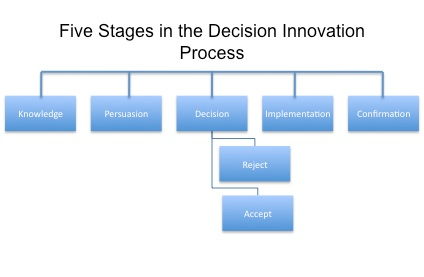
The five stages of adoption
Researchers have identified five stages of adoption that occur during the process of getting all stakeholders positively engaged in change. These are shown in the diagram below. The five stages are
- Knowledge – The person is made aware of the innovation.
- Persuasion – The person becomes more informed of the change.
- Decision – The person compares the advantages and disadvantages of the change and chooses whether to become involved.
- Implementation – The innovation is used. More information may be sought during this process.
- Confirmation – The decision on whether to continue to use the innovation or abandon it is reached.
 Problems revealed at the implementation stage
Getting the late majority and reluctant adopters to the stage where they decide to implement the change may take years. The implementation stage is the point where the school leader may think that the hard work has been done and that implementation will become easier.
Next page: Solutions to the problem
- TC- What student choice and agency actually looks like - November 15, 2016
- What student choice and agency actually looks like - November 14, 2016
- App of the Week: Science sensor meets your smartphone - November 14, 2016
Comments are closed.