
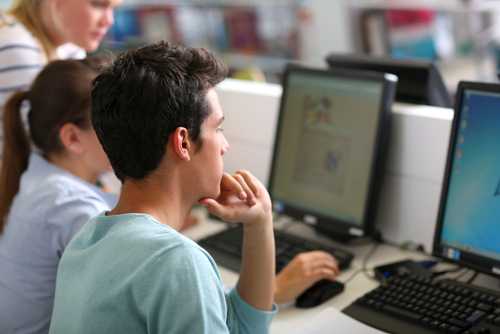
Flex models make use of a brick and mortar campus but most of students’ time is spent in an online environment, although a teacher is present on-site. Some programs, the report notes, make ample use of face-to-face time, such as facilitating group discussions away from computer screens, while others take a more hands-off approach.
In action: Innovations Early College High School, in Salt Lake City, which lets students help create their own learning plan by setting career goals and choosing online or face-to-face courses offered by other high schools or a local community college. For Innovations offered courses, students work through district-developed curricula with on-site teachers who provide individual and small-group instruction, and facilitate group projects. Students are even free to arrive and leave at their leisure between 7 am and 5 pm.
A La Carte, as a model, is exactly what it sounds like: students take a typical class load at their campus but supplement with personally-selected online courses, much like choosing platters off an a la carte menu. The report notes that it does not even have to be a whole school experience.
In action: Washington’s Spokane Public Schools, a district with two blended programs in place: one, a credit recovery program called ICAN, features special on-site classrooms at various campuses where students work through online courses with an instructor present; On Track Academy also serves at-risk students but with the purpose of moving them toward a technical or two- or four-year college degree. Students there have access to various skill centers staffed by qualified teachers who are on hand to work with students toward their set goals.
Enriched Virtual refers to models where students spend some time in a face-to-face environment but then are responsible for completing their work individually, either on-site or at home. “Many Enriched Virtual programs began as full-time online schools,” according to the report, “and then developed blended programs to provide students with brick-and-mortar school experiences.”
In action: Commonwealth Connections Academy, a Pennsylvania virtual public charter, uses drop-in centers to allow its virtual — and often at-risk — students to receive face-to-face instruction while they move through online courses. Workshops in STEM and humanities fields are also offered at the drop-in sites.
For more information about the case studies, read the full report online.
- TC- What student choice and agency actually looks like - November 15, 2016
- What student choice and agency actually looks like - November 14, 2016
- App of the Week: Science sensor meets your smartphone - November 14, 2016