
Inquiry and beyond
The top priority in these projects is not the technology or facilities, but the pedagogy behind using them. “This ideology of inquiry-based instruction is weaved into everything we do,” Wilkes said. “When students take responsibility for their own learning, that’s how you make a cultural change.”
The building will house a digital media lab with 27-inch iMac computers on which students can do everything from Keynote presentations to Garage Band compositions. In the engineering lab, students will be able to design the plans for a glider, for example, on computers, and then build their glider in real life. Students will have access to Z-Space virtual learning tools, on which they can do virtual dissections and other simulations. “It’s similar to Google Glass, in that the students will be wearing glasses and using a stylus to, say, remove a heart from a human body,” explained Wilkes.
The building will also house four external labs, also funded by “Friends of Phenix City Schools,” which solicits private donations for the district. These labs take advantage of open spaces within the building, such as the atrium. “The external labs will be more of a museum type space,” Wilkes said. “Again, we’re the fourth largest Housing Authority in the state of Alabama. This is stuff our students don’t typically have access to.” There will be health and fitness exhibits licensed through the Museum of Science and Industry in Chicago. There will also be a Global Imagination Magic Planet four-foot interactive digital globe, on which students will have access to over sixty Imax movies and other science resources through NASA and The Smithsonian.
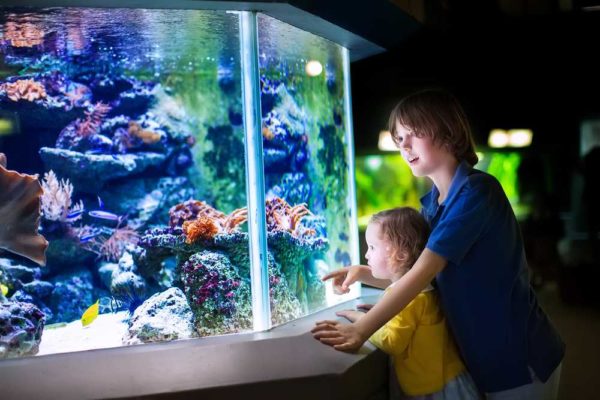
Finally, there are plans for a river tank ecosystem, which will be reminiscent of life in the Chattahoochee. “Our river system is so important and vital to our community,” explained Wilkes. “Clean water is a tremendous issue here.” There will also be a salt-water exhibit with three tanks housing species indigenous to the Gulf of Mexico in one area, species native to the Indian Ocean in another, and a large eight-foot predator tank in the middle of the room. “Half of the sixth and seventh grade science curriculum is relevant to water and oceanography,” Wilkes said, “and a lot of our kids will never have the opportunity to visit salt water on their own.”
The initiative has moved fast. It’s been just over a year since Wilkes arrived at the district, and they’ve already broke ground. “I believe that vision needs to be developed by people within the organization. I actually stood up initially at every meeting we initially had last year and absolutely would not give people a vision. We kept brainstorming and looking at our current situation, and where we needed to go in the world, so this initiative was really developed not by the superintendent but by the people on staff and the people in the community.”
Wilkes believes that collaboration is key to the project’s success. He’s also a big believer in empowering others to dream up big ideas and take risks to make them possible—as a way to motivate them to do their best work.
“We had an assistant principal here yesterday who had phenomenal ideas about what to do with grades nine through twelve,” Wilkes said. “We had a professional learning event for our local school administrators the other day and they had to develop a STEM project, and so many phenomenal ideas came out of that. It’s my job to put a dollar to those ideas and figure out a way to fund them. It’s amazing what happens when you stand back and let people do their jobs. Trust the people you work with. It’s a team effort.”
Wilkes also implores other districts to think big in order to solve big problems. “Don’t be afraid of failure. Be willing to take risks. Play on a big stage at any given chance. The most important factor in making any educational decision is does it positively affect students? Let that principle guide you, and remember, as Ms. Cindy Moss says, ‘Failure is our first attempt in learning.'”
Jennifer Welch is a freelance writer based in Brooklyn, NY.
- TC- What student choice and agency actually looks like - November 15, 2016
- What student choice and agency actually looks like - November 14, 2016
- App of the Week: Science sensor meets your smartphone - November 14, 2016