
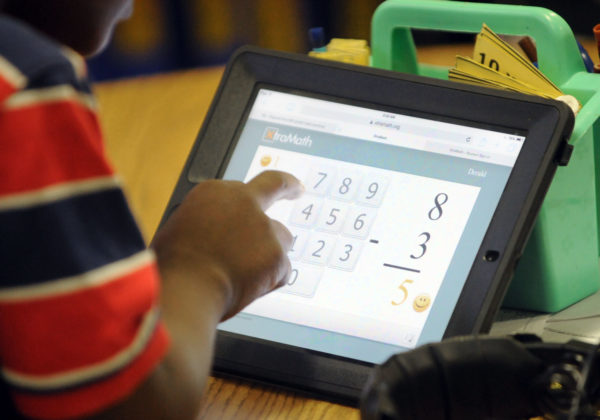
Taking a Blended Approach
A great example of this approach is at Gompers Preparatory School in San Diego, where a large percentage of students are ELLs. Incoming sixth-graders and their parents are given an orientation and log-in instructions for a phone-friendly math app, Learning Upgrade, and introduced to the flipped learning concept where students preview material at home before it’s formally taught in class.
The school shares its expectation that students will complete a full intervention curriculum of math lessons. Students, parents, and teachers buy in to a common goal of completing the curriculum before state testing at the end of the school year. The understanding is that, to achieve the goal, students will need to spend school time and home time, on computers and smartphones.
Many Gompers students have their own mobile phones, and others use their parents’ phones. The school builds in excitement and rewards through certificates, ceremonies, and recognition. And crucially, math teachers see a difference: When students have “pre-learned” a topic in the app, they perform much better when they encounter that topic in the classroom.
Educators need to have a goal to keep ELLs moving towards math proficiency from the very beginning. If teachers can find math resources that are effective with ELLs at school and at home, then students can make continuous progress in math, literacy, and beyond.
- The oral exam is back, and AI may be the reason - September 18, 2026
- Let’s work to keep our students while we still have them - September 17, 2026
- Quit saying “I’m not a math person” - September 16, 2026