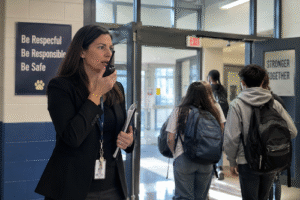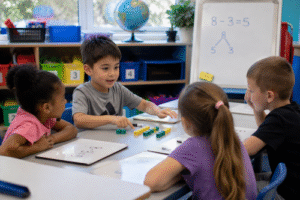
In the Ithaca City School District, we have long understood that relationships are not peripheral to the work; they are the work. A culture of love is not…

Educational research has never been more abundant, yet its impact on classroom practice remains uneven at best. While universities continue to produce studies on instructional strategies, student outcomes,…
Last month, Mesick Consolidated Schools banned digital devices in its elementary school of about 250 students. The decision wasn’t an agonizing one. The ban came at astonishing speed,…
In mathematics education, we have long relied on a familiar sequence: introduce vocabulary, demonstrate procedures, and assign practice. For some students, this works well enough.
In many schools, AI is being handled through individual teacher decisions rather than a shared structure. That makes sense in the short term. Teachers are responding in real…
After 20 years teaching high school math, I thought I understood why students struggled. Then I sat in my first professional learning session focused on early math and…
In many K–12 schools today, fragmented student data has quietly become one of the most significant barriers to effective decision-making and day-to-day operations. While digital tools have expanded…
Does the thought of student-led inquiry make you nervous? For some teachers, handing over control of the classroom to their students sounds like an invitation for disaster.
In recent years, educational research has sparked significant discussion about whether boys and girls learn differently and if gender-specific teaching strategies could enhance academic outcomes.
AI is rapidly reshaping education, but not always in ways that support learning. A growing number of AI tools promise to “help” students by doing assignments, writing papers,…
My first few years teaching math were a struggle for me and my students. Our textbook focused primarily on direct instruction: I do, then you do, but rarely we do.
AI is here, and it’s moving fast. For schools, that speed is both an opportunity and a risk: The right tools can transform learning, but the wrong ones…
Reading is competing for attention in a world built for scrolling. A recent University of Florida study found that the share of Americans who read for pleasure on…
Some might worry that the introduction of AI tools in the English classroom will simply lead to more cheating and even worse literacy rates, leaving students unprepared for…
I once met a student who had attended three different schools before arriving at mine. His parents described him in familiar terms: quiet, disengaged, unmotivated.
The world of work is changing fast. Careers no longer sit neatly within a single industry, city, or even country; they span disciplines, time zones, technologies, and cultures.
Last fall, during a professional development session I was running with a group of teachers in São Paulo, a fifth-grade teacher raised her hand and asked a question…
Schools have seen rising problems with student behavior since the pandemic. For too many K-12 districts, these student behavior challenges are leading to violence against teachers.
Recent updates to the Americans with Disabilities Act means digital accessibility for public educational institutions can not be ignored. It will become a legal mandate.
While nearly every industry is racing to integrate artificial intelligence, most schools are still teaching high school math the way it’s been done for decades--rooted in instructional material…
In other words, while technology can generate information and automate tasks, people still need to evaluate options, weigh tradeoffs, and determine what to do next. These are decision-making…
District leaders across the country are grappling with a deepening crisis: Student mental and behavioral health needs are growing more complex. In a recent national survey, 58 percent…
School leaders everywhere are working to implement change--new initiatives, new instructional frameworks, new technologies, new approaches to student support.
When Senator Bill Cassidy recently questioned whether K–12 systems are adequately preparing students for college-level math, he touched a nerve in the national conversation.
Schools have been struggling for nearly a decade with stagnant or declining test scores. Some have blamed external factors like the pandemic or children’s screen use outside of…
I’ve been a principal for 14 years, during which time I served as the leader of an alternative school, an early college, and a large middle school. Through…
Every school year brings an influx of IT solutions designed to reinvent K-12 education. Schools are primed to jump on the latest technologies to address the issues most…
When I shipped Gramms AI to the App Store, I ran straight into a question that every developer building for kids will eventually face: What does “age-appropriate” actually…
While prevention remains essential, 2025 has reinforced a hard lesson for district leaders: it’s not a question of if a cyber incident will occur, but how prepared a…
If you’re feeling a bit sluggish (rightly so), most likely your students are. It may not feel like they are the prime audience for learning about multiplication, division,…
Data has become one of the most important strategic assets in education. Yet across institutions, publishers, and edtech companies, it often remains fragmented, inconsistently governed, and difficult to…
Last year, a third-grade teacher in São Paulo told me she had "finally found the perfect AI tool." It generated colorful worksheets in seconds. Vocabulary lists, reading comprehension…
Chronic student absenteeism has reached troubling new heights in the post-pandemic K-12 landscape, with one in four students in many systems now missing significant class time.
On the most recent National Assessment of Educational Progress, only about one in four fourth graders in Michigan scored at or above proficiency in reading--a stark reminder that too…
Traditional education models rely on providing rigid pathways for students to follow. They learn a particular way to solve problems and focus on achieving specific outcomes, rather than…