
The vertical extension model
Vertical extension also allows students to remain within the same topic. Learning materials provide greater “depth” of learning and much more detail regarding the underlying knowledge.
This is different to horizontal extension.
Analogy:
This can be thought of as taking a microscope to the topic being studied in order to see greater detail.
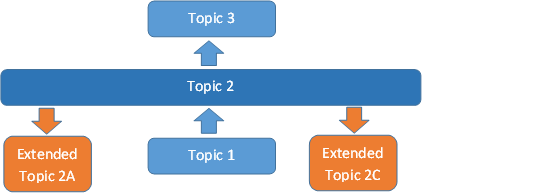
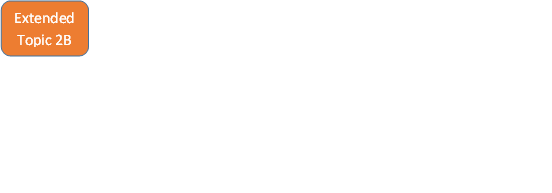
The current topic (Topic 2) is shown in dark blue. A student who completes Topic 2 quickly moves to the vertically extended sub-topics (Topics 2A, B and C), shaded orange. All students in the class then move to Topic 3 at the same time.
 Example:
Continuing with the Geography example, students who are studying Coastal Landforms may then focus in more depth on the processes that create these landforms, namely erosion and deposition. This may include waves, longshore currents, rip currents, tides, temperature variations, wind and gravity. Depending on the depth to be covered, students may delve even deeper into factors such as grain size of eroded materials and the impact of speed of water flow, different types of base rocks and the materials they are made of, their hardness and density, and how this impacts the type of landforms, etc. The list of possible areas of study is extensive.
Role of the teacher: In this model, the teacher has to have produced/made available the extension materials; all of these extra materials need be complete and available to students at the beginning of the course. This may take time to plan, research and implement, and this extra preparation time must be allowed for.
Assessment under this model is similar to that in the horizontal extension model; assessment can be taken by all students at the same time, as the extended students have simply studied the topic in more detail.
The teleport extension model
Teleport extension allows a student to move to a completely unrelated area of learning. This new area is not related to the current topic, or even the next topic of study. However, it remains within the discipline.
Analogy:
This can be thought of as something from a science fiction movie, with the learner being teleported to another location of study; a completely different area of study that holds some interest to him/her. The student is no longer in the same location as the binoculars or microscope mentioned in the previous models, but is in a completely different learning landscape.
- The traditional classroom works so why change it? - February 23, 2017
- Are outdated computers reverting students to a prehistoric era? - November 17, 2016
- Blended learning and the paradox of the experienced teacher - September 30, 2014
Comments are closed.