
When kids learn about real people who lived in the past, they begin to identify with them. They are able to see history as a story made up of patterns and repeating trends, not just a list of facts to memorize. That helps make the topic relevant to students and encourages them to apply those analytical skills to the world around them. When history becomes immediate instead of theoretical, it turns into an adventure instead of a chore. History taught in an immersive way helps students become engaged, excited, and eager to learn more.
Why Choose Games?
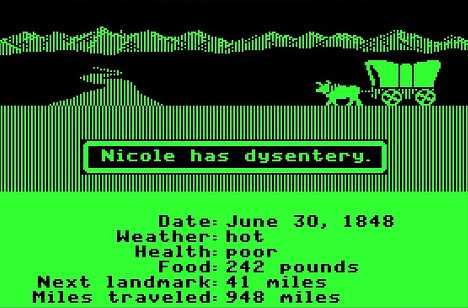
Part of what made Oregon Trail such an effective teaching tool was that it was structured as a game. Playing wasn’t about passing a test, it was about finding a way to get little Mary to the end without a catastrophe. Embedded in that experience was a variety of important information: certain foods are more nutritious or more durable than others; wagons are complicated machines that needed as much upkeep as a car does today; diseases were far more deadly in the past than they are now due to a lack of effective medication, etc. Learning was seamlessly blended with gameplay. Certainly, students learned about the dates the Oregon Trail was used, its geography, and its significance, but they also had a first-hand look into the very real hardships of the people who used it. That emotional connection to historic events is extremely powerful, as evidenced by the number of people who remember what they learned from a short game they played as children decades ago.
Today, with the implementation of the Common Core state standards, there is an emphasis on making text-to-self connections, especially in the primary grades. The evidence shows that when students make an implicit connection between information and themselves, it is more likely the information is remembered later. Immersive games like Oregon Trail ask players, “What would you have done in that situation?” This is more powerful than just physically reading a textbook and absorbing the facts because of its emotional connection and cumulative learning effect. It forces students to draw on what they know and requires them to think differently about the information they’re receiving.
Teachers have always known that games and learning belong together. Now we have remarkable technology available to us that makes the game experience more comprehensive and interactive than ever before. Immersive gaming today quite literally puts students in the shoes of someone else, providing a link between information and experience. These holistic experiences allow players to engage with a certain time period or environment as if they were there. In immersive games, history crosses the standard curricular boundaries and becomes a vehicle to build and apply higher-level skills.
Oregon Trail was groundbreaking when it was first introduced and continues to be the gold standard against which all history games are measured. With the recent focus on STEM, social studies has taken a back seat. STEM is absolutely vital to our kids’ success, but kids also need the tools to analyze, process, and implement information that social studies courses provide. It is my hope that educators will continue to take advantage of the deeper learning provided by the immersive social studies games that have followed in the path blazed by Oregon Trail.
Suzi Wilczynski, a former archaeologist and middle school teacher, is the founder and president of Dig-It! Games, an independent developer of interactive educational games for kids.
- TC- What student choice and agency actually looks like - November 15, 2016
- What student choice and agency actually looks like - November 14, 2016
- App of the Week: Science sensor meets your smartphone - November 14, 2016