
Prince and co-author Jason Swanson, director of strategic foresight for KnowledgeWorks, presented the report during CoSN’s 2018 conference in March.
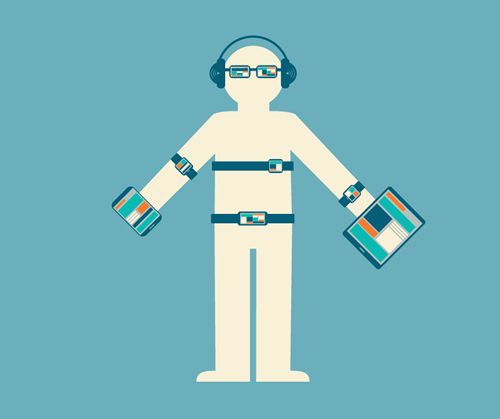
The report explores how technologies such as wearables, AR, and VR could potentially support current learning environments and create new opportunities to engage students, personalize learning, and build learners’ social-emotional skills through a deeper understanding of themselves and others’ experiences.
To help educators and education technology leaders explore these technologies, the paper features in-depth research on the potential future impacts, along with insights and implications for education stakeholders to consider when evaluating potential uses of wearables, AR, and VR.
Educators might be able to use these technologies inside and outside the classroom to add a layer of “digital depth”—the layering and integration of data, computing, and connectivity atop physical reality—to create more responsive learning environments. Three kinds of spaces emerge from the growth of digital depth:
- Enhanced physical spaces are grounded in physical reality but have a thin layer of digital information capture, sharing, and feedback. They have relatively low digital depth. Wearables are effective in creating enhanced physical space.
- Hybrid spaces use multiple digital layers and more extensive computer-generated content, connectivity, and experiences to enable experiences that have a higher degree of digital immersion but which are still anchored in physical space. Hybrid spaces have moderate digital depth. Augmented reality creates hybrid spaces with new capabilities for collaboration, visualization, and creation.
- Fully digital spaces provide full immersion in digitally created environments with little reference to physical space. Because of their high levels of digital depth, they can allow for novel world building and for shifts in identity and perspective through embodiment, or taking on the identity and context of another person or character. Virtual reality supports the creation of fully digital spaces.

- Children learn best on paper: We need better technology, not less of it - July 13, 2026
- In districts, reaching readiness, retention, and success - March 5, 2026
- AI use is on the rise, but is guidance keeping pace? - January 2, 2026