
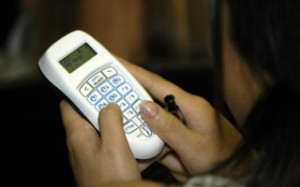
Struggling students can also get extra practice time by using the clickers outside the classroom. Green told the story of a student who entered in sixth grade and therefore missed the charter school’s fifth-grade catch-up year.
“She lacked the foundational math skills to complete sixth-grade work,” he said. “She needed more time and coaching. It was actually her idea to build in the extra time using the response system. She would practice during lunch and enter the answers with the clicker for immediate feedback. If she got it wrong she could reflect on her answer, correct it, and not make the mistake a second time. After catching up quickly, she passed the sixth grade and is currently passing seventh grade. While she had earned only a level 1 on the state exam for her fifth grade at the previous school, she earned a level 4 for sixth grade. She did all the work but the response system gave her the confidence and the extra time and practice she needed. The technology is an intervention that works. It’s not a gimmick, it’s not a trick. It verifies your thinking or challenges your thinking.”
Before the school’s adoption of student response technology, teachers would walk around the room while students were practicing their problems. “They say practice makes perfect,” said Green. “But it doesn’t make perfect, it makes permanent. Students might be practicing incorrectly for quite some time before the teacher got around to them.”
He also noted that student response technology keeps everyone participating. “No one can hide,” he said. “For a teacher, that’s a phenomenal thing. You know if a student is actually working to the fullest of their ability and speed. Better yet, students actually want to participate because it’s fun to use the devices.”
For students, answering via the response pads removes the embarrassment factor. They no longer need to be called to the front of the class for all to see if they got an answer or concept right or wrong. Students who normally remain silent in class now answer every question with confidence. However, Green sometimes projects the results from his computer to a whiteboard for all the students to see.
“Correct answers will pop up green, wrong answers are red,” he explained. “The students can reflect on their responses and rework the problem before moving on to the next. They’re usually able to find and correct the error themselves without any teacher intervention. Seeing their name associated with the answer on the interactive whiteboard is good social pressure. They work their problem much more meticulously.”
This year, Green will open his own school, Brooklyn East Collegiate Charter School, as the principal and plans to use student response systems in the classrooms. “When students come in and see the technology, they feel special and they pay closer attention because they’re using something that’s on their level technologically,” he said.
Enhanced data analysis
Administrators can use the data from the systems to benchmark student progress against proficiency goals. Then they can trend performance and progress over time for classes, demographic groups, and individual teachers and students. Spotting trends, they can drill down to delve into problems and design timely interventions. With accurate, real-time performance data at their fingertips, teachers, administrators, and districts can work more efficiently and make better decisions.
A new learning culture
Derrick Driscoll, a mathematics teacher at Westminster Secondary School, London, Ontario, Canada, has compared the mean performance and failures rates of students in an instant-response enabled classroom with students taught in the traditional manner. In his sample, 1 out of every 3 students in traditional classrooms received a failing grade for the course while only 1 out of 10 students failed classes where the teacher used instant student response data.
When he looked at only formal exam performance–quizzes and tests–the failure rate for traditional classes was 23.5 percent, but only 4.9 percent for classes where the teacher was using instant student response data. Mean performance for classes using student response pedagogy was 73.3 percent, while mean performance for traditional classes was 64.1 percent.
“When used appropriately, technology maximizes learning,” Driscoll said. “The real-time information provided by student response systems changes the entire culture of the classroom. It’s no longer a one-pony show where certain students raise their hands while others have disengaged. Everyone answers every question. This is absolutely critical to moving the class’ knowledge forward and also making the students feel that they are getting one-on-one attention. The act of posing a question and getting their responses via the devices creates the perception in the students’ minds that I care about them more than other teachers.”
Sometimes students disengage out of boredom because they have already heard the things that are being taught. Driscoll mitigates that risk through a streamlined process of pre-testing, assessed remediation, and post-testing. “My focus is on information they don’t already know,” he said. “The pre-test establishes a baseline. Here the class average may be 45, but it’s not punitive.
Driscoll said he tells his students that they will work together on remediation until they reach scores of 80 percent, and then they will be ready for a post-test. And during that process, Driscoll takes measurements to judge the effectiveness of his teaching.
“When you’re sharing with the students that you’re not always perfect, that you’re striving to help them attain a concept while measuring yourself, you’re communicating to them that you’re a different person. Performance is the guiding principle. These pre-test, remediation, and post-test scores are not part of their formal grade, but they participate because it’s part of the process,” he said.
In traditional classrooms, teachers instruct and then give a chapter test at the end of the week. The problem is that if students have misconceptions along the way, the teacher cannot address them until the following week when the class is already into the next chapter. Clearly, assessments such as Driscoll’s pre-test, remediation scores, and post-test have to be seamlessly integrated with instruction. They allow teachers to see throughout the week how students are progressing and to review material as necessary.

- Children learn best on paper: We need better technology, not less of it - July 13, 2026
- In districts, reaching readiness, retention, and success - March 5, 2026
- AI use is on the rise, but is guidance keeping pace? - January 2, 2026