
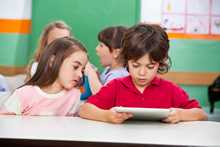
For 9 months, Blackwell compared the impact that iPad use and non-use in the three classrooms had on students’ performance on the STAR Early Literacy Assessment.
She found that students who shared iPads with their peers significantly outperformed students in the other two groups on the spring assessment. Data remained the same after controlling for baseline scores and demographics. In fact, students in sharing classrooms scored roughly 30 points higher than students in one-to-one and non-iPad classrooms.
The research points to the increasingly important role that collaboration plays in classrooms, especially among younger students, and how the combination of collaboration and technology tools can best be leveraged.
“One-to-one tablet computers may not be the most effective way to use technology for all grades and from a policy standpoint, we need to rethink what developmentally appropriate technology use is for young children,” said Blackwell in a statement.
“Shared iPad students significantly outperformed both the one-to-one and non-iPad condition, suggesting it’s the collaborative learning around the technology that made the difference, not just the collaboration in and of itself. While schools and districts may still want to go one-to-one in all grades, they may reconsider how the tablets are used, especially in earlier grades, in order to make the technology most effective.”
Blackwell will present her research, “iPads in Kindergarten: Investigating the Effect of Tablet Computers on Student Achievement,” at the International Communication Association Conference in May.

- Children learn best on paper: We need better technology, not less of it - July 13, 2026
- In districts, reaching readiness, retention, and success - March 5, 2026
- AI use is on the rise, but is guidance keeping pace? - January 2, 2026