
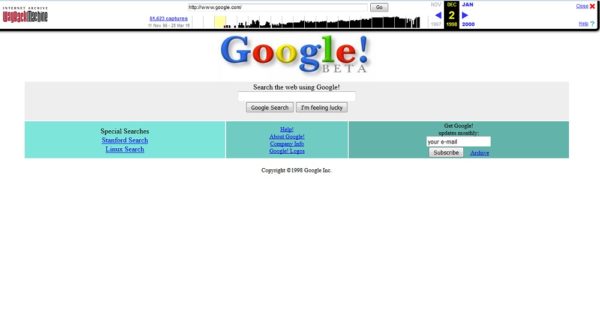
Suppose you ask students to report on the events of Sept. 11, 2001. Most students would Google phrases like “9-11” and “World Trade Center,” and they would find historical accounts of what happened. But imagine how much more powerful it would be for students to experience those events in the moment, as if they were living through them that same day. With the Wayback Machine, they can.
If you go to the Wayback Machine, and you type in CNN.com, you’ll see a timeline at the top of the page. Click on “2001,” and a calendar for the year will pop up. You’ll see that the days from Sept. 11 through the rest of the month are shaded in blue, meaning the website was archived in the Wayback Machine on those days. When you hold your cursor on the 11th, you’ll note that the site was archived three times that day. Click on one of those three links, and you’ll see the horrific photo of the World Trade Center being hit by a plane. All the links on the main CNN page work. It is truly a time traveling experience. You are seeing CNN’s coverage as if you are sitting in front of your computer in 2001. Imagine the lines of enquiry you can develop!
Compare that to a Google search, where you’re reading an account of the events that most likely was written years later. You’re not actually experiencing history as it’s happening. The difference is remarkable.
Experiencing recent history in the moment is a great benefit, but I was talking with a math teacher from Texas who had another innovative use for the Wayback Machine. She had her students look at the prices of goods on Wal-Mart’s website from 10 years ago and compare them with the prices today. Her students noted that certain items have gone up in price during that period, while others—such as TVs—have come down in price. She had her students do a mathematical analysis of the rate of change over time, and then they discussed why some items have gotten cheaper while others have become more expensive.
A science teacher I know used the Wayback Machine to have students look at how the thinking around climate change has evolved over time. Science isn’t as definitive as we often make it sound, and with the Wayback Machine, we can see how the scientific community has changed its opinion. We can also track how companies or organizations have changed their messaging around an issue.
The Wayback Machine also has important implications during an election year. You might ask students, “What did the candidates say about health care 10 years ago, and how does that compare to now?” With the Wayback Machine, they could find out rather easily. It’s much harder to hide.
There is this disturbing website I often refer to in my talks, MartinLutherKing.org, which is owned by a white supremacist group called Stormfront. If you put the web address into the Wayback Machine, you can see how it has changed since its launch in 1999. None of the text is the same; none of the images are the same. What’s interesting is that when it started out, it clearly was geared for adults. Over time, it became much more geared toward children, and the language on the website reflects this change: “Download flyers for your school.” That wasn’t there in 1999, but it’s there today.
Tracking the development of ideas and of messaging over time leads to rich lines of inquiry for students. By analyzing how the text, images, and other content on websites have changed, students can develop an understanding of how somebody tells their own story. This gives them a concept they wouldn’t understand if they were just looking at the site at any one point in time. It’s quite revealing.
Using the Wayback Machine can lead to some very deep reasoning in schools—from how you present yourself on the internet, to how you find missing links online, to how students can develop thoughtful lines of inquiry about how ideas change over time. How do different people or organizations change their story? What influences them? From experience, I have learned that as essential as it is to search the history of the web, many students do not know it exists. They need us to teach them how to use it.
- TC- What student choice and agency actually looks like - November 15, 2016
- What student choice and agency actually looks like - November 14, 2016
- App of the Week: Science sensor meets your smartphone - November 14, 2016
Comments are closed.