
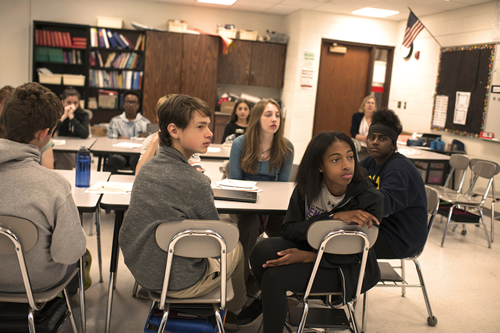
For the past six years, I’ve taught high school students in Washington D.C. about race, class, and gender in an elective course I created on social justice and Holocaust and genocide education. This year, with a news cycle that never sleeps and a student body with the internet at their fingertips, discussion of sexual harassment, hate, bigotry, prejudice, and oppression will be inevitable—and that’s a good thing.
I return to my classroom with renewed purpose: I must give my students the tools and courage to engage in intelligent, but intense, conversations with the power to inspire positive change. Adopt these five guiding principles to engage your students in courageous conversations.
1. Teachers must make themselves vulnerable.
It is important for teachers to make themselves vulnerable by discussing how these conversations affect them. During a conversation about gender, a student asked me, “So what is your role in this?” I had to pause and reflect the role I, a cis gendered male, play in the systemic oppression of women. I had to respond honestly to that question by acknowledging my male privilege and then bring it back to the conversation at hand. Once students realized I was not removed from the conversation, but a part of it, they were more open to discussing their own identities and stories.
Over the years I’ve taught about race, class, and gender, I’ve realized the more I talk about how I am both affected by these identities and the role I play in these identities, students are more likely to be honest about how their identities impact their lives and other individuals.
2. Create spaces of trust and safety—the conversation is not safe, the space is.
Creating a space where students feel comfortable having courageous conversations is crucial to facilitating honest dialogue around difficult topics. However, they must also understand that others in the room may challenge them on these ideas or personally held beliefs. I always make sure to remind my students that “the space is safe, but the conversation is not.” By this I mean, students have the ability to say what is on their minds and express notions that they have held or have been taught by parents or society without fear of being labelled for these ideas. However, students need to also understand that by being a part of this space, whatever they say, and whatever ideas they are bringing into this space, can and will be challenged.
To facilitate these discussions and ensure students do not feel attacked, I use the Accountable Talk Protocol, where students speak in “I statements” of I feel, I think, I believe… Thus, students can have ownership over what they contribute to the conversation and acknowledge the personal nature from which other students respond to their opinions and statements.
- Beyond the game: What schools must get right about student well-being in esports - November 10, 2026
- Moving beyond plaudits: The anatomy of effective recognition - November 9, 2026
- 5 signs a student is struggling in the post-literate era - November 6, 2026