
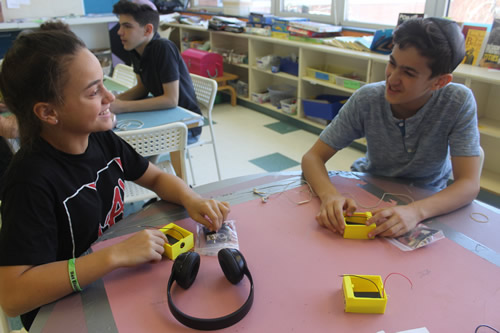
This past July, educators from the Solomon Schechter Day School of Bergen County arrived in the impoverished Mbekweni community in Paarl, South Africa to help open a first-ever library for the 1,500 students of the Langabuya School. They also delivered a stock of solar-powered reading lights designed and built by Schechter’s sixth graders.
Having learned about the compelling needs of this resource-challenged community, Schechter’s students helped purchase 1,000 English-language books, printed 500 in the students’ native language of Xhosa, and supplied simple solar-powered devices for Langabuya students—many of whom do not have electricity at home—to check out books and read them at night.
The natural extension to Schechter’s values-based global framework is the fall 2018 opening of the hands-on Popkin Innovation Lab, named after its generous alumni donor. The lab is equipped with cutting-edge technology that will empower students to solve real-world problems. They will learn to design, build, prototype and test potential solutions using a range of tools, including a sand blaster, a laser cutter, and a 3D printer, just to name a few.
The lab is meant to spark students’ creativity with the goal of tikkun olam, the concept in Judaism of helping repair our world. Even more so, it is meant to help develop students’ ability to question, dream, and test the ways in which they can benefit the world around them through design thinking, a hands-on method that challenges conventional thinking and pushes students to redefine problems so they can come up alternative strategies and solutions. At the same time, design thinking provides a solution-based approach with real people in mind.
At Schechter, the combination of a values-based education; hands-on, inquiry-based learning; and the integration of technology has proven to be a powerful tool in helping students develop a strong moral compass, one of four core pillars of the school.
1. Technology requires students to understand real-world consequences
Technology is an audience-widener. User-focused projects, coupled with purpose-driven use of technology, challenge students to engage with a broader audience and consider special circumstances or needs. For example, as students began designing solar-powered lights for students in South Africa, they realized that they could not provide even the simplest of assembly instructions in English to a largely non-English-speaking student body. They would have to design a product that could be quickly assembled with instructional images, including ways to repair a faulty light.
2. Technology fosters commitment and teamwork
When students designed the solar-powered lights for the Langabuya School, they had to work together to deliver a product on time that worked. They relied on collaboration and teamwork for the lights to be ready in time to be shipped to South Africa.
3. Students can develop their passions for helping others much earlier in life
Thanks to ubiquitous nature of technology and access to data and information, today’s students are no longer challenged to purely find the answer; they are being taught much more about framing the questions. As an authorized International Baccalaureate World School that focuses on cultivating international-mindedness through values and action, Schechter built its Innovation Lab as part of its transformational educational framework. This means there has been a shift away from content-based learning and recall to an ever-expanding learning environment that teaches students to draw up and synthesize a spectrum of information across all subject areas to help understand and empathize with the problems of others and come up with ways to help.
Teachers at Schechter are equipped with strategies and tools to help students identify the questions most important to them—and this ignites students’ academic, social, and emotional passions around learning.
4. Students see the world in a problem-and-solution model
Our new Popkin Innovation Lab was designed as a focal point for teaching students how to identify a problem and develop a real-world solution as they learn to work together as a team. This lays the groundwork for teaching “harder” skills such as programming, electronics, design, and computer-aided design, as well as “soft” skills such as how to work as a team, how to present and pitch a new idea and potential solutions, how to evaluate the proposed solutions of others, and how to learn from failure.
Given the rapidly changing job climate, students need both hard and soft skills to be able to solve problems and take it to the next level: developing empathy and compassion for others by devising solutions to problems in their communities and the greater world around them.
5) Technology allows for students to connect with others in developing countries
Technology gives students a window into the lives of others, often helping them recognize a range of issues. It helps provide them with tools to think beyond their immediate environment and empower them to dream of ways they can facilitate change. They begin to see that technology not only builds understanding, but also can be a powerful tool to help conquer real-world problems.
- Summer reading for teaching and school improvement: Harnessing the Science of Learning - July 24, 2026
- My son wasn’t dyslexic—he was never properly taught to read - July 23, 2026
- Chronic absenteeism isn’t the problem–it’s the signal - July 22, 2026