In 2023, Catherine Hartmann, a professor at the University of Wyoming, gave students in a history of meditation course a deeply personal assignment: try a contemplative practice and…
Every few years, something shifts how schools think about accessibility. A law changes, a new technology arrives, or a group of advocates succeeds in bringing attention to the…
A new national framework from AACTE (American Association of Colleges for Teacher Education) aims to help educator preparation programs (EPPs) navigate the rapidly changing role of artificial intelligence…
I’ve sat across from more than one district administrator staring at a dashboard full of reading intervention minutes and a flat progress line. The pattern is familiar: a…
Long before computers entered our homes and classrooms, photographs helped shape what people believed. Images carried a particular kind of authority: We did not simply look at them;…
As the school year begins, teachers often devote significant time to planning lessons, reviewing standards, organizing classrooms, and establishing routines. While these are all essential components of effective…
There’s a wise quote that says, “Kids don’t care about your expectations until they know you care about them. Connection is the foundation everything else stands on.”
Adolescence is one of the most consequential periods of human development, yet the environments designed to support it often fail to reflect its complexity. Spanning ages 10 to…
In first grade, educators shape the trajectories of how students feel about math. Long before they discover algebra or standardized tests, six- and seven-year-olds are forming beliefs about…
As the Director of Maintenance and Operations for 42 campuses across our district, my work is never small. From managing facilities and construction to navigating procurement and public…
Schools today are navigating an unprecedented convergence of academic gaps, behavioral challenges, chronic absenteeism and rising student mental health needs.
As school districts prepare for the 2026–27 academic year, new national data from BlazerWorks reveals a growing staffing crisis across K–12 education, with more than 90% of district leaders reporting increased…
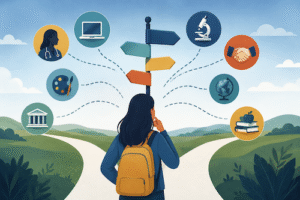
A post-graduation readiness report by YouScience found that the majority of graduating high school seniors lack confidence in their post-graduation plans, including choosing a college, paying for it,…
The answer to stagnating test scores is not adopting technology that has never demonstrated any ability to move test scores. Educators have to finally recognize that hope is not a strategy…
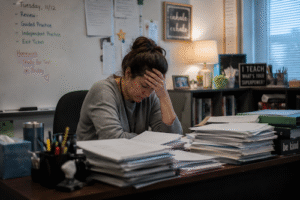
Teacher stress declined modestly in 2026, but teachers were still far more likely than similar working adults to report higher stress, worse well-being and greater financial strain, extending a…
“Maybe we have too much teacher training.” That headline is a sentence I never thought I’d write, given that I run a company built around supporting teachers’ professional…
AI plays a supportive educational role for nearly 70 percent of top-performing math students asked about their study habits, according to a new survey.
In mathematics education, we have long relied on a familiar sequence: introduce vocabulary, demonstrate procedures, and assign practice. For some students, this works well enough.
In many schools, AI is being handled through individual teacher decisions rather than a shared structure. That makes sense in the short term. Teachers are responding in real…
In recent years, educational research has sparked significant discussion about whether boys and girls learn differently and if gender-specific teaching strategies could enhance academic outcomes.
I once met a student who had attended three different schools before arriving at mine. His parents described him in familiar terms: quiet, disengaged, unmotivated.
Schools have seen rising problems with student behavior since the pandemic. For too many K-12 districts, these student behavior challenges are leading to violence against teachers.
District leaders across the country are grappling with a deepening crisis: Student mental and behavioral health needs are growing more complex. In a recent national survey, 58 percent…
School leaders everywhere are working to implement change--new initiatives, new instructional frameworks, new technologies, new approaches to student support.
Chronic absenteeism has stabilized at historically high levels, signaling a long-term engagement challenge rather than a short-term pandemic disruption, according to a new national white paper released by…
The dominant narrative around today’s students is bleak: declining test scores, post-pandemic learning loss, and widespread concerns about student behavior and mental health.
While prevention remains essential, 2025 has reinforced a hard lesson for district leaders: it’s not a question of if a cyber incident will occur, but how prepared a…
Chronic student absenteeism has reached troubling new heights in the post-pandemic K-12 landscape, with one in four students in many systems now missing significant class time.
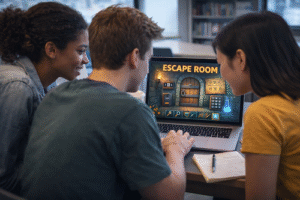
Have you ever been to an escape room? For those unfamiliar with the term, an escape room is a structured, problem-solving experience where participants are locked in a…
Across the country, schools are raising alarms about chronic absenteeism. News stories highlight rising numbers of missed days, legislators are demanding answers from districts, and educators are feeling…
In our district, families were checking multiple apps just to keep up with school communication. One child’s teacher posted in one platform. Another school used something different. District…
In just one academic year, Marietta City Schools in Georgia saw the percentage of elementary English learners (ELs) working in or above grade level rocket from 11 percent…
Microschools are small learning environments that typically serve a limited number of students and emphasize personalization and strong relationships. Often blending elements of traditional schooling, project-based learning, and…