
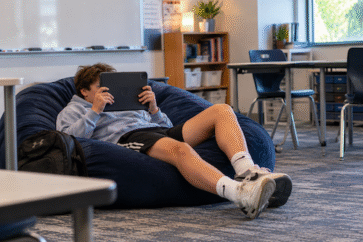
Denver is opening more specialized classrooms as the number of students with autism grows
As the number of children identified with autism rises nationwide, more students are needing special education services
The autism center at Denver’s West High School is twice as big as a typical classroom and more than half as empty. That’s intentional: These specialized centers are meant to have fewer students, more adults, and be a more versatile space.
Top Stories
Cheating is not the problem–it’s a solution (in a zero-sum educational system)

In a TED Talk viewed over 2 million times, Efosa Ojomo of the Christensen Institute made the provocative case that corruption isn’t the problem holding poor countries back. Corruption is the solution for people in poor countries to make progress when facing scarcity around basic needs like food, education, health care, economic opportunity, and jobs.
Parents worry about ed tech. Most still see a place for it, polls suggest.

Some parents are organizing campaigns to opt their kids out of classroom tech. Others are suing education software companies. But there may be a quieter majority: Parents who support some screen time in schools.
5 strategies to boost U.S. K-12 math achievement

A new report from the Center for American Progress details the underlying causes behind this decline and highlights promising solutions to improve math outcomes and outlines five specific policy-based strategies to boost math achievement nationwide.
What E-Rate makes possible: Four lessons from our district

For nearly three decades, E-Rate has helped school districts build and sustain the network infrastructure that supports teaching, learning, safety, and the many systems educators rely on every day.
Teachers weigh the realities of classroom technology in new national survey

While classroom technology is nearly universal, educators are navigating a growing disconnect between how digital tools are mandated and how they actually function, according to Teaching for Tomorrow: Screen Wise, a new report from the Walton Family Foundation and Gallup, in partnership with the Joan Ganz Cooney Center.
An early childhood classroom: Supporting emotional well-being amid everyday challenges

Early childhood classrooms are seeing a clear shift. Young children are starting school feeling increasingly worried and overwhelmed compared to years past.
Inspiring curiosity for career exploration and mentoring for pathway success

In my eight years as a high school CTE, Engineering and Architecture Pathway instructor, I have witnessed students and their families struggle to navigate their career trajectory. Every year, I hear three scenarios: “I think I know what I want to do,” “My parents want me to be a…,” and “I have no idea what I want to do.”
Beyond book displays: How to build lasting support for your school library

When school librarians hear the word marketing, many immediately think of newsletters, social media posts, bulletin boards, or eye-catching displays. Those tools certainly have their place, but they’re only part of an effective marketing strategy.
EDUCATION RESOURCE CENTERS
Evaluations That Elevate: Moving Your District From Compliance to Growth

What if evaluation felt less like paperwork and more like progress? Observation cycles, rubric scoring, summative ratings, SLOs, and growth plans shouldn’t live in disconnected systems. Explore how one platform helps HR directors, superintendents, and instructional leaders bring it all together — for every employee, every role, every district.
Sponsored Content
Why interactive solutions are a smarter investment for schools

School IT leaders face a constant balancing act to deploy technology that enhances learning while keeping systems secure, manageable, and cost-effective.
Advancing digital equity through teacher leadership

Meaningful opportunities for teachers to build expertise and leadership beyond their classroom add to a sense of professionalism and fulfillment. In an age when the role of technology in education is rapidly changing, why not allow teachers to lead the way?

Why interactive solutions are a smarter investment for schools

School IT leaders face a constant balancing act to deploy technology that enhances learning while keeping systems secure, manageable, and cost-effective.
Wearable tech helps students overcome central vision challenges

Central vision loss–a condition that impairs the ability to see objects directly in front of the eyes–can have profound academic and social impacts on K-12 students.
