
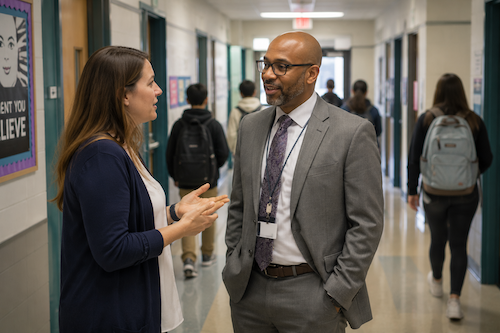
A new principal's job is not to change the school--it is to spend the first year understanding the school culture.

4 things new principals can do to strengthen school culture


A new principal's job is not to change the school--it is to spend the first year understanding the school

Key points:

Over the last 15 years, I have observed a recurring pattern. A new principal, whether brand new to the role or a veteran principal arriving at a new school, wants to make an immediate impact. It makes sense. We want to show that we were the right choice for the job. We want to demonstrate that we are willing to work hard and improve things. We want to help.

I remember arriving at one school and immediately wanting to give the librarian feedback. I had opinions about how the library was organized, which books were displayed, and even the posters hanging on the walls. In my mind, I was helping.

Luckily, a wise veteran teacher pulled me aside and shared some important context. She explained that the librarian’s most important role wasn’t organizing shelves. It was creating a safe and welcoming space for students, especially those who were new to the school. She spent countless hours building relationships with children and reaching out to families. The issue wasn’t that the librarian wasn’t doing her job. The issue was that she needed more support. The better solution was hiring a library aide to help maintain the collection so she could continue focusing on the work that mattered most.

Over the years, I have observed a second pattern. New principals who rush to make changes rarely get the results they are hoping for.

Even when our intentions are good, quick changes can leave teachers and staff feeling undervalued. They can send the message that the new leader has already decided what is broken before taking the time to understand why things are done the way they are.

After leading in multiple schools, I have come to believe that the opposite approach is far more effective. Except for urgent child safety concerns, a new principal’s job is not to change the school. It is to spend the first year understanding the school.

Here are four things I do to help me understand a school before trying to lead one.

1. Invest in relationships before initiatives

    The most important work in your first year is building relationships with every single person on your campus, from the custodians to the front office staff to the students to the teachers. If they are a human being on your campus, take the time to get to know them.

    In a smaller school, this can be done through individual meetings with teachers. I typically schedule 15 minutes with each teacher and ask questions such as:

    • What do you enjoy most about working here?
    • What challenges make your work harder?
    • What are our students’ greatest strengths? What are their greatest challenges?
    • What support would you like from the administration?
    • If you could change one thing about our daily operations, what would it be?

    In larger schools, this can be done through grade level or department focus groups. In really large schools, it can be done through a Google Form. However you do it, the goal is the same: Be curious, listen, and seek to understand. I ask follow-up questions and take notes. Not every piece of feedback will be objective. Some people will have agendas. That’s okay. If you listen carefully enough, patterns will emerge. The goal is not to solve every problem. The goal is to understand the people you serve.

    I get to know students by walking around during breaks, welcoming them off the bus in the morning, and making myself a regular presence in the hallways during passing periods. In the mornings, I tell students, “Good morning, we’re glad you’re here today.” I ask about the soccer game they played last weekend, their favorite YouTuber, the book they’re reading, or the latest project they’re working on. I comment on artwork displayed in the hallways or congratulate them on a performance or accomplishment. In the afternoon, I tell them to have a great afternoon. The goal is to become such a familiar part of students’ day that they don’t think twice about seeing you in the hallways.

    We all know that teacher aides, nurses, custodial staff, security personnel, and front office staff can make or break a school. They are often the hardest-working people in the building and hold an incredible amount of institutional knowledge. I make a point of checking in with them several times each week, thanking them for what they do, and asking how I can support them.

    These conversations take time, but they are never time wasted. They are the foundation upon which every future decision, initiative, and improvement will rest.

    2. Observe and appreciate what is already working

    When you arrive at a new school, it is easy to focus on what needs to be fixed. Every school has challenges. Every school has things that could be improved. But every school also has strengths. Your job during the first year is to find them. Before you can build on a school’s strengths, you first have to notice them.  

    Notice the teacher greeting students at the door.

    Notice the spotless bathrooms.

    Notice the kind way a teacher speaks to a student.

    Notice students laughing as they enter a classroom.

    Notice a well-paced lesson or a creative project that engages learners.

    Notice a safety monitor who has developed positive relationships with students.

    I’m sure it goes without saying, but you cannot notice these things from your office. That’s okay, because if you followed the advice in #1, you’ve already made a habit of walking around your building. If you oversee multiple buildings, assign each day of the week to a different location and spend ten minutes there in the morning and ten minutes there in the afternoon.

    Noticing is only the first step. The second, and even more important step, is acknowledging what you have noticed.

    Send a short email: “I appreciated the way you spoke to that student in the hallway. You maintained high expectations while showing respect.”

    Send a text: “I just walked by your classroom, and I loved hearing the kids laughing! An elementary school should be full of joy.”

    Leave a sticky note: “I noticed students discussing your poetry activity in the hallway. They were excited about what they were learning.”

    Tell them in person: “Your morning meeting was spectacular. What a great way to set the tone for the day.”

    Mention the observation during a staff meeting: “I was in the Grade 8 team meeting the other day and was impressed that they started with student concerns before moving on to the logistics of their Social Studies Fair.” Public appreciation serves two purposes. It recognizes great work, and it quietly communicates what you value as a leader.

    Make a personal goal to authentically appreciate three people each day. This appreciation should not necessarily be clinical observations of standards being met, but celebrations of connections being made.  Keep track to ensure you are not just noticing the teachers who are louder, more visible, or whose classrooms happen to be closest to your office.  Over time, those moments matter. Think of them as deposits into a trust account. The more deposits you make, the more trust and goodwill you build. And when the time eventually comes to lead change, that trust will be one of your most valuable assets.

    3. Understand before you change

    You are finally in charge of your own building, and you have so many ideas! A great podcast you listened to, an article you read, or the exact opposite of what your last principal did.

    Let me stop you right there.

    For the entire first year, don’t do any of that.

    Obviously, if it is a district mandate or a child safety issue, do your job. Beyond that, resist the urge to start implementing new initiatives. Instead, spend your time gathering data, asking questions, and seeking to understand.

    When I first arrived at a new middle school, I was surprised to learn that there was no advisory or social-emotional learning program. Advisory programs provide students with a consistent adult advocate and a sense of belonging. Explicitly teaching skills such as self-management, communication, goal-setting, and responsible decision-making helps set students up for success both in school and in life.

    It was very tempting to begin implementing programs that I had seen work in other schools. But this was too important to get wrong. Instead, I spent the entire first year asking questions and gathering both anecdotal and numerical data.

    I asked questions such as:

    “What have people tried before?”

    “When did this practice begin? How did it go?”

    “What problem was it originally designed to solve?”

    Through those conversations, I learned that the school had tried an advisory program before, but it had not been successful because the program did not meet the needs of our diverse student population.

    Through staff surveys, I learned that some teachers did not believe we needed dedicated time for social-emotional learning because, as one teacher put it, “Our kids all get along.”

    Then we conducted student focus groups.

    To everyone’s surprise, students consistently told us that they wanted more structure and opportunities to build connections and a stronger sense of belonging.

    After an entire year of listening, gathering information, and studying the data, we came together as a staff, reviewed what we had learned, and determined our next steps.

    (Spoiler alert: Five years later, we have a custom designed and robust advisory and social emotional learning program called LifeSkills.)

    Every system has a history. Understanding that history helps you avoid repeating mistakes and positions you to make better decisions in the future. By year two, you will have the context, relationships, and credibility needed to improve things collaboratively rather than imposing solutions.

    4. Find your own leadership true north

    During your first year in a new school, you are building the foundation for a culture that will support you for years to come. You are suspending judgment and approaching people and systems with curiosity. You are gathering data, learning the history of the school, and beginning to understand what makes the community unique.

    At the same time, you should be asking yourself an important question: What is the principle that will guide me when things get tough?

    And they will get tough.

    You will face difficult parent conversations. Staff disagreements. Budget decisions. Questions about student discipline. Competing priorities. In those moments, having a clear leadership compass helps you stay grounded and make decisions that are consistent and transparent.

    For me, that compass is a simple question:

    What is best for kids?

    I use those exact words all the time. I use them in meetings when we are discussing a new initiative. I use them when teachers come to me for advice or support. I use them when we are working through disagreements. I even have the phrase displayed on a light box in my office as a daily reminder.

    The reason it works is that it shifts the conversation away from personal preferences and back to our shared purpose. We may not always agree on the answer, but we can usually agree on the question.

    A colleague of mine uses the phrase, “Every kid, every day.” Another leader I admire often asks, “Will this decision help us build the kind of school we want for our students?” The specific words matter less than having a guiding principle that keeps you centered when the work becomes complicated.

    During your first year, don’t rush to create a vision statement or launch a strategic plan. Instead, listen, learn, and pay attention to what matters most to you as a leader. Over time, your true north will emerge.

    When it does, hold onto it. It will guide your decisions, shape your culture, and remind everyone why the work matters in the first place.

    Being a school leader is a huge honor and an even bigger responsibility. The school leader sets the tone and is the biggest influencer of school culture. The strongest leaders are the ones who listen carefully, appreciate what is already working, take the time to learn why things are currently the way they are, and earn the trust of the people they serve. There will be time to introduce new ideas, but first walk the hallways, ask questions, celebrate people, and soak it all up. By taking the time to understand your new school deeply, you will be setting yourself up for years of success.

    Sign up for our K-12 newsletter

    Name
    Newsletter: Innovations in K12 Education
    By submitting your information, you agree to our Terms & Conditions and Privacy Policy.

    Want to share a great resource? Let us know at submissions@eschoolmedia.com.

    eSchool News uses cookies to improve your experience. Visit our Privacy Policy for more information.