
Key points:
- Camera-sharing capability bridges securely connects existing school cameras to emergency communication centers
- Comprehensive school safety planning protected our teachers and students
- How location precision enhances safety and reduces response times in emergencies
- For more news on school emergency operations, visit eSN’s Educational Leadership hub
School safety emergencies are inherently chaotic, frightening, and made even more perilous by a lack of real-time visibility once an emergency is underway. In an active shooter incident, first responders often arrive at the scene with little or no knowledge about what is happening inside the school.
Nearly every public school has security cameras. According to the National Center for Education Statistics, 93 percent of schools had video surveillance systems as of 2021, up from 61 percent a decade earlier. Yet during an actual emergency, the people coordinating the response, the 911 dispatchers, can’t see events as they take place.
They are effectively blind to what those cameras capture. The gap isn’t about technology; it’s about access. The cameras are there and the footage exists, but it stays locked inside school systems, out of reach for the people who need it most in real time.
Live video changes how emergencies are handled
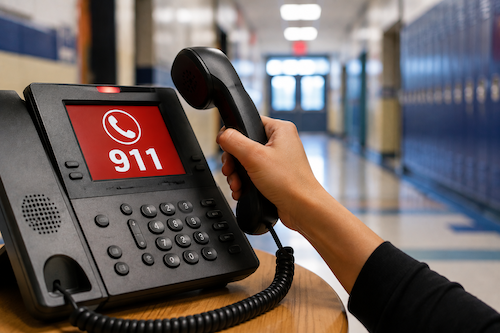
Camera-sharing capability bridges that gap by securely connecting existing school cameras to emergency communication centers (ECCs). When an incident occurs, 911 dispatchers can instantly access live video feeds without having to rely on secondhand updates.
With real-time visibility, dispatchers can relay specific, actionable information to first responders, such as where a suspect is located, who’s in danger, which areas are unsecured, and whether a weapon is visible.
That kind of critical visual intelligence shapes decisions before anyone arrives on scene. Without it, responders are forced to rely on fragmented information, often seconds or minutes behind reality.
There’s widespread public support for adopting this technology. A recent survey found that 96 percent of parents support sharing school camera feeds with ECCs during active shooter scenarios or similar emergencies.
While privacy concerns must be addressed, often they are not framed in the right context. These systems are not engaged in continuous monitoring or expanding surveillance. They are not in place to assess a teacher’s effectiveness in the classroom or to monitor students’ daily behavior. Access is limited to the duration of an actual emergency, ensuring privacy is maintained during normal situations.
Controls can be tightly implemented with clear rules about who can view it and for how long. The goal isn’t more oversight or gathering and sharing data on students; it’s to ensure better information in critical moments.
Camera sharing also pairs naturally with early-warning technologies like AI-based gun detection. These systems can flag potential threats in real time, giving responders a clearer picture before they arrive.
- We urgently need to rethink media literacy education–here’s how I did - October 9, 2026
- E-Rate’s quiet impact on student success - October 8, 2026
- We need a continuous K–12 literacy system - October 7, 2026