
Students are Asking about STEM Careers
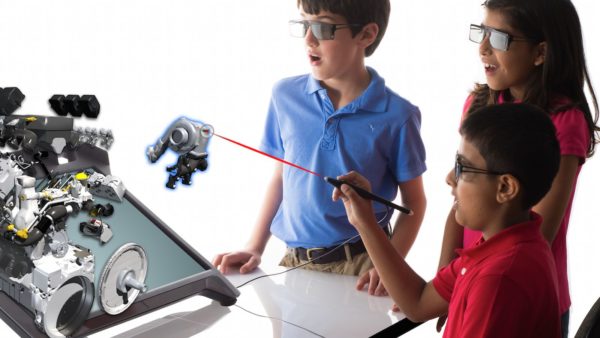
At Franklin Square, each of the district’s three K-6 schools has a lab of 12 zSpace all-in-one computers. Every classroom goes into the lab at least once a week for a STEM lesson that supports whatever they’re learning in the classroom–earth science, physical science, biology, mathematics, engineering, and even social science.
Maura Gallagher, the assistant superintendent of curriculum and instruction at Franklin Square, explained how the district has made some changes since its first year with zSpace.
“We had fewer units in year one, so we had about three students to a computer. One of them would usually tune out,” said Gallagher. “Now, we have enough units to have a 2:1 ratio of zSpace units per student. This configuration encourages collaboration and cooperative learning. Kids are taking turns and having discussions.”
Gallagher was both surprised and thrilled that VR was prompting students to be more curious about what STEM subjects are and how they might be useful in their lives.
“It’s opening doors for them. This is a foundational time in their educational lives, and they’re already starting to make connections between what they’re learning with zSpace and how they can apply these concepts in real life,” she said. “I don’t think I’ve ever heard students this young spontaneously ask about careers in fields like botany or medicine.”
Teachers are Excited, Too
Right now, the district’s STEM teacher is doing most of the work with the students and the zSpace lab, but Gallagher and Trotta say that the possibilities have ignited the teachers’ imaginations as well.
“The other week, we had a teacher go to the zSpace lab to look at elephant vertebrae,” said Trotta. “I’ve also seen social studies teachers use it to demonstrate the size and shape of ancient objects. zSpace has a library of items that includes things like the first printing press and the Parthenon. If you can’t see those things in real life, you can see them in zSpace.”
As classroom teachers begin to plan more lessons that include zSpace, they can use the existing lesson plans that are included with the zSpace software, or they can easily modify lessons. All projects and activities are aligned with both Common Core and Next Generation Science Standards (NGSS).
The educators, parents and students at Franklin Square consider their first foray into VR a success, and plan to continue the program, knowing that VR will continue to become more commonplace in our everyday lives.
“I wish I would have had this as an elementary student,” said Trotta. “It would have been a lot easier to learn some difficult concepts. Luckily, today’s students have the tools to have a hands-on experience with just about anything, from cells to planets. A textbook can’t bring that to life. It’s a whole different level of engagement.”