
Key points:
- Schools need to encourage and support career exploration programs
- Career readiness in the AI era needs decision practice, not just tool access
- Education in a connected world: Preparing students for global careers
- For more news on career exploration, visit eSN’s Innovative Teaching hub
In my eight years as a high school CTE, Engineering and Architecture Pathway instructor, I have witnessed students and their families struggle to navigate their career trajectory. Every year, I hear three scenarios: “I think I know what I want to do,” “My parents want me to be a…,” and “I have no idea what I want to do.”
Most families and students subscribe to the idea that post-secondary education is the best viable option for future success, but there is no one-size-fits-all pathway to success. The first step to finding the pathway that best suits each student is introducing them to a variety of options.
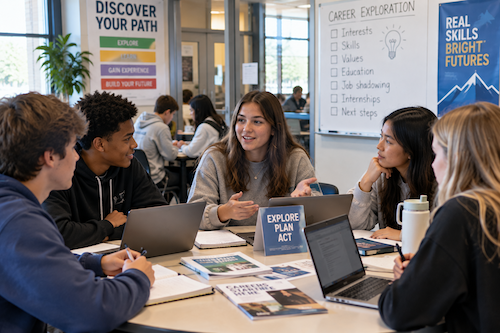
Imagine the variety of pathways a student may be inspired to consider if they were introduced to 50-100 career guest speakers while in high school and had the opportunity to participate in hands-on career-readiness curriculum. At Ruben S. Ayala High School, we strive to expose all students to a multitude of career options through the Project Lead The Way (PLTW) curriculum, our after-school Architecture, Construction, and Engineering (ACE) Mentorship program, and an industry guest lecture series featuring 25-30 speakers per year who share their career journeys.
I recall my first week teaching, when a 9th grader approached me and explained that she wanted to become an aerospace engineer someday. I told her how much I appreciated her sharing her dream with me and informed her that over the next four years, I would do my best to offer a multitude of career exploration opportunities and guest speakers to share their story. Over the course of several years in the pathway, dozens of guest speakers and a job shadowing opportunity that grew into an internship, the student approached me in the fall of her senior year and said, “I now know what I want to do with my life: I want to study environmental civil engineering, with a focus on water.”
Since then, that student has gone on to graduate from Berkeley’s civil engineering program, held over five water internships, and recently co-presented with me at the nation’s largest water conference sponsored by the American Water Works Association-ACE26 in Washington, D.C. This story reminds me that exposure to options creates meaningful opportunities.
In 2021, another student attended an after-school lecture by a Colombian-born architect who migrated to America when he was a child. My student was so inspired by his story that they eventually reached out to the architect and were able to secure a summer internship 2,000 miles away from home at the company’s Chicago office. That experience solidified his interest in applying to architecture school, and he is expected to graduate next year with an architecture degree. Exposure to careers in the classroom that are supplemented with authentic work-based learning experiences will have a profound impact on a student’s trajectory.
As a PLTW Engineering instructor, I have been blessed to teach a four-year pathway that gives me access to amazing hands-on, project-based learning opportunities and allows me to mentor students for up to four years. Every day is an opportunity for me to create a connection between the skillsets taught, the technology learned, and projects created in class with real-world career pathways that align with their interests. Over the years, we have acquired new technologies and teaching resources to expand opportunities for our students to be more engaged in the classroom and see the connection to industry.
While secondary education can have a transformative impact on a child’s life and career trajectory, current graduation requirements focus heavily on providing students with a seamless track towards post-secondary education, while limiting opportunities to take more CTE electives that could better prepare students for their career choices. In California, we have 15 CTE industry sectors, but only four are represented on our campus, and yet adding more sectors would cannibalize the others.
Our school is taking intentional steps to expand early exposure to trades and operations, not as a replacement for university pathways, but as additional options that better align with some of our students’ interests, skillsets, and lifestyles. For example, we are working with Build California, a comprehensive workforce development program created to inspire, engage, and activate the next generation of California’s construction workforce. We have also just launched the very first high school chapter for the California-Nevada section of the American Water Works Association, granting our students membership to this professional organization and providing access to professionals in water operations, research, engineering and administration.
This past June, I presented at the American Water Works Association’s national ACE26 conference in Washington, D.C. on workforce development. The title of my presentation was: AQUAGEN-Empowering the Next Generation of Water Heroes. At the conclusion of the presentation, five water treatment operators approached me and answered my call for more operators to visit our classroom to share their journey from high school to their current careers in the water sector. The irony is we had all traveled over 2,700 miles to a conference in Washington, D.C. to realize we were only 25 minutes away from each other in SOCAL. I’ve found that people are eager to share their story, validate their journey, and hopefully inspire others to succeed – mentors are the real heroes.
Schools need to allow, encourage, and support various after-school programs like ACE Mentorship to help fill the current gap of career exposure to skilled trades. We have seen our ACE mentorship program grow from 13 to over 75 students per year, and as a result, Construction Management and Civil Engineering are our fastest-growing areas of interest in the pathway. This is a direct result of volunteer mentorship from the architecture, construction and engineering fields related to infrastructure.
As we prepare our students with the necessary hands-on training, power skills, project-based learning opportunities and effective collaboration and communication skills, we need to complement that with visible connections to career pathways that align best with a student’s interests, skillset and aspiration. If we can effectively do this, we will not have students “chasing a passion.” Instead, they will be mastering their pathway with passion.
- Year-round K-12 recruitment can win the talent pipeline and retention game - October 13, 2026
- Standardize to sustain: Building a resilient K-12 technology strategy - October 12, 2026
- We urgently need to rethink media literacy education–here’s how I did - October 9, 2026