
Key points:
- Content knowledge matters, but it is incomplete without application
- Career readiness starts with a critical, undertaught skill: Decision Education
- Decision Education: A new approach to driving STEM workforce readiness
- For more news on Decision Education, visit eSN’s Innovative Teaching hub
It’s graduation season.
Across the country, students are stepping onto stages with transcripts that signal readiness for what comes next. They can name elements on the periodic table, convert fractions to decimals, recite the Constitution, and identify a metaphor in a classic novel. Their test scores suggest they are prepared for college, careers, the military, and other postsecondary pathways.
But are they prepared to make the decisions those next steps require?
A post-graduation readiness report by YouScience found that the majority of graduating high school seniors lack confidence in their post-graduation plans, including choosing a college, paying for it, pursuing a career pathway, evaluating a job offer, and assessing which risks are worth taking. These types of decisions affect all students, regardless of zip code, ethnicity, or gender.
I call this disconnect the “hidden curriculum gap.”
Closing it doesn’t require adding another initiative to already-full school schedules. It requires recognizing what’s missing and building a bridge.
A system that teaches knowledge, not judgment
Schools have long focused on teaching students what to know, not necessarily how to think. Content knowledge matters, but it is incomplete without application.
What do I mean by this? For example, students can learn how to calculate percentages and probabilities, but real-world application means also developing the skill to think in probabilities: If I start this assignment the night before, how likely am I to finish it on time? What’s the likelihood I get into my top college choice given my GPA? What’s the probability I get hired at this job?
Every student must navigate choices about careers, finances, training opportunities, and long-term goals in a world shaped by uncertainty and rapid change. Yet decision-making itself is rarely taught systematically. When it appears, it’s usually confined to electives or extracurriculars like debate or STEM clubs.
Artificial intelligence is now part of students’ daily learning, offering powerful tools while placing greater demands on judgment. Students must evaluate information, weigh tradeoffs, and make complex decisions earlier than previous generations. Still, we largely assume these skills will develop on their own.
Here’s the thing: Decision-making is not an instinct; it is a skill, and like literacy or numeracy, it can be taught and strengthened over time.
The secret sauce: Decision Education
Decision Education draws on the sciences and humanities to teach students how to think, not what to think.
It gives them tools to evaluate information, clarify what’s important to them, recognize possible thinking traps, and make informed decisions under uncertainty. This is not a separate subject competing for time. It is a layer that strengthens learning already happening across classrooms.
When students build decision literacy, or the ability to apply knowledge in real-world contexts, this can change the trajectory of their lives and careers. That’s exactly the kind of learning Career & Technical Education (CTE) is designed to support.
CTE, which includes hands-on learning, industry-recognized credentials, and pathways in fields like healthcare, technology, and the skilled trades, is reshaping how we prepare students for life after graduation, and it is essential for all students, not just some.
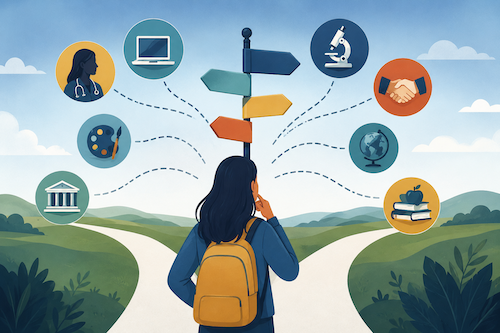
CTE places students in decision-rich environments: choosing pathways, weighing tradeoffs, and navigating real-world scenarios with real consequences. When we think about ways to meet the hidden curriculum gap, infusing the teaching of decision skills into CTE is not only a natural integration, it’s what makes CTE more effective.
Exposure to career pathways alone is not enough. Students can learn technical skills, earn certifications, and explore industries, yet still lack structured opportunities to think through the decisions shaping their futures. Technical training opens doors, but it doesn’t ensure students know how to choose between them.
Workforce data reinforces this. Analysis by the Burning Glass Institute found decision-making skills are explicitly stated in more than 40 percent of job postings across industries (but are implied or assessed during interviews in many more), including technical roles. Employers aren’t just looking for people who can do the work; they need people who can evaluate options, understand tradeoffs, and adapt.
That’s why decision-making shouldn’t sit alongside CTE; it should be embedded within it. Learning decision-making skills needs to be a key part of CTE learning.
What needs to change: Moving from standards to classrooms
If decision-making is so essential, why isn’t it consistently showing up in classrooms?
Part of the challenge is alignment. Standards, including those guiding CTE and college-and-career readiness, often emphasize critical thinking, but do not explicitly mention decision-making. And without curriculum and instructional support, these expectations don’t always translate into daily practice.
What’s needed is not another standalone initiative, but stronger integration.
This means integrating decision-making into core academic content so students practice judgment while building knowledge and skills. It includes training teachers to embed these practices into existing instruction without adding burden, and auditing current materials to identify where decision-making skills can be strengthened.
This is possible: We can ensure that every student, in every pathway, has consistent opportunities to build decision-making skills.
Tennessee already has a model that works
Tennessee offers a strong example of what this can look like in practice.
The Tennessee Board of Regents’ SAILS (Seamless Alignment and Integrated Learning Support) initiative demonstrates how decision-making skills can be intentionally integrated directly into coursework preparing students for life after high school without disrupting the curriculum, course structure, or graduation requirements.
One course in particular stands out: Mathematical reasoning for decision-making.
Instead of teaching math as something abstract and disconnected from real life, this course helps students apply mathematics to decisions they are already facing, like financial choices, interpreting statistics in the world around them, explaining their thinking clearly, and weighing the tradeoffs that shape their postsecondary paths. Students leave with tools they can apply for a lifetime.
This approach moves students beyond gut instinct and informal shortcuts toward evidence-based, data-informed thinking. That shift is how we begin to build true decision literacy, preparing students not just to graduate, but to navigate what comes next.
Closing the hidden curriculum gap
Every student deserves to graduate with the ability to make informed decisions about their future.
By aligning Career & Technical Education with Decision Education, we can close the hidden curriculum gap and prepare students not just for their first step after graduation, but for every decision that follows.
College, workforce, and life readiness depend on the same core skill: judgment. And even in a world shaped by uncertainty, we can help students develop it.
- Teachers weigh the realities of classroom technology in new national survey - September 25, 2026
- An early childhood classroom: Supporting emotional well-being amid everyday challenges - September 24, 2026
- Inspiring curiosity for career exploration and mentoring for pathway success - September 23, 2026