
Key points:
- Cybersecurity becomes less about remembering a rule and more about making a judgment
- For schools, cyber resilience starts at the data layer
- The hidden cost of fragmented student data in K–12 schools
- For more about K-12 cybersecurity education, visit eSN’s IT Leadership hub
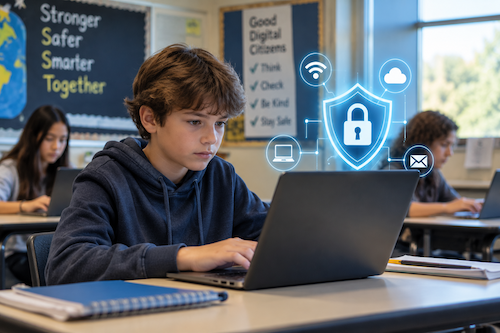
Students are already making cybersecurity decisions every day. Giving them a list of rules is not the same as teaching them how to recognize a threat.
K-12 cybersecurity education matters because U.S. schools are more dependent on technology than ever, while the threats facing them continue to evolve. CoSN’s U.S. State of EdTech 2026 report, based on responses from more than 600 education technology leaders across 44 states, found that cybersecurity remains their number one technology priority. At the same time, 65 percent identified insufficient cybersecurity staffing and the lack of a dedicated budget as leading barriers to addressing those challenges.
School districts invest in firewalls, identity protection, filtering, monitoring, multifactor authentication, and endpoint security. All of those controls matter, but they cannot make every decision for the person sitting in front of a screen. Eventually, a student or staff member receives a message, follows a link, shares information, or is asked to log in somewhere and has to decide whether to trust what they are seeing.
That human decision is why cybersecurity education deserves attention alongside technical security.
My own perspective comes partly from years spent supporting and managing IT in British secondary schools. At Ken Stimpson Community School, I worked in an environment serving around 1,200 students. I later managed IT at South Hunsley School, which served roughly 2,300 students. The terminology and education systems are different from those in the United States, but working with technology at that scale taught me something that translates directly to U.S. K-12 environments: technical controls can reduce risk, but they cannot remove the need for people to make good decisions.
Knowing the rule is not the same as recognizing the threat
Most students have heard basic online safety advice. Do not share your password. Do not click suspicious links. Be careful about what you post online.
The challenge begins when the threat does not look suspicious.
A phishing message might use a familiar logo, appear to come from a service the student recognizes, and warn that an account will be disabled unless they act quickly. A link might look genuine at first glance. Generative AI is also making convincing text, images, audio, and other content increasingly easy to produce.
In those situations, cybersecurity becomes less about remembering a rule and more about making a judgment. Who actually sent this? Does the request make sense? Where does the link go? Why am I being asked for this information? Can I verify the request another way?
Students need opportunities to practice answering those questions before the consequences are real.
Give students the opportunity to get it wrong safely
Instead of simply telling students not to click suspicious links, schools can put a realistic but safe message in front of them and ask what they would actually do.
Would they follow the link? Check the sender? Report the message? Ignore it?
More importantly, why?
A simulated phishing exercise can allow students to make the decision first and then explain what they noticed or missed. Perhaps the sender’s address is slightly different from the genuine organization. The message might create artificial urgency, point to an unexpected domain, or ask for information the legitimate organization would not normally request.
If a student makes the wrong choice during an exercise, no account has been compromised and no data has been lost. Instead, the mistake becomes the lesson.
That is one reason simulations and game-based activities can work particularly well for K-12 cybersecurity education. Students can make a choice, see the consequence, understand why it happened, and try again. The same approach can be applied to password reuse, social engineering, unsafe information sharing, suspicious downloads, and AI-generated or manipulated content.
The individual threat will change. The habit of stopping and asking, “Why should I trust this?” has much more staying power.
Cybersecurity belongs in digital literacy
Practical cybersecurity education should not be limited to students pursuing computer science or technology careers. Most students will never become cybersecurity analysts or network engineers, but almost all will rely on online accounts, email, cloud applications, and connected devices throughout their lives.
That makes basic cybersecurity judgment part of digital literacy.
CISA takes a similarly broad view in its Protecting Our Future report on K-12 cybersecurity. The agency says school leaders need to establish and reinforce a cybersecure culture and makes clear that IT and cybersecurity personnel cannot carry that responsibility alone.
Students should be part of that culture, not simply users being protected by it.
Schools can start small
None of this requires U.S. districts to add another semester-long course to an already crowded curriculum. Short exercises can still teach useful habits.
A teacher could spend 10 minutes comparing two emails and asking students which one they trust and why. Students could work through a situation in which someone has already clicked a suspicious link and decide what should happen next. They could examine a message, image, or online claim and identify what they would check before believing or sharing it.
These activities do not require a cybersecurity lab or specialist equipment. What matters is the thinking behind them: stop, examine the information, question what is being requested, make a decision, and explain the reasoning behind it.
U.S. schools cannot prepare students for every phishing email, scam, impersonation attempt, or piece of manipulated content they will encounter. The threats will change too quickly for that.
What K-12 cybersecurity education can do is help students build habits that remain useful as technology changes: pause before acting, question unexpected requests, verify information, recognize when something does not make sense, and know when to ask for help.
The aim is not to turn every student into a cybersecurity professional. It is to let students practice making cybersecurity decisions while getting one wrong is still a learning opportunity rather than a real security incident.
- Why K-12 cybersecurity education needs practice, not just awareness - September 14, 2026
- The compliance trap waiting on the other side of Title II - September 11, 2026
- The everyday access control gaps schools overlook - September 10, 2026