
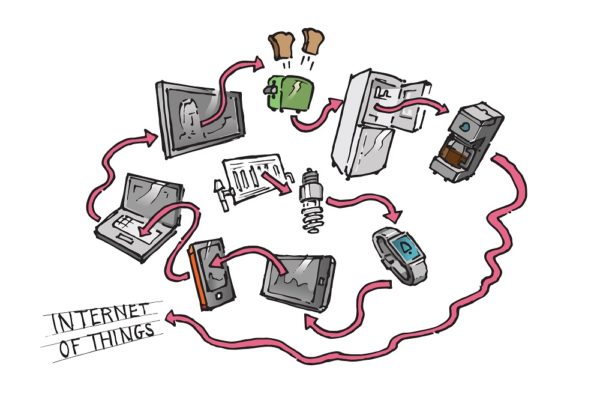
In the K-12 environment, smart school devices are now embedded in everything from cameras and video to temperature sensors, wireless door locks, smart HVAC systems, tablets and ebooks, multi-touch tables, 3D printers, and smart podiums. In a survey of more than 600 IT managers across both K-12 and higher ed, Extreme Networks found that 46 percent feel “smart schools” will have a major impact over the next one to two years. The benefits cited include: increased student engagement, better leveraging of mobile learning, more personalized education, improved efficiency, and cost reductions.
Bob Nilsson, director of solutions marketing for Extreme Networks in San Jose, Calif., said the earliest examples of IoT in schools include thermostats, lights, and other environmental aspects of the physical classroom. Video monitoring that is sensitive to motion is another example, as is the use of low-cost instrumentation that allows students and teachers to monitor science experiments while off campus.
So far, Nilsson says just 9 percent of IT managers have implemented IoT on campus, with just 3 percent saying they had “firm plans” to do so within the next one to three years. “IoT is one of the concepts that has a long introductory tail, but that will take off quickly once it catches on,” Nilsson asserted, noting that most school IT managers feel it could take up to five years for IoT to fully impact the educational environment.
Before that happens, Nilsson says institutions will need to shore up their bandwidth (to support the additional devices, which tend to “gobble up bandwidth,”), shore up their networks, address any related privacy and security concerns, and determine which displays and dashboards will be needed for displaying the IoT data. “IT managers will also need to educate themselves on the necessary software platforms,” said Nilsson. “API gateways, integration platforms as a service [iPaaS], and enterprise service buses [ESBs] enter the mix here.”
Getting over the humps
In assessing the Internet of Things’ potential in the K-12 space, Nilsson says, “To some extent, it’s quite unpredictable right now.” Some of that uncertainty is based on the sheer number of new devices being introduced every year—a fact that makes it difficult to predict IoT’s future.
“Teachers and administrators will begin to see how all of this [technology] works together, and then use that knowledge to create interactive dashboards and sensors that are spread throughout the schools,” Nilsson said. “The next step will include student wearables that can be monitored via dashboard and used to send reminders (i.e., to exercise more) and alerts.”
Already experimenting with and using IoT in the K-12 environment, Davis said budgetary constraints also come into play when more technology is incorporated in the classrooms. The smart pot project, for example, involved one, high-level fourth-grade math class due to budgetary constraints and the cost of the sensor arrays. “Typically I like to do projects that involved an entire grade level so everyone gets the experience,” Davis said, “but we just didn’t have the resources to make that work.”
And while things are changing, right now, for students (and likely many adults as well), the IoT concept is still too abstract and difficult to grasp. “We’re still figuring out how to make it more concrete and understandable for elementary students,” said Davis. “The good news is that IoT is both fun and motivating. Because engagement is a key prerequisite to learning, IoT is helping us get over some [instructional] humps.”
3 key success factors for IoT in education
In How Ubiquitous Connectedness Can Help Transform Pedagogy, Cisco outlines three main factors that must be addressed to ensure widespread and successful adoption of the “Internet of Everything” (IoE) in education. They are:
- Security: Cisco says IoE security will become an “enormous issue across all markets,” and particularly in education. “Without assurances, pervasive development of IoE will not take place across educational institutions. Information must be available—yet confidential—when needed, with the owner of the information deciding which people, groups, or organizations may have access to it,” the company states.
- Data Integrity: Integrity of data must also be assured, as well as its accuracy, authenticity, timelines, and completeness, according to Cisco. Success will be predicated on an “open platform” that allows all partners working together to use the same baseline technologies.
- Education Policies: Policies that encourage adoption of technology in the classroom and its effective integration into curricula are crucial. “Such policies must include sound change management practices among educational institutions to reduce the barriers to technology adoption and increase its scale,” according to the whitepaper.
- TC- What student choice and agency actually looks like - November 15, 2016
- What student choice and agency actually looks like - November 14, 2016
- App of the Week: Science sensor meets your smartphone - November 14, 2016