
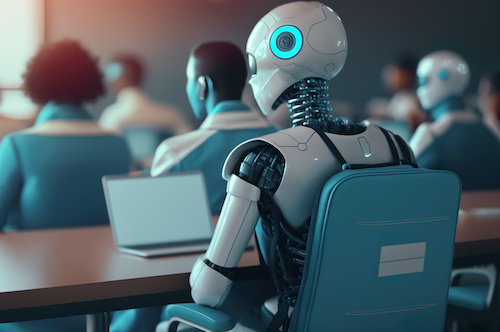
Like many others, we had much to learn about the promise and perils of AI in our schools and communities. We have embarked on this journey and are eager to proceed hand-in-hand with our community — knowing that other districts will be looking to New York City schools for guidance.
Our team began discussions with tech industry leaders about their platforms’ potential and the future possibilities for schools, educators, and students. Most importantly, we consulted our most trusted experts — citywide educators, many of whom had already started teaching about the future and ethics of AI, thanks to the Computer Science for All initiative in our schools, while using generative AI to enhance their teaching.
For example, students at a Queens middle school are debating ethical issues surrounding AI prejudice while participating in teacher-supported activities to learn about its potential, such as asking ChatGPT questions and researching the accuracy of its answers. Teachers at this middle school are experimenting with AI to create personalized lesson plans and grade papers. This school is merely one example of many we found among our educators.
While initial caution was justified, it has now evolved into an exploration and careful examination of this new technology’s power and risks.
New York City Public Schools will encourage and support our educators and students as they learn about and explore this game-changing technology while also creating a repository and community to share their findings across our schools. Furthermore, we are providing educators with resources and real-life examples of successful AI implementation in schools to improve administrative tasks, communication, and teaching. We will also offer a toolkit of resources for educators to use as they initiate discussions and lessons about AI in their classrooms. We’ll continue to gather information from experts in our schools and the field of AI to further assist all our schools in using AI tools effectively.
As we celebrate the global Day of AI on May 18, we are putting this work at the forefront. Using resources developed by MIT, we encourage all schools to engage students in activities exploring how artificial intelligence has already impacted their lives and the broader issues it presents to our society.
Our nation is potentially on the brink of a significant societal shift driven by generative artificial intelligence. We must make sure that this technology’s benefits are equitably distributed to prevent further widening of socioeconomic gaps in our country. We will educate our students about the significant ethical concerns that many leaders in tech and government are contemplating, which both educators and students are already discussing in their classes. However, we will also ensure our students are supported by AI’s opportunities and prepared for the jobs of today and the future. Many of those opportunities will be built on technological innovations — both AI and innovations we do not yet know.
Chalkbeat is a nonprofit news organization covering public education.
Related:
6 ways AI tools will impact tutoring
Can GPT-4 and TikTok usher in a new learning frontier?
- Why learning can’t stop when the lesson ends - October 19, 2026
- The future of educational equity isn’t just more resources–it’s more access to experiences - October 16, 2026
- Vibe coding: 3 easy steps to classroom magic - October 15, 2026