
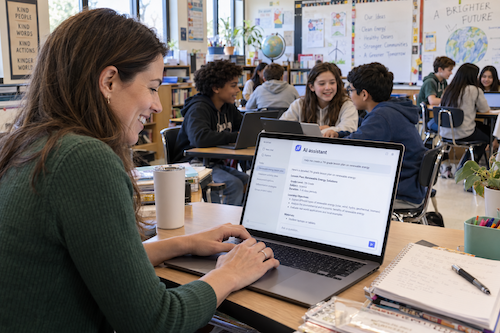
No matter where you turn today, it feels as though people just can’t stop talking about artificial intelligence (AI). Suddenly it’s become a part of our workspace, our entertainment, the tools we use for shopping and paying bills, but perhaps most notably, it’s quickly found its way into our classrooms.
This has naturally caused concern among educators, who up till now have mostly approached AI with a mixture of suspicion and frustration. Not me, though. I believe these new tools have the potential to radically change education for the better – if we’re bold enough to master them.
What I like most about AI is that it gives teachers superpowers. From generating imagery for lessons to reducing the time spent on busywork, AI is already reshaping the way educators prepare for class, spark engagement, and connect with students.
However, AI’s greatest superpower might be that it allows teachers to create computer programs. Where once coding a useful activity required hours of time and effort, teachers can now generate their ideas in a matter of minutes. All it requires are three easy steps:
- Pick your coding partner: The best way to get started is by selecting your AI coding partner. Programs like ChatGPT, Claude, and Gemini are all viable options, so feel free to use whichever program you already know best. From there, start asking questions to your AI tool, describe your learning goals, and get a better idea of what you want to accomplish. Once the details are all in place, simply ask the AI program to generate some code for whatever you want to build.
- Pick a coding playground: Once your AI partner has generated the desired code, take that data and place it into a Code Playground like CodePen or JSFIDDLE. This step may sound intimidating, but don’t be discouraged! Code Playgrounds are tools that let you execute code and examine how it appears when running. Take some time to play around with your creation, test its effectiveness, and consider what improvements could be made.
- Have fun and collaborate: Remember to approach this task with a Maker’s Mindset.You probably won’t get the desired outcome on your first try and that’s ok! It’s all part of the learning process. Once you have determined what needs to be fixed, simply return to your AI program and tell it what you want it to change. It will give you new code which you can use to patch things up! Above all, be sure to collaborate with other educators who are also in the process of exploring these programs.
The future of AI is filled with possibilities, and educators have an exciting opportunity to help shape it. By approaching AI with curiosity and creativity, we can use these tools to bring new ideas to our classrooms, make our work more efficient, and create richer experiences for our students. AI may give teachers new superpowers, but it is our passion, imagination, and commitment to students that will turn those powers into meaningful change.
- Vibe coding: 3 easy steps to classroom magic - October 15, 2026
- Helping students discover they belong in science - October 14, 2026
- Year-round K-12 recruitment can win the talent pipeline and retention game - October 13, 2026