
Key points:
- True transparency requires that a district’s systems speak the same language
- Data alone doesn’t determine success–leaders who know how to use it do
- Beyond the dashboard: Why K-12 educators need data literacy, not just data
- For more news on data and subject mastery, see eSN’s Educational Leadership hub
There’s a confusing trend going on in the nation’s classrooms: While national test scores have dropped to levels not seen in decades, average high school GPAs are actually climbing. Grading systems vary heavily from classroom to classroom and teacher to teacher. A student who receives a B+ could be proficient in a subject, but it may just mean they consistently turned their homework in on time. These inconsistencies suggest the traditional grading system is increasingly disconnected from the skills students have truly mastered.
The research is hard to ignore: A 2023 study by the Thomas B. Fordham Institute reveals that even as grade inflation accelerates, actual student achievement in math and reading has stalled or dropped. This decoupling of grades from mastery is likely a product of the hidden mechanics of the gradebook, where total teacher autonomy can lead to disparities in true visibility into student progress. When one educator weights a single project at 95 percent or drops a full letter grade for a single missed homework assignment, grades become an unreliable metric for support. Consequently, parents are left with a distorted picture of progress, and schools risk deploying costly interventions for “behavioral” failures while real academic gaps remain unaddressed.
To fix this, districts must move past the limitations of the Student Information System (SIS). Too often, these systems act as static filing cabinets for compliance rather than dynamic maps of learning, with data trapped across disconnected platforms. By consolidating these data points, administrators can better understand how classroom grades align with external measures like end-of-year assessments, helping teachers ensure grading practices provide a consistent picture of student readiness across classrooms. When report cards suggest students are on track, but assessments tell a different story, it creates confusion for families and educators alike. A well-designed dashboard can surface these patterns across classrooms and schools, helping leaders identify where grades and demonstrate mastery are aligned, and where additional support might be needed.
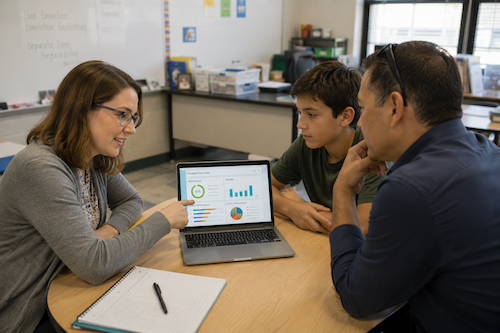
True transparency requires more than clear communication between families and staff; it demands that a district’s systems speak the same language, too. Too often, districts purchase tools with only the teacher’s dashboard in mind, leaving parents on their own to navigate an entire ecosystem of platforms. To resolve this, districts must treat families as the primary customers of data, prioritizing universal compatibility and investing in tools that can turn complex numbers into clear summaries. A parent shouldn’t need to be a data scientist to know if their child is on track to graduate; by providing a single, unified dashboard that contextualizes growth alongside attendance and behavior, districts empower both educators and families with an easily accessible view of their students’ progress.
- Public schools at the starting line: Beginning a new pathway with scholarship granting organizations - August 14, 2026
- The foundation for student success is a positive classroom culture - August 13, 2026
- The biggest back-to-school challenge - August 12, 2026