
Key points:
- Educators should use the data they collect to improve instructional practices
- Students won’t remember every lesson, but here’s what’ll stick
- First graders need a chance to explain their math thinking
- For more on middle school math data, visit eSN’s Innovative Teaching hub
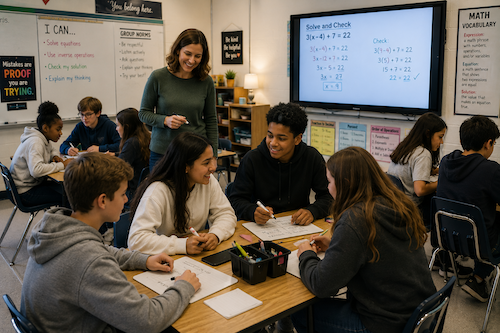
Picture a group of middle school math teachers meeting to mull over a specific problem. Their eighth graders keep missing the same assessment question about graphing a system equation, and the educators’ assignment is to figure out why.
As the team engages in conversation around the performance data, it becomes clear their students may be missing a foundational concept like what a solution means. The teachers reflect on where the gap between instruction and understanding might be occurring and how best to reinforce the concept.
This real-life example represents how having classroom-level data has changed the way teachers in the Metropolitan School District of Washington Township think about the natural progression of teaching math. Instead of placing the burden on students to input the correct answer, educators ask themselves if they developed concepts thoroughly enough, based on students’ day-to-day assessment results. The availability of consistent, real-time data is informing richer, more focused discussions at weekly PLCs and across the district’s three middle schools, which in turn is contributing to improvements in student achievement.
Washington Township students’ scores on the Indiana state proficiency exams have risen to 36.2 percent for spring 2025 and a projected 40 percent for spring 2026, based on performance across three checkpoints during the year—surpassing the pre-COVID rate of 34.3 percent. This success at the middle school level has led to positive anticipation around bringing this approach to the high school math department starting this fall. While our data shows that we have surpassed our pre-COVID proficiency rates, we recognize that this milestone is just one step in our ongoing efforts to improve student outcomes. We remain committed to continuous improvement and understand that there is still important work ahead to ensure every student reaches their full potential.
Collecting the right data
In recent years, schools have mastered data collection. But just gathering, storing, and comparing information is not sufficient—educators have a responsibility to make sure they are collecting data they can use to improve instructional practices. The data itself should not be an endpoint.
This has been new terrain at Washington Township. In 2024, our middle school math team started using a data platform designed to offer holistic, actionable insights all in one place. This transition prompted teachers to scrutinize the progress data being collected. As a result, middle school math students now take two weekly assessments, created at the instructional coaching level to ensure continuity in core math courses across all three schools.
Our mindset around the data has shifted. Scores are no longer viewed as an evaluative tool but rather as a structured starting point for meaningful conversations about teaching and learning. These conversations can be difficult, but they are essential for improving students’ understanding and mastery.
Setting higher expectations for students
Our data platform has helped us establish a holistic picture throughout the year of spiraling, where we systematically revisit previously learned content to improve students’ retention and recall by helping their brains construct meaning around the concept.
Having more clarity about what content is being taught—and why—has led to increased rigor in our classrooms. Seeing the formative data collected each week helped motivate us to develop common pacing guidelines across all three middle schools.
In addition, teachers’ rising expectations of their students’ ability to grasp content have led to the students themselves asking deeper questions. This combination has been game-changing for our learners. There is a strong correlation to their gains in the classroom compared to achievement on state standards exams.
Expanding this approach to other subjects and grades
Constantly chasing the next solution is absolutely exhausting for everybody involved. Knowing the district was not going to keep changing edtech tools created buy-in. After two years of steadily developing trusting relationships among the 29 teachers in three middle school math departments, we have reached a point where we operate as one unit across buildings—and our teamwork will expand to the high school starting this fall.
The insights gained within our middle school math department have also benefited the ELA program, which has also adopted the data platform we use. Their instructional coach and I constantly talk about the results, how they compare to state assessments, and what we can improve.
Our middle school math team will continue to advance our practices as well. We are exploring how to use data more in real time in the classroom. We are expanding teachers’ knowledge base so they become skilled at creating standards-based assessments tailored to pinpoint exactly what students still need to learn and their misconceptions about the content. For instance, with multiple-choice exams, answers B and C would highlight different errors that need to be addressed through reteaching or one-on-one instruction.
Perhaps best of all from a teacher standpoint is the confidence school leaders have in our professional capabilities. Demonstrating success is good, but being able to point to exactly why that success is occurring generates a higher level of trust, respect, and autonomy.
- The future of educational equity isn’t just more resources–it’s more access to experiences - October 16, 2026
- Vibe coding: 3 easy steps to classroom magic - October 15, 2026
- Helping students discover they belong in science - October 14, 2026