
PBS Reno is unique in this service delivery model. Each PBS station decides what its educational outreach programs will look like. We’re proud to be able to reach so many students in diverse educational contexts.
A robot for every student
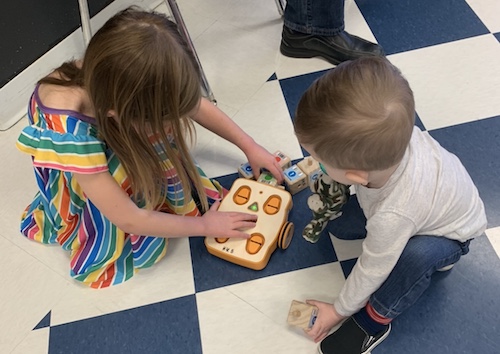
Our lessons are taught by a team of approximately 40 facilitators, most of whom are retired teachers who get paid for their time. Among them, they have 225 robots to take on the road. We use robots called KIBOs, which are specifically designed for children as young as 4—and which, importantly, don’t require students to have a computer. Instead, students program the robot by arranging a series of wooden blocks with commands printed on them and they scan the sequence, telling the robot what they want it to do.
The lessons, which are all designed to meet our state standards, take approximately 45-60 minutes. We have two lessons for each grade from preschool to 4th. Having two lessons allows a facilitator to go to a particular classroom one day to provide a workshop, and then come back later to build on their knowledge with the second lesson. Each lesson includes a read-aloud to tie in literacy, a PBS video clip, and then hands-on activities.
Since there are so few opportunities for young students to interact with robots, and especially for the rural students we serve, it’s really important that they each get to use their own robot during the lessons. We want every child to get their hands on a robot and practice some coding.
Engaging families, too
To keep the learning going after our two visits, every lesson includes an at-home activity for students to do with their family. For example, the KIBO programming blocks are all printed with simple instructions like move forward, turn right, or turn left, so a take-home activity might be for kids to take cards home with similar instructions so they can “program” a family member who has to do exactly what the cards say. They can direct their parents and siblings to do the hokey pokey!
We also try to bring caregivers and siblings in on the fun with family nights, which have been a great success. The screen-free programming is great for these events because many rural schools don’t have enough computers for everyone to use one. With the block-based programming, no matter how remote we are and how few computers are available, everyone can take a shot at teaching KIBO to dance.
We find this playful, project-based approach to robotics works really well for young students. A lot of the robotics programs for older learners tend to be more competition-based. We’re focused more on helping students understand just what makes a robot a robot, how it takes commands, and other basic coding questions. We hope that by helping students and their teachers work through these ideas, they’ll both be more comfortable with the underlying concepts when they move on to more advanced robots, including the competitive ones.
During the 2021-2022 school year, we held 787 workshops serving about 20,000 students—and the program is growing, mostly by word of mouth among teachers who see how it expands their students’ horizons. As we’ve done activities related to the Mars Rover, for example, we’ve seen that a lot of little kids don’t realize that a robot can’t think for itself. That’s a really basic thing that adults know, but it blows little kids’ minds that they have to tell the robot what to do. They see these big robots out in the world, and then they’re so excited when we help bring them to their level.
Related:
Why educational robotics is a critical STEM learning tool
How robotic gamification helped my elementary students love STEM
- Career readiness in the AI era needs decision practice, not just tool access - September 4, 2026
- Building an everyday equitable practice for AI in schools - September 3, 2026
- A new approach to middle school math data boosted our state test scores - September 2, 2026