
Key points:
- Engagement is something teachers build into lessons to reach students
- With students tuning out, it’s time to rethink the classroom
- This district’s STEM “space station” is a growing YouTube hit
- For more on student engagement, visit eSN’s Innovative Teaching hub
On Valentine’s Day, my fifth graders broke up with King George III.
They wrote him letters, real ones, with reasons, and to do it well, they had to go back into their textbooks and dig up the evidence. Every grievance the colonists had ever aired, every broken promise and overreach of power, became ammunition for a breakup that felt, to a 10-year-old, deeply personal. They understood something that day that no worksheet had ever quite managed to teach them: The colonists and the crown were done, and they could explain exactly why.
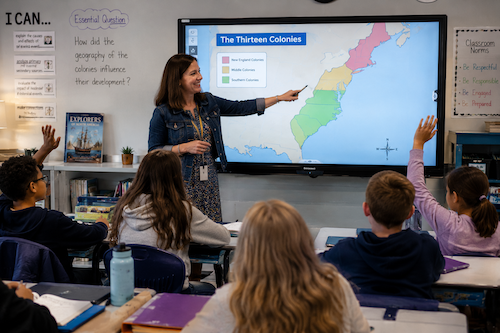
I’ve been teaching fifth grade in Massachusetts for 26 years. I hated social studies as a kid. I found it boring, heavy on dates and facts, and light on everything that might make a person actually care. For a long time, I avoided it. I was the STEM person on my team, happy to hand off the history. But somewhere along the way, I started asking myself what it would look like to teach social studies the way I wished someone had taught it to me. This article is my attempt to answer that question.
Tell them the truth
The foundation of everything I do is honesty. Kids can handle more than we give them credit for, and fifth grade is not too early to start teaching them that history is complicated, contested, and ongoing.
One of the most important skills I now build into my teaching is lateral reading–the practice of reading across multiple sources rather than accepting a single account at face value. We talk openly about the fact that everyone has a perspective, including news outlets, including textbooks, including me. I’m also deliberate about language, teaching students that the words historians choose matter and that a single word can either reduce a person to their circumstances or acknowledge their full humanity.
Design for urgency
Engagement in social studies isn’t something students arrive with; it’s something you build into the lesson. The breakup letter worked because students felt the stakes. They weren’t summarizing a conflict; they were participating in one.
That’s the design principle I keep coming back to: How do I make students experience this? When I teach the Articles of Confederation, I run a mock voting process where the class has to pick a mascot under the same rules the early colonists used: nine votes and it’s decided. Students feel the unfairness in their bodies before they can name it on a page. When I introduce the three branches of government, I describe them as a three-legged stool and ask what happens when one leg shifts. The image sticks in a way that a definition never would.
I also design deliberately for carry-home curiosity. At the start of every unit, I send families a letter explaining what we’re studying and offering conversation starters for the dinner table. We live near Boston, so there’s no shortage of real-world touchpoints. Even beyond geography, I’ve found that when students feel like they know something their parents don’t, they can’t wait to share it. That energy at the dinner table is, in its own way, the whole point.
Teaching the hard stuff
When my students encounter images and primary sources from the founding era, I ask them to think carefully about who is represented and who isn’t. Those conversations don’t stay abstract for long. Students start asking why, and those questions lead naturally into the deeper work of understanding how history was shaped and by whom.
That kind of engagement is exactly what I saw when students began discussing representation after working through materials in our program. One guardian emailed me to say her son had never been more excited to come home and talk about what he was learning. When kids go home and keep the conversation going, you know something real happened in your classroom.
I teach civic complexity and representation directly because honest history requires it. I’m also careful to keep my own political opinions out of the room. My job is to give students the tools to think, not to think for them.
Remarkably, I’ve never gotten pushback. I think families respond to a teacher who’s clearly coming from a place of rigor and care.
The curriculum is a tool, not a script
That same rigor shapes how I think about curriculum. When my school was evaluating social studies programs, my non-negotiables were clear: Massachusetts standards alignment, a variety of modalities, accessibility for all learners, and meaningful differentiation support. I wanted something that could reach the student who needs the book read aloud and the student who’s ready to go three levels deeper, without requiring teachers to build everything from scratch.
We landed on TCI, a program that delivered on all of those criteria, and the professional development that came with it pushed me to go deeper. That led me to run my own sessions for colleagues, many of whom had been using the same materials for years without realizing the full range of what was built in. Once we did a deep dive together, the excitement in the room was the same thing I try to create for my students: the feeling that there’s more here than you thought.
None of that was in my job description. But when you’ve seen what’s possible, it’s hard to watch colleagues settle for less.
What other teachers are leaving on the table
The biggest gap I see in professional development isn’t effort; teachers work incredibly hard. It’s imagination. When teachers receive upgraded curriculum materials without real training, they default to the most familiar interpretation: essential question, read the book, fill out the workbook. There’s so much more available, and most of it doesn’t require building anything from scratch.
I model the same curiosity-first mindset with my colleagues that I try to build with my students. I ask questions. I take risks. I show them what’s possible when you treat the curriculum as a starting point rather than a ceiling.
The fifth day of my teaching week belongs to something I call Discovery Quest, a genius-hour structure where students choose a big question, research it independently, and present it to the class. Over time, those questions migrate toward history on their own. Students start wondering about World War II, about mythology, about how things got the way they are. I didn’t assign that curiosity. I just built the conditions for it.
What I’d tell my younger self
Give it a real shot. Even if you hated social studies as a kid, especially if you hated it.
I avoided this subject for years because I remembered it as boring. What I’ve learned is that the boredom was a teaching problem, not a content problem. History is full of moral complexity, human drama, and unresolved questions that are still being answered in the world my students are inheriting. The least I can do is make sure they arrive there as thinkers.
These are the kids who shouldn’t repeat the mistakes we’ve already made. A teacher who once avoided the subject is now one of its most passionate advocates, and that, I think, is its own kind of lesson.
Looking back, I know part of what shaped this path was a remarkable World History teacher I had in high school named Chief. He didn’t just teach the concepts, he stepped back and let us create, build, and discover for ourselves. I’ve carried his approach with me ever since, and I think his influence has been quietly present in everything I’ve tried to build in my own classroom.
- The future of educational equity isn’t just more resources–it’s more access to experiences - October 16, 2026
- Vibe coding: 3 easy steps to classroom magic - October 15, 2026
- Helping students discover they belong in science - October 14, 2026