
Blended and hybrid learning models were first introduced to extend personalized and flexible learning options to selected individuals or groups of students. But with onset of the pandemic, widespread adoption of blended and hybrid models suddenly became a necessity across all student populations.
Two years later, how have districts overcome the initial challenges and applied the lessons learned to re-imagine teaching and learning and develop an innovative vision for change in their school communities?
Join eSchool News for a panel discussion with leaders and educators who share a passion for the bold new vision of blended and hybrid learning as the future of education.
You’ll hear how schools can:
- Integrate flexible in-person learning experiences with enhanced collaborative online learning to maximize facility use
- Build a custom curriculum with a mix of core courses, electives, CTE pathways, and more
- Deliver instruction with their teachers, virtual teachers, or a combination of the two
- Reserve the option for some students to attend 100-percent online

- Children learn best on paper: We need better technology, not less of it - July 13, 2026
- In districts, reaching readiness, retention, and success - March 5, 2026
- AI use is on the rise, but is guidance keeping pace? - January 2, 2026
More from eSchool News
Back to school in 2026: The trends shaping K-12 education this year
As students and educators settle into the 2026-27 school year, K-12 leaders are navigating a landscape shaped by rapid technological change, persistent academic challenges, and growing pressure to demonstrate that new tools and strategies actually improve teaching and learning.
The oral exam is back, and AI may be the reason
In 2023, Catherine Hartmann, a professor at the University of Wyoming, gave students in a history of meditation course a deeply personal assignment: try a contemplative practice and write a reflective analysis on the experience.
Let’s work to keep our students while we still have them
According to research I recently saw , About 16% of young people ages 18 to 24 are not in employment, education, or training. Researchers call them NEETs, or disconnected youth. After 35 years in public education, I read the number a different way.
Quit saying “I’m not a math person”
It’s quite rare to hear someone say, “I can’t read” or “I’m illiterate so I don’t read.” On the other hand, lots of people claim that they’re “not a math person.” The phrase isn’t just “I don’t like math.”

5 questions to help every district leader make better decisions
As budgets remain tight and expectations for measurable student growth increase, every instructional decision carries greater weight. Choosing one initiative often means delaying another, making it even more important to separate promising ideas from approaches supported by stronger evidence.
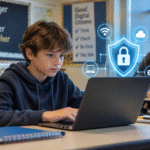
Why K-12 cybersecurity education needs practice, not just awareness
Students are already making cybersecurity decisions every day. Giving them a list of rules is not the same as teaching them how to recognize a threat.

The compliance trap waiting on the other side of Title II
Every few years, something shifts how schools think about accessibility. A law changes, a new technology arrives, or a group of advocates succeeds in bringing attention to the topic. Right now, it’s Title II of the Americans with Disabilities Act.
The everyday access control gaps schools overlook
School leaders have invested heavily in campus security over the past decade. Cameras, visitor management systems, emergency communication platforms, and access control upgrades have become standard parts of many districts’ safety strategies.
AACTE releases national framework on AI in educator preparation
A new national framework from AACTE (American Association of Colleges for Teacher Education) aims to help educator preparation programs (EPPs) navigate the rapidly changing role of artificial intelligence in education.

When practice becomes data: Helping teachers respond to student misconceptions
A student can complete 20 questions and still leave a teacher with very little useful information. A score may show that something went wrong, but it does not always show which learning objective needs attention, whether the problem is a misunderstanding or a careless error, or what the student should practice next.